Indigenous Peoples and Human Rights
Showing posts with label human rights. Show all posts

October 9, 2026

Censored News Computer Targeted and Destroyed after Investigative Series


Censored News Computer Targeted and Destroyed After Investigative Series


Donate via PayPal


Donate on Venmo: 
@Brenda-Norrell


Hello Readers,

Censored News computer was targeted and destroyed last night. Our last post published last night was on the weaponized drones over the border.

Before that, we wrote about the Mohawk Mothers, MK Ultra torture, the search for childrens graves, and the new documentary, 'The Truth is Buried: Mohawk Mothers vs McGill University.' Our article included the words of Heather, an Epstein survivor trafficked as a child by the US Border Patrol in Tucson.

This week's articles include an investigative report on the alarming proposed data center by a Native non-profit that is collecting blood and DNA of Cheyenne River Lakota in South Dakota.

Censored News most viewed articles this week include those by Ophelia Rivas. Ophelia's new book, 'Significant Impact' documents the 10 spy towers constructed by Israel's Elbit Systems on the Tohono O'odham Nation. Ophelia and co-authors successfully completed a book tour in Arizona.

The good news is that Censored News has increased by millions of page views in the past couple of years. In September, we had nearly a half million views.
Censored News has no ads, salaries or revenues. We are a service to Indigenous Peoples and human rights. This is our 20th year. Censored News was born out of censorship.

Thanks for reading, Brenda
brendanorrell@gmail.com
https://bsnorrell.blogspot.com

July 16, 2026

At the United Nations, Indigenous Human Rights Defenders Testify on Persecution and Treaties

At the United Nations, Indigenous Human Rights Defenders Testify on Persecution and Treaties

By Brenda Norrell, Censored News, Thursday, July 16, 2026 Upddated

GENEVA --  At the U.N. Expert Mechanism on the Rights of Indigenous Peoples, Indigenous youth and women are in the forefront, while Indigenous from around the world describe their struggle to be recognized by the governments in their homelands, and be heard and respected. Indigenous in Canada reported success today in treaty negotiations.


Australia Aborignals and Torres Strait Islanders: Women and Youth Testify

Aboriginal youths from Australia and Torres Islanders were among the strong youth voices at the United Nations today. The delegation shown here said biomedical research is being weaponized against their people; and is being carried out against them without free, prior and informed consent.

"Biomedical data must be wholly managed, stored, and owned by its respective communities. Indigenous people will always be the first scientists and health practitioners. The next 20 years must be defined by indigenous authority over our research, our data, and our health future," the youth delegate said.

T
his week, Indigenous youths testified that they must be recognized and involved in decision making at the United Nations.


Exiled Russian delegate testifying.

Russia and Ecuador at the UN -- They're not giving up. Again today, exiled Indigenous from Russia and the Far North called for the release of two women imprisoned in Russia, U.N. participants and climate justice advocates, Daria Egereva and Natalia Leongardt, who have been behind bars for six months. The Russian Federation has repeatedly taken the floor attempting to discredit the delegation of exiled human rights defenders. Russia is demanding that they be silenced and removed from the sessions.

Ecuador: Delegates parents targeted

In a another wave of oppression for those speaking out at the U.N. Pacha Teran of Ecuador said yesterday that her parents home was attacked after she testified at the U.N. Expert Mechanism on the Rights of Indigenous Peoples in Geneva, which is broadcast globally by the U.N.

"Con mi participo en la 19.ª sesión del EMRIP - ONU, donde he denunciado vulneraciones de derechos en mi pais, hoy la vivienda de mis padres fue objeto de una agresión."

(With my participation in the 19th session of the EMRIP - UN, where I denounced human rights violations in my country, today my parents' home was the target of an attack," Teran said on social media on Wednesday.)

Teran is in the delegation testifying on the militarization and violence by the government of Ecuador security forces. 

Colombia's women bear the greatest burden. Screenshot Censored News.

COLOMBIA: Indigenous Women Carry the Greatest Burden

"How many rights can a people lose before the world recognizes it?" Colombia's Indigenous delegate from the Ethnic Commission for Peace in Defense of Territorial Rights asked the U.N.

"This is the question we bring today on behalf of indigenous people and particularly women in Colombia. Colombia has borne the brunt of decades of fights and ethnic communities are currently trapped between armed leaders murdered with impunity."

"Boys and girls suffer forced recruitment in a persistent fashion. The women bear the brunt of this. They are the most displaced and have the greatest violation of their collective rights."

The dismantling of the peace agreement has resulted in a loss of hope.

The peace agreements included an indigenous historic chapter. Eight years later, only 13 percent of those commitments have been fully complied with.

"Prior consultation, which is a mandate in the constitution, continues to be ineffective. And in less than a month, a government which has dismantled the peace agreements has taken over. And as a result, there is a loss of hope."

"The communities are the guardians of the environmental rights protecting all of our territories where the state is absent. Food sovereignty of thousands of families depends on this. And in the territories which are most hit by the conflict, it is the communities and community leaders, in their majority women, who ensure the guardianship of this for the next generation to avoid the war that has been our scourge."

While Colombia prepares for a new president, Indigenous Peoples said the situation is urgent.

"Experts, we would like to ask for an urgent recommendation to protect indigenous communities and their women leaders before the 7th of August when the government is to change in Colombia."

Stagnation and regression. This is how the Special Rapporteur described the state of human rights for Indigenous Peoples.

The U.N. Special Rapporteur on the Rights of Indigenous Peoples, Dr. Albert Kwokwo Barume, Democratic Republic of Congo, said that when a nation wants to erase Indigenous Peoples, they target first the land, and second Indigenous women's bodies.

"Today, indigenous people are resorting to court cases, but most of those court cases remain also unimplemented. That's a trend we have in terms of human rights. The second trend is a very escalating criminalization of indigenous peoples. Indigenous people are arrested, detained, killed, and affected by hate speech, legal harassment, numerous cases."

"The mandate— we keep receiving multiple complaints. Recent case includes killing of Albino Ramirez in Colombia, the murder of lawyer Sandra in Mexico, killing of Guarani leaders in Brazil, and an indigenous person being on death row in Tanzania, and many other cases across Asia, Africa, Latin America. And the entire world."

"There is also a proliferation of hate speech, Indigenous people in social media being harassed, Indigenous people in detentions, including key Indigenous people such as Daria in Russia and many others across, across the world. We have what we know as Guardia Indígena, community-based organization mostly led by indigenous young people being criminalized, harassed, and most of them detained."

Dr. Barume pointed out two key major issues.

"The first is a historical and continuing contemporary violation of indigenous women reproductive rights. And I say in that report that when anyone want to erase an indigenous peoples or nation, there are 2 key targets. Those key targets are first land and second indigenous women's bodies."

"That violation in that report, I do highlight that states are falling short of their international commitments. On land rights, land rights, as I indicated, there is a total stagnation on implementing the territorial rights of indigenous peoples."


Red River Metis Ambassador Clement Chartier 

Red River Metis of Manitoba, Canada, described the negotiations with Canada that resulted in a decade of reconciliation, which led to over $3 billion in funds for Red River Metis. Red River Metis Ambassador Clement Chartier said Canada embraced the U.N. Declaration on the Rights of Indigenous Peoples, during Trudeau's administration, and began implementing it. Red River Metis now have a Treaty for final ratification in process in Canada.

During the U.N. Expert Mechanism on the Rights of Indigenous Peoples today in Geneva, Indigenous described their struggles to be recognized and heard in their home countries.

The B.C. Treaty Commission in Canada reported success as it moves forward with modern day treaty negotiations for self-governance for Native Nations in B.C.


Indigenous from Peru continue to call for action to ensure the rights of Indigenous Peoples, at the U.N. Expert Mechanism on the Rights of Indigenous Peoples. Indigenous in Peru, Brazil, Argentina, Nicaragua, and Ecuador told the U.N. this week of the militarized oppression in their countries -- the deaths, imprisonments, loss of land and poisoning of their rivers -- as they defend their lands and water from logging, mining, and oil and gas drilling.


Racism in Argentina and the southernmost region of South America

"Being Indigenous should be a source of pride," said an Indigenous representative from the southernmost region of South America. She spoke on behalf of Identidad Marrón, a civil society organization that works against structural racism that affects indigenous peoples and human mobility in Argentina and neighboring countries -- Chile, Uruguay, and Bolivia -- known as the South Cone region of South America.

Racism has not disappeared for Indigenous Peoples here, and it is now twenty years after the U.N. Declaration on the Rights of Indigenous Peoples. She said whether they are in their countries or in neighboring countries, there is racism.

"In our cities, we continue to be identified primarily by the color of our skin, our traits, or our national origin rather than the rights that the Declaration recognizes, we hold."

"Such social profiling, which is facilitated increasingly by biometric technologies and facial recognition, is limiting access to rights and leading many people to hide their Indigenous identity, not because they're ashamed, but because they need to survive."

"Therefore, we would like to suggest that in monitoring opinion number 18 of 2025 on the rights of Indigenous peoples to data, we include the status of mobility or on the move and racial profiling and algorithmic profiling incidents as categories, ventilated ones, not— and an intersecting approach."

"States also need to take measures to prevent racial profiling, including Argentina. The rights of Indigenous peoples need to support us where we live, work, and move, and they should also ensure that migration does not mean that we are invisible, and being Indigenous should be a source of pride."

Indonesia

Indigenous from Indonesia point out that the reality in their homelands, and what the government of Indonesia says in the United Nations sessions are not the same. Indigenous point out that the mining that the Indonesian government claims it has stopped is actually proceeding, and a pipeline is doing further damage.


AFRICA: An Indigenous Ogani delegate described how the lack of recognition for Indigenous in Ethiopia and Nigeria has resulted in destruction mining and oil extraction, during the discussion on the U.N. Declaration on the Rights of Indigenous Peoples, UN DRIP.

"As we prepare to celebrate the 20th anniversary of the adoption of the UN DRIP,
it is saddening to report that many countries in Africa, particularly Ethiopia and Nigeria have not implemented UN DRIP and are yet to recognize indigenous people in their countries."

"Denying indigenous people amounts to denying their collective rights. Recognition of indigenous people are not given privilege, but an existential issue.

"The UN Special Rapporteur on the rights of indigenous people have identified lack of
recognition as one major issue that contributes to indigenous people's exclusion in Africa."

The lack of recognition results in large scale mining operations in the Oromiyo territory in Ethiopia, and oil extracting on Ogoni, Nigeria, where extraction has been taking place without the people's free, prior and informed consent.

"Furthermore, these attractive activities have been destroying the forest and contaminating waters of Indigenous communities in Ethiopia and Nigeria."

"We call on the Expert Mechanism to reinforce its effort for the endorsement of UN and recognition of indigenous people in Africa. Ethiopia and Nigeria should
recognize and ensure the full participation of Indigenous people in decision making process affecting their land and resources."

Censored News Original Series: UN Expert Mechanism

'Keeping It Alive' the Beauty of Ancient Languages, Path to Memory and Identity

Indigenous at UN Expose AI Data Centers and Racially Biased Misinformation

At the UN, Indigenous Testify on Persecution and Treaties

UN Expert Mechanism on the Rights of Indigenous Peoples Begins in Geneva

Copyright Brenda Norrell, Censored News 2026

August 21, 2024

Tohono O'odham Ofelia Rivas: The Pirates Who Stole My Words


Ofelia Rivas on her homeland. Photo by Jason Jaacks copyright, Censored News

Tohono O'odham Ofelia Rivas: The Pirates Who Stole My Words

White privilege and piracy permeates university professors and dissertation writers, says Ofelia Rivas, Tohono O'odham, pointing out that today more than 20 books use her words about O'odham and the border without her permission. The pirates range from the United Nations and book authors, to non-profits and corporate-paid activists.

By Ofelia Rivas, Tohono O'odham, Censored News, August 13, 2024

Pirates

In 2003 the Elders from my fathers community and the ceremony Elders from my mothers community appointed me by consensus to be their voice.

Prior to 9-11 hundreds of heavily-armed border patrol soldiers invaded O'odham lands violently attacking O'odham in their yards, homes, communities, on reservation roads and state highways.

September 11, 2023

The United Nations and U.S. Government: What their new reports are not telling you

Saguaro cactus recklessly destroyed to build the border wall at Ajo, Arizona. Photo by Laiken Jordahl


The United Nations and U.S. Government: What their new reports are not telling you

By Brenda Norrell, Censored News, September 11, 2023
French translation by Christine Prat

There are two new reports: One is the U.S. report on the destruction and violation of laws during the building of the border wall during the Trump era. The new report is by the US government's office that claims to be independent: The Government Accountability Office.


The other new report, making its way to the United Nations Human Rights Council, is the report from the UN Expert Mechanism on the Rights of Indigenous Peoples on the militarization affecting Indigenous Peoples. The final report has some of the powerful testimony and struggles -- but it leaves out some of the greatest tragedies and heartfelt testimony.

Ofelia Rivas, Tohono O'odham, on her homeland. Photo by Jason Jaacks. Ofelia's website is O'odham Solidarity at https://www.oodhamrights.org/

Ofelia Rivas, Tohono O'odham, and founder of O'odham Voice against the Wall, has spent her life on the border in the struggle for human rights and battling the militarization of the border.

Ofelia responded to the two new reports and the murder of her childhood friend, Raymond Mattia, and fellow community member, murdered by the U.S. Border Patrol and law enforcement on May 18. Raymond was shot nine times in a rain of bullets on his front door steps, in Ali-Jegk on the Tohono O'odham Nation.

January 13, 2023

The Smithsonian is Missing -- The Racist Dark History of Collecting Native Remains is Silenced


The Smithsonian exploits Native American arts and culture, while covering up its history of robbing graves and refusing to return Native American remains.


Whitewashing History and Harboring Native Remains

The Smithsonian paid bounties for Native American skulls for racist studies resulting in grave robbing, executions of Native people and the Massacre at Sand Creek. Today, the Smithsonian refuses to make the facts public, and delays the return of Native American remains to their homelands for reburial.

Brenda Norrell
Censored News
January 13, 2023

In a new database showing institutions harboring Native American remains -- the Smithsonian is missing.

The Smithsonian is concealing from the public its collection of more than 10,000 Native remains, and the dark history of its racist skull collection -- for the purpose of intelligence studies based on race -- which led to grave robbing. It was one reason for the Massacre at Sand Creek.

July 13, 2021

Indigenous Rights Defenders Battle to Their Deaths in Mexico


Simon Perez, David Valdez, Tomas Rojo, Luis Urbano

Indigenous Rights Defenders Battle to Their Deaths in Mexico

By Brenda Norrell
Censored News

MEXICO CITY —  Indigenous Rights Defender Simón Pedro Pérez López, Tzeltal, was murdered by a gunman on a motorcycle in southern Mexico. Simon was the fourth well-known Indigenous rights defender to be assassinated in Mexico since May.

Simon was gunned down outside a market in Simojovel, a town in Chiapas state, on July 5. He was known better as Simón Pedro and had been active in a social justice organization born out of the 1998 massacre of 45 Indigenous people in the nearby town of Acteal.

Simon, shown on the screen, was honored in Paris, as the Zapatistas delegation arrived in Paris this week. Simon was assassinated in Chiapas on July 5, 2021.

September 3, 2019

Tohono O'odham Protest Against Border Wall and Israeli Spy Towers on Arizona Border


Ofelia Rivas protesting Trump's border wall
Tohono O'odham protested the border wall being constructed in the
fragile Sonoran Desert on Saturday, and the Israeli spy towers now
targeting the Tohono O'odham Naiton.
Photos copyright Ofelia Rivas.


(Photo above) U.S. military surveillance helicopter
over Gu-Vo community this morning on Tohono O'odham Nation. Below: in Gu-Vo community today.

Trump's Border Wall is Death to Endangered Species and Sacred Places

Photos by Ofelia Rivas, Tohono O'odham
Article by Brenda Norrell
Censored News copyright
Sat., Aug. 31, 2019

AJO, Arizona -- As Trump's bulldozers destroy the pristine Sonoran Desert at Organ Pipe Cactus National Monument nearby, Tohono O'odham and Arizona residents are protesting the inhumane destruction.

Ofelia Rivas, Tohono O'odham who lives on the border, told Censored News, "Beautiful day in the O'odham homeland, united group of people came to be a voice for the lands and  nature against genocidal policies of an inhumane government system attacking all life."
"The Society of these stolen lands should legally charge these inhumane crimes against this disgraceful person."
"The group will continue to be a voice for the honor of the bees, the endangered sacred animals, plants and the entire land and people," Rivas said.

All endangered species laws and all laws protecting sacred Native American places have been smashed. The border wall construction is already using a vast amount of water in the desert here for concrete.
These defenders are also protesting the Israeli spy towers now targeting the Tohono O'odham Nation. The Israeli defense contractor Elbit Systems plans to construct these spy towers and destroy sacred burial places and ceremonial places on the Tohono O'odham Nation. The tribal government approved these spy towers in March, but Gu-Vo District continues to oppose this oppression and destruction. Elbit already carries out Apartheid security in Palestine.

Ofelia Rivas is the founder of O'odham Voice against the Wall, and has spent her life battling the abuses of the U.S. Border Patrol. Ofelia lives on the border on the Tohono O'odham Nation and is a voice for human rights.
Donate to Ofelia on her website, for gas funds for her work, at:
http://tiamatpublications.com/

Photos copyright Ofelia Rivas, Tohono O'odham.
Censored News
May not be used without permission.


More: Trump's bulldozers destroying the pristine Sonoran Desert and Organ Pipe Cactus National Monument! Photos and video:
https://bsnorrell.blogspot.com/2019/08/trumps-monster-bulldozers-now-ripping.html

May 26, 2019

US Infiltrators: The Facts the U.S. Forgot at Human Rights Hearing in Jamaica


Photos: Attacks on water protectors at Standing Rock. 1 Those responsible for attack with dogs. 2 Heath Harmon 3 US militarized law enforcement. 4. Water Protector attacked by dogs. 5. Deep cover infiltrators at Standing Rock and Iowa.

The paid FBI informant, Fusion Center, special ops military infiltrator, and US excessive force that the United States failed to mention during international human rights hearing

By Brenda Norrell

Censored News

KINGSTON, Jamaica -- The United States failed to take responsibility for the excessive force resulting in serious injury at Standing Rock, and for placing an FBI informant in the camp of water protectors during the US testimony at the Inter-American Human Rights Commission.

April 26, 2019

Inter-American Commission on Human Rights to Hear Testimony on Suppression of Indigenous Resistance to Extractive Industries in North America


(Photo above) February 1, 2017, eviction of Last Child Camp at Standing Rock, ND (photo: Ryan Vizzions Standing Rock Rising)

By Water Protector Legal Collective
Censored News

BISMARCK, North Dakota – The Inter-American Commission on Human Rights (IACHR) recently announced that it will conduct a hearing on the Suppression of Indigenous Resistance to Extractive Industries in North America.

October 26, 2017

Nataanii Means in Paris 'Learning to Be a Human Being at Standing Rock'


Nataanii Means Photo by Christine Prat in Paris

Words of Nataanii Means in Paris
Recorded and transcribed by Christine Prat in Paris
Censored News
French translation by Christine Prat
http://www.chrisp.lautre.net/wpblog/?p=4243

PARIS -- Nataanii Means was one of the speakers during the 37th Annual Day of Solidarity with Indians of the Americas organized by the CSIA-nitassinan. He talked about his experience in Standing Rock, during the struggle against the Dakota Access Pipeline, DAPL, commented on the documentary “Rise," by Michelle Latimer, produced by Viceland.
After presenting himself, as Lakota, Omaha and Dineh, and thanked the people in the audience for having taken time from their Saturday in order to be there, Nataanii talked about what he had been going through last year.
"For the past two years, the CSIA has brought me out to perform, to speak, and last year I was living at the camps, I was living in a Teepee with my friend Tyler, in the Camp Red Warrior. I took time to fly over here and then I went back. The tension had grown a lot and I ended up being arrested, on November 27th. It was the day we called ‘The Treaty Camp Raid’. I think our initial charges were a felony charge and three misdemeanor.
Just watching that film brought back a lot of memories, a lot of good memories, a lot of bad memories, a lot of regret, a lot of pain, and a lot of anger.
You know, a lot of us, we gave up a lot to go out there and our whole lives changed after that. The film was very beautiful, the pictures are very beautiful, of my people, and I don’t want you to keep that in your head as how we are all the time. Because we come from very hard circumstances. Our biggest fight, our whole fight, was with each other. I have to tell you straight away, because we fought each other hard.
And it was really a struggle to even go on, like to physically stop the pipeline, we were fighting eternally just to do that. Because a lot of people in the camps did not respect the diversity of tactics. 
A lot of people gained a lot of things from this fight, you know, as far as eagle boots, as far as money... For me, I gained a lot of regret. I was just talking to Tara [Houska], right there, we were watching the end of that video... F--k that, man! It ends so badly! And all those veterans coming, it did not help anything. From the beginning of the camps - you have to understand - our people have been oppressed for so long, that we have just not gained the knowledge and the just understanding of what matriarchy is. But ideas of patriarchy are so implemented into older people, they have suffered through the system, it has just been in them, for generations. It was really hard to work in that camp because of those ideas of patriarchy, they kind of reign supreme, even though we were trying to stay true to ourselves.
Myself and a few of my friends, we stayed through the winter, after we were ended, we stayed three months after that. And that’s when we’ve really seen the corruption of Standing Rock Sioux Tribe [council], of IRA [Indian Reorganization Act] governments. We’ve seen how those veterans showed up, ended up infiltrating into certain groups and dividing the people. Later on we found out that those infiltrating groups were bringing drugs in. And the winter was really hard, one of the hardest we’d been through, we got four blizzards. And that’s when I learned how to be, it was one of the hardest times of my life. It was how I learned to be a human being, I think.
Because we had to care for each other, we had to watch out for each other. It was not about any kind of groups in the camp, it was about who is living there. And it was about not freezing to death. And that kind of detoured us from thinking about the pipeline. During that time, the work was presumably halted. But they were drilling underneath the river the whole time they were not supposed to be working. We did not have the numbers, we did not have the support, and we did not have the energy to even carry out any kind of action to stop the drilling.
I tell you the story because I thought it would help, but I don’t want to keep these guys [other speakers] waiting because I tell a long story. I tell you the story on this one:
There is one point in February when with Witko and Tufawon, we got back from a trip [to call banks to disinvestment], and our friends Yazz and Sage, and a few other people said “we have an idea”. They had this paper, it was divided in three sections and one said ‘weeks’, the other said ‘months’ and the other said ‘years’. I said ‘what is this?’ And they told me ‘if you had to do time, how much do you wanna do, to stop this pipeline?’ I just looked at it and I thought ‘no time’. We were suffering of severe paranoia, and we were tired all the time, and it was cold, and there are a lot of things that are not seen on camera: we fought the cops many times on the bridge, the National Guard... and by that time we got arrested most of the time, so I looked at that paper and I said ‘years’.
And that’s not to brag, that’s not to be seen as this much of a warrior, I don’t think of myself as a warrior. I mean, I would have preferred it to be weeks, but I looked at it, ‘if I want to do this, it is when I want to sacrifice’. And it was only me and Sage that picked years. And each category had a role to play in our plan, Anyway, they had a women gathering a couple of days after that, a few of my aunts came to share wisdom with those young women and they got some power in camps, it was really good to see. When I say ‘my aunts’, it’s Madonna Thunderhawk and Marbella Philips.
They were part of that women’s camp. We went to them with the plans to ask their advice, because those women were at Wounded Knee in 1973 and since that tie they’ve done so much work for the movement. So I asked them what they thought. And they told me ‘you’re too young, we don’t need you in prison yet. There are already enough of us in prison’. And it confused me. I did not know how to feel about that.
And they really did not want us to do it. So we listened to them. For we value them, we value their opinions, their wisdom. So we did not go through with the plan, we went through with another one, which did not even work. The cops had finally found out about it. That’s the end of February, that’s when they closed the camps. And they had done drilling in March. But ever since that decision, everyday I think about that.
What remain is torment and regret. I don’t think we won. I think we lost, we lost our fight. And I know about losing fights!
I don’t know what the answer is, I don’t want to pretend to know what the answers are. I know what I have to do as an indigenous young man. I am honored to be up here, with these people, I am honored to be here with you and I am honored to represent my Nation, and I just came to the realization a while ago, that we’re gonna have to fight every single day in our life and that’s something I don’t expect you to understand, I don’t think you will understand it, but that’s what we do, that’s who we are.
And I think that balances my torment, because I am so proud to be this person I am, so proud to have my ancestors running through my veins. So I am going to honor them the best way I can, every single day of my life.
And I’ll continue to fight, whether that be through music, through art, through court systems, through frontline work, for community development or with the youth.
------------
Copyright Nataanii Means, Christine Prat, Censored News
No potion may be reproduced without permission of Nataanii Means

June 14, 2017

Trump ropes Mexico into Human Rights Disaster Conference in Miami -- Migration from Central America

.
During an annual walk from Tucson to San Xavier, Tohono O'odham Nation, walkers remember those who have died on the border. Migrants from Central America, including many Indigenous Peoples, die each year on the Tohono O'odham Nation, after walking across countries in search of safety and a better life. Photos by Brenda Norrell, Censored News.
Trump ropes Mexico into Human Rights Disaster Conference on Migration of Central Americans

Shared by AIM West
Censored News
On Thursday, Secretary of Homeland Security John Kelly and Secretary of State Rex Tillerson will bring the governments of El Salvador, Honduras, Guatemala, and Mexico together in Miami for the Conference on Prosperity and Security in Central America.

The Trump Administration has roped Mexico into co-hosting this discussion on how to address the root causes of Central American migration. However, their “solutions” look like more of the same policies that created these problems in the first place; they plan to lower regulations to attract predatory transnational corporations under the “free trade” framework and further militarize the region to fight the failed War on Drugs and crack down on migrants and refugees.

May 21, 2017

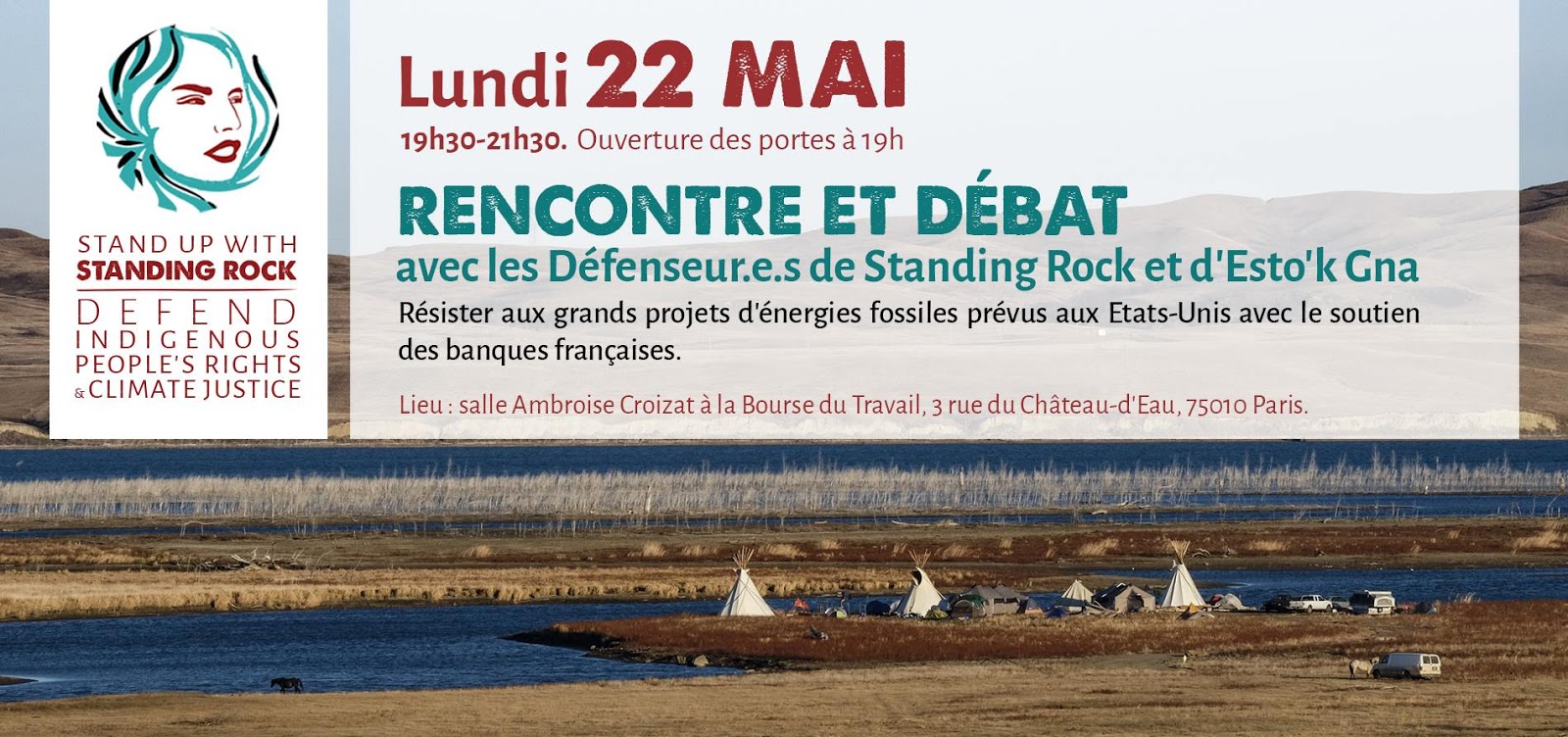
Native American Water Protectors Begin European Tour in Paris

Native American Water Protectors Begin European Tour in Paris
More photos at:

In Paris, water protector Juan B. Mancias
Tribal Chairman at 'Carrizo/Comecrudo Tribe of Texas

.
"Yesterday we were welcoming the Water Protectors from USA, Rachel Heaton, Nataanii Means, Wasté Win Young, Rebekah Hinojosa, Juan B. Mancias and Rafael Gonzalez, with some first actions." Photo courtesy Stand Up with Standing Rock.
.
Solidarity with Water Protectors in Paris yesterday.
.

.
Rachel Heaton, Muckleshoot
Rachel Heaton, member of the Muckleshoot Nation in Washington State, said of the photo above, "Some of the awesome organizers we get to tour around with.. it is the work of 24 organizations that got us Water Protectors here. 
Upon arriving in Paris we went right into actions. There is so much organizing going on here in Europe and it's exciting being a part of it." Photo by Rachel Heaton.

.

.
Nataani Means, Dineh
Nataani Means, Dine' from Chinle on the Nation Nation, said, "
We're about to hit an eleven city tour in Europe. Doing divestment work, as well as performing music in each city of the tour. We're gonna continue waking people up to what's going on not only with the destruction of Mother Earth but educating about our communities, what we go thru. And what we're still facing on our nations. When I started doing music this is what I wanted to do it for. Educate people about who we are in the 21st century. Prayers to everyone traveling, it's gonna be tough cause I really haven't been home in a minute and we just finished a two month tour here on turtle island. Myself and these beautiful people will do our best to represent in a powerful way."
.
 Waste Win Young, Dakota from Standing Rock
has just arrived in Paris. Young was among those camped and resisting the Dakota Access Pipeline.

.
Water Protector Rafael Gonzales


Four additional cities are joining the Tour ! Water Protectors will come in Paris, Brussels, the Netherlands, Köln, Geneva, Barcelona, Madrid, Bilbao, Bologna, Rome and Naples. Be ready friends ! Quatre villes s'ajoutent à la Tournée des Défenseur.e.s de l'eau. Ils passeront donc à Paris, Bruxelles, les Pays-Bas, Cologne, Genève, Barcelone, Madrid, Bilbao, Bologne, Rome et Naples. Soyez prêt.e.s les ami.e.s !


Standing Rock Water Protector European Tour and Schedule

From May 20th till June 14th, some activists of the Standing Rock’s movement will come to Europe for a solidarity tour called “Stand Up With Standing Rock”.
In Standing Rock, North Dakota, United States, the so called “water protectors” fought against the Dakota Access Pipeline (DAPL). Thanks to months of non-violent resistance gathering people from all over the country and from various backgrounds, they put a stop to the project during the Obama administration. But as Trump got the presidency, he decided to defend his own financial interest by sending the army to evacuate the Oceti Sakowin camp, build in the pipeline route. One month after, the oil was flowing inside the pipeline. But the fight is not over, as the water protectors took care of spreading it all over the Turtle Island (North America) and are now willing to spread it all over the world.

April 26, 2017

LIVE in New York: Indigenous Women Protecting Earth, Rights and Communities

/
Michelle Cook, Dine', and Casey Camp Horinek, Ponca in New York today.


Photo by Michelle Cook
Click arrow below to watch.


===========================


Featuring 

Casey Camp Horinek (Ponca; Ponca Nation Council Woman, WECAN Advisory Council Member, USA)
Lucy Mulenkei (Maasai; Executive Director of the Indigenous Information Network, Kenya)
Kandi Mossett (Mandan, Hidatsa, Arikara; Lead Organizer on the Extreme Energy & Just Transition Campaign with the Indigenous Environmental Network, USA)
Gloria Ushigua* (Sápara; President of the Association of Sapara Women, Ecuador) - to be confirmed
Betty Lyons (Onondaga; President and Executive Director of the American Indian Law Alliance, USA)
Michelle Cook (Diné; human rights lawyer and founding member of the of the Water Protector Legal Collective at Standing Rock, USA)
Heather Milton Lightening (Pasqua First Nation, Cree, Anishinabe, Blackfoot and Dakota; Indigenous Tar Sands Campaigner with Polaris Institute, Canada)
Alina Saba (Limbu; Nepal Policy Center, Nepal)

Watch more on Indigenous Women's Media
https://www.facebook.com/womensindigenousmedia/videos/440975529591193/
Read more about forum:
http://bsnorrell.blogspot.com/2017/04/indigenous-women-voices-of-global_24.html

July 5, 2016

New Report: Israeli Arms Dealer Profits from Migrant Misery on Tohono O'odham Nation

Arms Dealers profit from the wars they fuel and then again with border surveillance and migrant misery

Israeli arms dealer Elbit, protested in UK and around the world, is now targeting
Tohono O'odham burial grounds with Israeli/US spy towers. Elbit is responsible
for Apartheid security and drones in Palestine.

This inhumane 'cage' was used for migrant detention in 2007 on the Tohono O'odham Nation, where temperatures can exceed 115 degrees. An Indigenous delegation, including Mohawks, were shocked by the cage in use by the Tohono O'odham Nation and US Border Patrol. Lenny Foster, Navajo, said, "It is no more than a dog cage." Photo Ofelia Rivas, O'odham.


By Brenda Norrell

Censored News copyright


A new report exposes the arms dealers profiting from migrant misery and border surveillance, including the Israeli arms manufacturer Elbit Systems which is now targeting the Tohono O’odham Nation with Israeli/US spy towers.

On the western Tohono O’odham Nation, Gu-Vo District has said, ‘No!’ to the integrated fixed towers. "These U.S. proposed towers also are not on the border but in our communities and on the border of the Tohono O'odham Nation reiterating discrimination and deliberate attack on the O'odham," said O’odham’s Gu-Vo District.


Israel’s Elbit Systems, awarded the US border contract by Homeland Security, is exposed in a new report “Border Wars: The Arms Dealers Profiting from Europe’s Refugee Tragedy.”


Arms dealers and border surveillance profiteers are exposed as benefiting from the wars that they fuel, and the migrant misery they create, states the report released jointly by the European Stop Wapenhandel and Transnational Institute on Monday.

The new report states:


Most perverse of all, it shows that some of the beneficiaries of border security contracts are some of the biggest arms sellers to the Middle-East and North-African region, fuelling the conflicts that are the cause of many of the refugees. In other words, the companies creating the crisis are then profiting from it.


While exposing the arms dealers in Europe profiteering from the refugee tragedy, the new report also exposes Elbit’s role in Palestine and on the Arizona border.


The new report states:


Israel's Elbit has already constructed
US/Israeli spy towers this year on the Arizona
border in the Nogales area. The Tohono
O'odham Nation is now targeted.
Major, and often controversial, deals in the border security field include the Finmecannica-deal with Libya, as well as the US Secure Borders Initiative. This initiative included a billion-dollar contract with Boeing, to build a border security network along the northern and southern borders of the United States. The project was plagued by severe (technological and legal) problems and was finally cancelled. It was partially replaced by a smaller project ($145 million), for which Israeli arms producer Elbit built a network of surveillance towers on the border between Mexico and Arizona. As in Europe, the militarisation of the US border with Mexico has been criticised by human rights organisations because of its negative impacts on refugees rights and the way it forces refugees to use more dangerous routes to avoid border enforcement.


The report also exposes how Elbit drones are used by Israel to attack Palestinians. This comes as Native Americans are speaking out in support of Palestinians and speaking out in opposition to Israel and Border Apartheid.


The report states:


In 2015, Switzerland ordered six UAVs from Elbit for surveillance missions by border guards, for approximately 230 million euros. The deal was criticised because the same model, the Hermes 900, is used by Israel for attacking Palestinians. Without naming specific countries, Elbit writes it also performs “programs relating to border security projects, coastal surveillance systems and integrated airport security systems for European and other governments.”


The new report also exposes another Israeli company responsible Gaza border wall surveillance It is Israeil’s BTec.


Israeli companies are the only non-European receivers of research funding (thanks to a 1996 agreement between Israel and the EU) and also have played a role in fortifying the borders of Bulgaria and Hungary, and promote their expertise based on the West Bank separation wall and the Gaza border with Egypt. Israeli firm BTec Electronic Security Systems, selected by Frontex to participate in its April 2014 workshop on ‘Border Surveillance Sensors and Platforms’, boasted in its application mail that its “technologies, solutions and products are installed on [the] Israeli-Palestinian border.”

The report states, "There is one group of interests that have only benefited from the refugee crisis, and in particular from the European Union's investment in 'securing' its borders.”


“They are the military and security companies that provide the equipment to border guards, the surveillance technology to monitor frontiers, and the IT infrastructure to track population movements."

Elbit Systems is currently targeting the most traditional O'odham communities.


The Gu-Vo District opposes this proposal. Gu-Vo is in the western most district of the Tohono O'odham Nation.


The Gu-Vo District said in a statement, "The Gu-Vo District opposes these proposed tower sites to protect cultural sites on the holy mountain now called the Ajo Mountain Range. The mountain holds human remains of our people and also places of our cultural practices (medicine bundles) home and home of the ceremonial deer and bighorn sheep and mountain tortoises that are protected under the Endangered Species Act."


"The United States government military forces, the border patrol, have not been forthcoming with impact information, such as health effects and have deliberately misinformed the people regarding the immediate environmental impacts such as the roads they will build on the mountain and installation of electrical power lines to the sites as well as that these proposed tower sites will have a 25-year or longer impact on the mountain, the animal and plant life and the O'odham lives."


"The Gu-Vo District communities landscape have already been greatly impacted by numerous unauthorized roads and destruction of our mountains and hills of great significance to the O'odham way of life. Our future generations will face more restriction to live on our original lands as our rights as original Indigenous peoples continue to deteriorate."


"These U.S. proposed towers also are not on the border but in our communities and on the border of the Tohono O'odham Nation reiterating discrimination and deliberate attack on the O'odham," said Gu-Vo District.

.


Copyright Brenda Norrell, Censored News