Indigenous Peoples and Human Rights

May 25, 2016

Sacred Stone Camp: Human Shield Blocking Access to Dakota Access Pipeline


Human Shield of Prayer Moves in Front of Dakota Access Pipeline Construction!

Posted on May 24, 2016
May 24, 2016 – Camp of the Sacred Stones, Cannon Ball, North Dakota
Indigenous Rising

Today, in opposition to the Dakota Access pipeline and the illegal start of  its construction in North Dakota, a human shield of prayer has moved in front of the construction site northeast of Cannon Ball, ND on the east bank of the Missouri River. The human shield of prayer is on United States Army Corp of Engineer property.
[The Dakota Access Pipeline is a proposed 1,168-mile, 30-inch diameter pipeline that will connect the Bakken and Three Forks production areas in North Dakota to Patoka, Illinois, transporting over 450,000 barrels of oil per day.]
These land defenders plan to stay at the construction site in an display of non-violent prayerful action as long as possible.
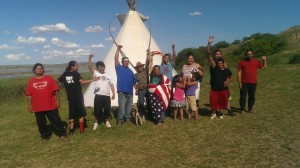
Oceti Sakowin water protectors before they cross the Missouri River to create a human shield against Dakota Access pipeline construction
Oceti Sakowin water protectors before they cross the Missouri River to create a human shield against Dakota Access pipeline construction.


THE FOLLOWING IS A STATEMENT BY THE WARRIORS WHO WILL BE ENGAGING IN NON-VIOLENT DIRECT ACTION AT THE DAKOTA ACCESS CONSTRUCTION SITE:
We are telling the Army Corp of Engineers that they have a trust responsibility to the Oceti Sakowin. That without water there is no life. To deny the permit for Dakota Access now and be good stewards of the land they stole from us which by law is still ours.
“We are headed across the river to the route of Dakota Access to pray. Remaining non-violent to any obstacle that we may face,” says Wiyaka Eagleman, Sicangu Lakota, Elsevier S.D.
“Today I’m going over the river to pray hard and as long as I can for the people to have a change of heart to stop this pipeline,” says Jeremiah Canku Maza, Standing Rock Sioux Tribe
“I stand strong with my relationship in this area. I am here to remind people of who’s land that we are truly protecting. The water, land, animals and air. They give us life. Greed kills. No more pipelines. Honor the treaties,” says Tania Aubid
“We are here to stop a snake who wants to cross the Missouri river. This is Oceti Sakowin treaty territory. No one asked for our input. No Dakota Access pipeline. America is built on stolen lands,” says Justin Rowland from the Fire Lightening Band of the Oglala
The Army Corp of Engineers is expected to make a decision soon. We want a full EIS, we want this pipeline to be denied. We want the world to know we stand on our treaty rights and for all the people who drink the water from the Missouri and use it for fishing, and recreation. Life is more important than a pipeline.
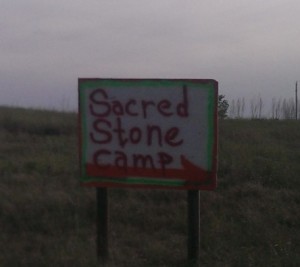
Direction Sign to the "Sacred Stone Camp" near Cannonball, ND
Direction Sign to the “Sacred Stone Camp” near Cannonball, ND
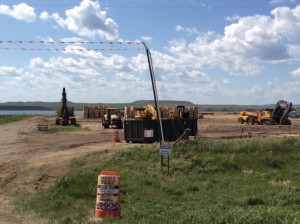
Dakota Access Pipeline Construction Site in ND. Northeast of Cannon Ball, ND across the Missouri River.


Sign the petition to the Army Corps of Engineers: https://www.change.org/p/jo-ellen-darcy-stop-the-dakota-access-pipeline


Sacred Stone Camp: Human Shield on Standing Rock in North Dakota is blocking construction of the Dakota Access Pipeline which is threatening the water sources of the Dakota, Lakota and Dakota.
More information:

May 24, 2016

AIM West: 'Broken Rainbow' film and Louise Benally: Oakland May 25, 2016


May 23, 2016

Houma Native to Speak out at Shell Annual Meeting: Netherlands May 24, 2016


Photo  Monique Verdin by Andy Cook
Keep it in the Ground: Intervention from Gulf of Mexico Indigenous Delegate at Shell Annual General Meeting
Photo opportunity outside the Annual General Meeting (AGM): Circustheater, Circusstraat 4, The Hague, The Netherlands, Tuesday, May 24, 2016, 9 am local time.
For interviews with delegate contact:
Suzanne Dhaliwal, UK Tar Sands Network  0044 777 269 4327 suzanne@no-tar-sands.org
Monique Verdin, 001 504 330 0768, moniquemverdin@gmail.com
WHAT: Indigenous delegate from the Gulf of Mexico will speak out against offshore drilling at the Shell AGM 2016, and will present a pop-up exhibition of 10 foot professional photos documenting climate impacts on communities of New Orleans. An action will also take place in the Gulf coast on May 24th to amplify the Shell AGM intervention, as residents call for an end to the US federal government sale of ocean drilling leases.
Monique Verdin, resident of the Louisiana coast and member-elect of the Houma Nation Council will travel to the Shell AGM in the Netherlands, supported by the Indigenous Environmental Network and UK Tar Sands Network to call on the board and investors to put an end to new offshore leases in the Gulf of Mexico in light of the history of environmental devastation in the Gulf and its related community impacts, as well as the recent 90,000 gallon Shell oil spill. The ecology and local economy of this region is still reeling from the impacts of the BP Deepwater Horizon Disaster in 2010.
WHO:  Monique Verdin is an indigenous daughter of southeast Louisiana’s Houma Nation, and is a photographer and filmmaker.
“Multinational corporations continue to drill off our coast, while the federal government is putting more offshore lands onto the auction block than ever before. This is absurd. The only way to ensure we protect the water and sanctity of life in and along the Gulf Coast is to put an end to extreme fossil fuel development. Oil and gas infrastructure, from pipelines to wells to refineries, are gambling with the health of our environment and the wellness of our communities along the coast. We need immediate action to facilitate just transitions and the ability to ensure we keep carbon in the ground for our communities across the Gulf and for communities around the planet.” Monique Verdin
As a Hurricane Katrina evacuation veteran and a witness to Deepwater Horizon disaster, Monique was inspired to become an active community organizer to oppose new leases in the Gulf. Her stunning photographs document this devastation. The indigenous people of the Mississippi River Delta are witnessing rapid land loss due to rising seas and an eroding landscape desecrated by fossil fuel mining and manipulations. Monique documents this as a personal journey in her film ‘My Louisiana Love’ (2012) which has been screened internationally.
WHY: Coastal communities in the Gulf of Mexico oppose Shell’s exploration of new leases of offshore drilling, the risks of deepwater drilling as evidenced by the recent Shell oil spill in the Gulf this month, and the impacts of climate change on coastal communities. These communities also experience impacts of explosions, poor air quality, and failure from Shell to address these concerns.
Monique participated in the Break Free actions in Washington DC on Monday, May 16th, 2016.

ECUADOR: Palm Oil Companies Focus of First Case on Rights of Nature


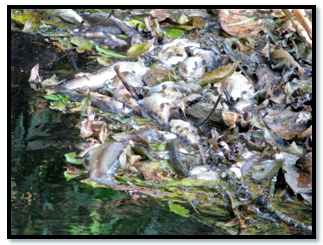
A mass amount of dead fish piled together on the surface of the Chiquita River the same day, when that Los Andes Extractor threw its residual waste waters into the river after extracting the palm oil

UPDATE: Constitutional-based civil suit of the ancestral communities Guadualito, La Chiquita, and Nature


Dear Supporters,

We write to you with an update about the constitutional-based civil suit of the ancestral communities Guadualito, La Chiquita, and Nature versus the oil palm companies in San Lorenzo Canton (Esmeraldas Province) of Ecuador, which began in July 2010.

It is the first civil court case in Ecuador and the world in which Nature is a subject of rights! The provincial court’s judgment will also set special precedence because an Indigenous and an Afro-descendant community have come together with Nature to defend their ancestral rights!  Learn more here.

After months of silence, there is news that the judge will make his decision any day now! The oil palm companies are pressuring the judicial officials, thus we must also react!

It is critical that we let the judge and the communities know that the world is watching and awaiting a just decision in favor of the Indigenous, Afro-descendant and the rain forest/river communities!

That’s why it is urgent that you sign and spread wide and far the following petition.
Click here to find the petition, more details, and a link to like our Facebook page.

Thank you and ... Please sign and share with your social media network as well.
More info:
CASE SUMMARY A PORTRAIT OF HUMAN AND ENVIRONMENTAL DEVASTATION: STOP THE INVISIBILIZATION!!!
Over the years, since 1998, the oil palm monocultures have resulted in severe deforestation, biodiversity loss, and contamination of the rivers, soil, and air. Consequently, the Afro-descendant and Awá people, who live in the communities of La Chiquita and Guadualito, which are surrounded by the oil palm plantations, also have contracted new diseases. Click here to view images and learn more about their plight.

May 21, 2016

Pyramid Lake: Eagle Staff Run and Honoring Warriors of 1860


Photos by Carl Bad Bear Sampson and Buck Sampson

Article by Brenda Norrell
Censored News

PYRAMID LAKE PAIUTE NATION -- The Eagle Staff War Memorial Run recounted the Pyramid Lake War of 1860. The nine mile run on Friday, May 20, 2016, ended with a feed for the people. 
Buck Sampson said, "It was the Eagle Staff War Memorial Run for the War Between the Calvary and the Indians at Pyramid Lake in 1860, told by the Indians and their descendants who fought to save the Natives. It was the Indians telling their side of the story of how it all started."
"Two white traders kidnapped two Indian girls, nine and twelve, and raped and molested them for a week. Indians found the girls tied up in their cellar and the Indians killed the five white men there," Sampson told Censored News.
"Volunteers from Virginia City went to Pyramid Lake to teach the Indians a lesson. Some of the warriors stayed back, allowing the women and children to escape to main camps in Nixon, Nevada, at Pyramid Lake."
Sampson said that at Pyramid Lake, they had two wars.
"Indians defeated the volunteers in the first battle. Major Ormsby was killed in the war by Paiute Indians. Native casualties weren't bad compared to the Calvary.
"Then, at the Mudd Lake Massacre in 1865, the Calvary wiped out women and children, and the old men, at Mud Lake."


Copyright Buck and Carl Sampson
Censored News