Indigenous Peoples and Human Rights
Showing posts with label Australia. Show all posts

July 16, 2026

At the United Nations, Indigenous Human Rights Defenders Testify on Persecution and Treaties

At the United Nations, Indigenous Human Rights Defenders Testify on Persecution and Treaties

By Brenda Norrell, Censored News, Thursday, July 16, 2026 Upddated

GENEVA --  At the U.N. Expert Mechanism on the Rights of Indigenous Peoples, Indigenous youth and women are in the forefront, while Indigenous from around the world describe their struggle to be recognized by the governments in their homelands, and be heard and respected. Indigenous in Canada reported success today in treaty negotiations.


Australia Aborignals and Torres Strait Islanders: Women and Youth Testify

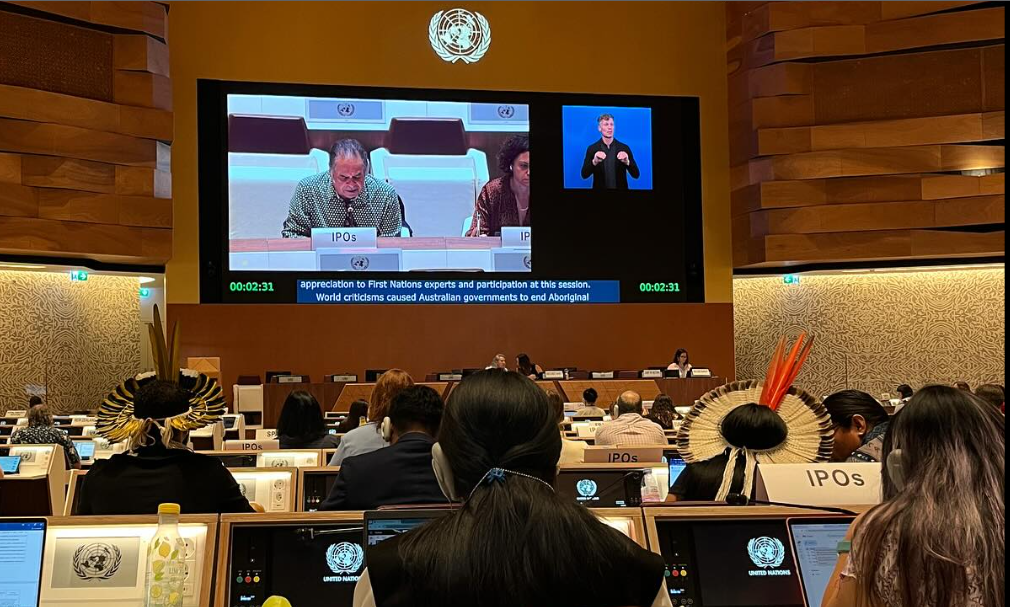
Aboriginal youths from Australia and Torres Islanders were among the strong youth voices at the United Nations today. The delegation shown here said biomedical research is being weaponized against their people; and is being carried out against them without free, prior and informed consent.

"Biomedical data must be wholly managed, stored, and owned by its respective communities. Indigenous people will always be the first scientists and health practitioners. The next 20 years must be defined by indigenous authority over our research, our data, and our health future," the youth delegate said.

T
his week, Indigenous youths testified that they must be recognized and involved in decision making at the United Nations.


Exiled Russian delegate testifying.

Russia and Ecuador at the UN -- They're not giving up. Again today, exiled Indigenous from Russia and the Far North called for the release of two women imprisoned in Russia, U.N. participants and climate justice advocates, Daria Egereva and Natalia Leongardt, who have been behind bars for six months. The Russian Federation has repeatedly taken the floor attempting to discredit the delegation of exiled human rights defenders. Russia is demanding that they be silenced and removed from the sessions.

Ecuador: Delegates parents targeted

In a another wave of oppression for those speaking out at the U.N. Pacha Teran of Ecuador said yesterday that her parents home was attacked after she testified at the U.N. Expert Mechanism on the Rights of Indigenous Peoples in Geneva, which is broadcast globally by the U.N.

"Con mi participo en la 19.ª sesión del EMRIP - ONU, donde he denunciado vulneraciones de derechos en mi pais, hoy la vivienda de mis padres fue objeto de una agresión."

(With my participation in the 19th session of the EMRIP - UN, where I denounced human rights violations in my country, today my parents' home was the target of an attack," Teran said on social media on Wednesday.)

Teran is in the delegation testifying on the militarization and violence by the government of Ecuador security forces. 

Colombia's women bear the greatest burden. Screenshot Censored News.

COLOMBIA: Indigenous Women Carry the Greatest Burden

"How many rights can a people lose before the world recognizes it?" Colombia's Indigenous delegate from the Ethnic Commission for Peace in Defense of Territorial Rights asked the U.N.

"This is the question we bring today on behalf of indigenous people and particularly women in Colombia. Colombia has borne the brunt of decades of fights and ethnic communities are currently trapped between armed leaders murdered with impunity."

"Boys and girls suffer forced recruitment in a persistent fashion. The women bear the brunt of this. They are the most displaced and have the greatest violation of their collective rights."

The dismantling of the peace agreement has resulted in a loss of hope.

The peace agreements included an indigenous historic chapter. Eight years later, only 13 percent of those commitments have been fully complied with.

"Prior consultation, which is a mandate in the constitution, continues to be ineffective. And in less than a month, a government which has dismantled the peace agreements has taken over. And as a result, there is a loss of hope."

"The communities are the guardians of the environmental rights protecting all of our territories where the state is absent. Food sovereignty of thousands of families depends on this. And in the territories which are most hit by the conflict, it is the communities and community leaders, in their majority women, who ensure the guardianship of this for the next generation to avoid the war that has been our scourge."

While Colombia prepares for a new president, Indigenous Peoples said the situation is urgent.

"Experts, we would like to ask for an urgent recommendation to protect indigenous communities and their women leaders before the 7th of August when the government is to change in Colombia."


Red River Metis Ambassador Clement Chartier 

Red River Metis of Manitoba, Canada, described the negotiations with Canada that resulted in a decade of reconciliation, which led to over $3 billion in funds for Red River Metis. Red River Metis Ambassador Clement Chartier said Canada embraced the U.N. Declaration on the Rights of Indigenous Peoples, during Trudeau's administration, and began implementing it. Red River Metis now have a Treaty for final ratification in process in Canada.

During the U.N. Expert Mechanism on the Rights of Indigenous Peoples today in Geneva, Indigenous described their struggles to be recognized and heard in their home countries.

The B.C. Treaty Commission in Canada reported success as it moves forward with modern day treaty negotiations for self-governance for Native Nations in B.C.


Indigenous from Peru continue to call for action to ensure the rights of Indigenous Peoples, at the U.N. Expert Mechanism on the Rights of Indigenous Peoples. Indigenous in Peru, Brazil, Argentina, Nicaragua, and Ecuador told the U.N. this week of the militarized oppression in their countries -- the deaths, imprisonments, loss of land and poisoning of their rivers -- as they defend their lands and water from logging, mining, and oil and gas drilling.


Racism in Argentina and the southernmost region of South America

"Being Indigenous should be a source of pride," said an Indigenous representative from the southernmost region of South America. She spoke on behalf of Identidad Marrón, a civil society organization that works against structural racism that affects indigenous peoples and human mobility in Argentina and neighboring countries -- Chile, Uruguay, and Bolivia -- known as the South Cone region of South America.

Racism has not disappeared for Indigenous Peoples here, and it is now twenty years after the U.N. Declaration on the Rights of Indigenous Peoples. She said whether they are in their countries or in neighboring countries, there is racism.

"In our cities, we continue to be identified primarily by the color of our skin, our traits, or our national origin rather than the rights that the Declaration recognizes, we hold."

"Such social profiling, which is facilitated increasingly by biometric technologies and facial recognition, is limiting access to rights and leading many people to hide their Indigenous identity, not because they're ashamed, but because they need to survive."

"Therefore, we would like to suggest that in monitoring opinion number 18 of 2025 on the rights of Indigenous peoples to data, we include the status of mobility or on the move and racial profiling and algorithmic profiling incidents as categories, ventilated ones, not— and an intersecting approach."

"States also need to take measures to prevent racial profiling, including Argentina. The rights of Indigenous peoples need to support us where we live, work, and move, and they should also ensure that migration does not mean that we are invisible, and being Indigenous should be a source of pride."

Indonesia

Indigenous from Indonesia point out that the reality in their homelands, and what the government of Indonesia says in the United Nations sessions are not the same. Indigenous point out that the mining that the Indonesian government claims it has stopped is actually proceeding, and a pipeline is doing further damage.


AFRICA: An Indigenous Ogani delegate described how the lack of recognition for Indigenous in Ethiopia and Nigeria has resulted in destruction mining and oil extraction, during the discussion on the U.N. Declaration on the Rights of Indigenous Peoples, UN DRIP.

"As we prepare to celebrate the 20th anniversary of the adoption of the UN DRIP,
it is saddening to report that many countries in Africa, particularly Ethiopia and Nigeria have not implemented UN DRIP and are yet to recognize indigenous people in their countries."

"Denying indigenous people amounts to denying their collective rights. Recognition of indigenous people are not given privilege, but an existential issue.

"The UN Special Rapporteur on the rights of indigenous people have identified lack of
recognition as one major issue that contributes to indigenous people's exclusion in Africa."

The lack of recognition results in large scale mining operations in the Oromiyo territory in Ethiopia, and oil extracting on Ogoni, Nigeria, where extraction has been taking place without the people's free, prior and informed consent.

"Furthermore, these attractive activities have been destroying the forest and contaminating waters of Indigenous communities in Ethiopia and Nigeria."

"We call on the Expert Mechanism to reinforce its effort for the endorsement of UN and recognition of indigenous people in Africa. Ethiopia and Nigeria should
recognize and ensure the full participation of Indigenous people in decision making process affecting their land and resources."

Censored News Original Series: UN Expert Mechanism

'Keeping It Alive' the Beauty of Ancient Languages, Path to Memory and Identity

Indigenous at UN Expose AI Data Centers and Racially Biased Misinformation

At the UN, Indigenous Testify on Persecution and Treaties

UN Expert Mechanism on the Rights of Indigenous Peoples Begins in Geneva

Copyright Brenda Norrell, Censored News 2026

September 17, 2024

Protect Ha'Kamwe' Stop Big Sandy Lithium Mine Phoenix Courthouse Sept. 17, 2024


Zoe Perry, left, and Loveena Watahomiegie, right, as they join other members of the Hualapai Tribe while marching in front of U.S. District Court as they gathered to try to persuade a federal judge to extend a temporary ban on exploratory drilling for a lithium project near tribal lands Tuesday, Sept. 17, 2024, in Phoenix. (AP Photo/Ross D. Franklin)

US judge unlikely to rule until next week as Arizona tribe fights to extend ban on lithium drilling

PHOENIX (AP) — "Members of an Arizona tribe urged a federal judge Tuesday to extend a temporary ban on exploratory drilling for a lithium project near lands they have used for religious and cultural ceremonies for centuries.

"The judge indicated she wouldn’t decide for more than a week whether to grant the tribe’s request or lift a temporary restraining order she issued last month."


July 22, 2024

Aboriginal Elder Describes Australia's Child Abuse to United Nations

Photo courtesy New South Wales Aboriginal Land Council, Censored News

Aboriginal Elder Describes Australia's Child Abuse to United Nations

By Brenda Norrell, Censored News, July 22, 2024

GENEVA -- Aboriginal elder BJ Cruse described the Australian government's child abuse and cultural genocide of children -- aimed at breaking Aboriginal children's spirit -- during the United Nations Expert Mechanism on the Rights of Indigenous Peoples.

July 14, 2024

Indigenous Expose Racism and Genocide at U.N. -- Governments Rush to Deny Abuses and Insult Presenters


Rachana Sam At on behalf of the Asia Indigenous Peoples Caucus points out that Indigenous Peoples can not participate in this process unless approved by a non-governmental organization, and this must change for there to be enhanced participation. Photo AIPC.

Indigenous Expose Racism and Genocide at U.N. -- Governments Rush to Deny Abuses and Insult Presenters

By Brenda Norrell, Censored News, July 14, 2024

GENEVA -- Indigenous youths spoke with courage and eloquence, calling out the environmental racism and genocide carried out by governments around the world. In response, government representatives rushed to deny the human rights abuses, and in some cases, used insulting language to criticize Indigenous Peoples who exposed their abuses, during the U.N. Expert Mechanism on the Rights of Indigenous Peoples.

The representative of France denied the government is responsible for genocide in New Caledonia. Azerbaijan denied responsibility for genocide in Armenia and used derogatory accusations, describing speakers as frauds and part of a "smear campaign." 

The United States government failed to describe the ongoing seizure of Native ancestral lands for lithium and copper mines, and fake green energy projects targeting ceremonial places.

The Russian Federation government criticized speakers on Thursday. Responding to speakers statements, he said their status needs to be examined. He claimed some had lost touch with their communities, and some were funded by former colonial powers. He also said one organization presenting a statement was not recognized in Russia.

"We need to exclude the participation of chauvinists and racists," the Russian Federation government representative said.

July 10, 2024

United Nations: Australian Aboriginal children seized, 'green energy' impacts worsen for Saami


Systematic racism in Australia means that Aboriginal children are being seized from their families, children that are later the victims of a system that results in high rates of child incarceration in Australia's prisons, a representative told the U.N. Expert Mechanism on the Rights of Indigenous Peoples this morning. Screenshot by Censored News.


United Nations: Australian Aboriginal children seized, 'green energy' impacts worsen for Saami 

Brenda Norrell, Censored News, July 9, 2024

GENEVA -- Australian Aboriginal children continue to be seized from their families by the government, and the situation for Saami in Norway is worsening because of 'green energy' projects, Indigenous representatives told the United Nations Expert Mechanism on the Rights of Indigenous Peoples today.

Both Norway and Australia had country engagements with the UN Expert Mechanism on the Rights of Indigenous Peoples during the past year, but Australian Aboriginal and Saami representatives said today that conditions are not improving.

Urgent Plea from Guatemala

June 28, 2024

Australians Rush to Mine Lithium in Hualapai's Sacred Place, a Navajo Enterprise is Leading the Desecration


Australians Rush to Mine Lithium in Hualapai's Sacred Place, and a Navajo Enterprise is Leading the Desecration

Update:

The Bureau of Land Management approved the Big Sandy lithium project in the area of Hualapai's Ceremonial Place in June. The so-called 'Navajo Transitional Energy Company,' a Navajo Nation enterprise is carrying out the drilling operation for an Australian mining company. This is the latest attack on sacred places by Interior Sec. Deb Haaland's BLM. It is another fake green project destroying ceremonial places for lithium for batteries, under the name of green energy for profits for an Australian corporation.

BLM approves lithium mine on June 6, 2024 
https://www.blm.gov/announcement/blm-approves-lithium-exploration-project-arizona
 Ha’Kamwe’

By Brenda Norrell, Censored News, April 11, 2024

Translated into French by Christine Prat

SYDNEY, Australia -- While sipping wine at the Sydney Opera House, investors hear how much money they can make mining lithium in Arizona. The enthusiastic project manager is excited to tell them that Arizona loves mining, as can be seen with all its copper mines.

"They are a mining friendly state," says Paul Lloyd, managing director at Arizona Lithium, owned by Hawkstone Energy, in Perth, Australia.

"They are very pro-lithium production."

On the other side of the world, Hualapai are offering prayers at their sacred spring, Ha’Kamwe’ their sacred place for healing and rites of passage, including childbirth and coming-of-age ceremonies for young women. It has been their ceremonial place since time immemorial.

Not far away, in Farmington, New Mexico -- a bordertown with a long history of crimes against Native Americans -- a new epicenter of fake green energy projects emerges.

January 22, 2024

Double Exposure: Genocide in Residential Schools, as Biden Genocide Case Begins in U.S. Federal Court

Blue Quills Indian Residential School


Double Exposure: Genocide in Residential Schools, as Biden Genocide Case Heads to US Federal Court

By Brenda Norrell, Censored News, Updated Jan. 21, 2024

The National Centre for Truth and Reconciliation in Canada released new records from residential schools, which were essentially prisoner-of-war camps where Native children were victims of genocide. At the same time, the Center for Constitutional Rights in the United States announced its case filed against President Biden for genocide in Palestine begins in federal court in northern California on Friday.

The National Centre for Truth and Reconciliation said the Oblates are transferring all outstanding records to the National Centre for Truth and Reconciliation. The first group of residential school records is now on its public website.

January 11, 2018

Eight Indigenous Made Films at Sundance Film Festival 2018

.
Akicita: The Battle of Standing Rock
.
Smoke Signals anniversary showing

Sundance Institute

Wednesday, January 10th, 2018

Schedule for Park City, and Salt Lake City, Utah showings:

http://www.sundance.org/pdf/film-guide/SFF18_PPG_Grid.pdf

Following President and Founder Robert Redford’s original vision, Sundance Institute has remained committed to supporting Native American artists throughout the Institute’s history. This support has established a rich legacy of work and has supported more than 300 filmmakers through labs, grants, mentorships, public programs, and the platform of the Sundance Film Festival.

The Native American and Indigenous Program has a global focus and through its work strengthens Indigenous cinema. Filmmakers supported over the years include: Sterlin Harjo (Seminole/Muskogee), Taika Waititi (Te Whānau-ā-Apanui), Billy Luther (Diné/Hopi/Laguna Pueblo), Andrew Okpeaha MacLean (Iñupiaq), Aurora Guerrero (Xicana), Sydney Freeland (Diné), Ciara Leina’ala Lacy (Kanaka Maoli), Lyle Mitchell Corbine, Jr. (Bad River Band of the Lake Superior Tribe of Chippewa Indians) and Shaandiin Tome (Diné).

This year, eight Indigenous-made films will be premiering at the Sundance Film Festival, January 18-28, in Park City, Utah. In addition, there will be a special 20th Anniversary Archive Screening of Smoke Signals, directed by Chris Eyre (Cheyenne/Arapaho) with the screenplay by Sherman Alexie (Spokane/Coeur d’Alene). This is also our opportunity to introduce the Native Program’s filmmaker Fellows for the coming year.

Feature Films
World Cinema Documentary Competition

.

Genesis 2.0 / Switzerland, Directors: Christian Frei, Maxim Arbugaev (Yakut/Buryat), Producer: Christian Frei — On the remote New Siberian Islands in the Arctic Ocean, hunters search for tusks of extinct mammoths. When they discover a surprisingly well-preserved mammoth carcass, its resurrection will be the first manifestation of the next great technological revolution: genetics. It may well turn our world upside down.

NEXT

.


We the Animals / U.S.A., Director: Jeremiah Zagar, Screenwriters: Daniel Kitrosser, Jeremiah Zagar, Producers: Jeremy Yaches, Christina D. King (Creek and Seminole Nations), Andrew Goldman, Paul Mezey — Us three, us brothers, us kings. Manny, Joel and Jonah tear their way through childhood and push against the volatile love of their parents. As Manny and Joel grow into versions of their father and Ma dreams of escape, Jonah, the youngest, embraces an imagined world all his own. Cast: Raul Castillo, Sheila Vand, Evan Rosado, Isaiah Kristian, Josiah Santiago.

Spotlight

.


Sweet Country / Australia, Director: Warwick Thornton (Kaytej Nation), Screenwriters: Stephen McGregor, David Tranter (Alyawarra Nation) — Australian western set on the Northern Territory frontier in the 1920s, where justice itself is put on trial when an aged Aboriginal farmhand shoots a white man in self defense and goes on the run as posse gathers to hunt him down.

Short Films

.

Mud (Hashtł'ishnii) / U.S.A., Director and screenwriter: Shaandiin Tome (Diné) — On her last day, Ruby faces the inescapable remnants of alcoholism, family and culture.

.

The Violence of a Civilization without Secrets / U.S.A., Directors and screenwriters: Adam Khalil, Zack Khalil (Sault Ste. Marie Tribe of Chippewa Indians, Jackson Polys (Tlingit) — An urgent reflection on Indigenous sovereignty, the undead violence of museum archives and post-mortem justice through the case of the "Kennewick Man," a prehistoric Paleoamerican man whose remains were found in Kennewick, Washington State in 1996.


.
Nuuca / U.S.A. / Canada, Director: Michelle Latimer (Métis/Algonquin) — The oil boom in North Dakota has brought tens of thousands of new people to the region and with that has come an influx of drugs, crime and sex trafficking.


.
I Like Girls / Canada, Director/Screenwriter: Diane Obomsawin (Abenaki) — Charlotte, Mathilde, Marie and Diane reveal the nitty-gritty about their first loves, sharing funny and intimate tales of one-sided infatuation, mutual attraction, erotic moments and fumbling attempts at sexual expression.

Documentary Premieres

.
Akicita: The Battle of Standing Rock / U.S.A., Director: Cody Lucich, (Estom Yumeka Maidu Tribe of Enterprise Rancheria), Producers: Heather Rae, Gingger Shankar, Ben-Alex Dupris (Colville) Standing Rock, 2016: the largest Native American occupation since Wounded Knee. Thousands of activists, environmentalists and militarized police descend on the Dakota Access Pipeline in a standoff between oil corporations and a new generation of Native warriors. This chronicle captures the sweeping struggle, spirit and havoc of a people’s uprising.

20th Anniversary Archive Screening
.

Smoke Signals / U.S.A., Director: Chris Eyre (Cheyenne /Arapaho); Screenwriter: Sherman Alexie (Spokane/Coeur d'Alene) The chronicle of athletic and charming Victor Joseph from the Salmon Indian Reservation really begins when he learns of his father’s premature and sudden death. With no money, he accepts the offer of his quirky and garrulous childhood buddy, Thomas-Builds-the-Fire, to pay for the trip, but only if he goes along. Their ensuing odyssey becomes an exploration of social and personal being, but this is not a typical account laced with angst and despair. Eyre and Alexie have fused their cultural legacy with a cinematic vision that is fresh, honest, and deeply cynical of the trite images and ideas about what it is to be Indian in America.

Native Filmmaker Lab Fellows
These two Fellows participated in the Native Filmmakers Lab with their projects in May 2017 and will end their year-long Fellowship at the Festival with ongoing support, screenings, guided film discussions, and networking events. At the Lab, these fellows worked with a cast and crew to practice shooting scenes from their short films under the expert creative mentorship of Program alumni, Creative Advisors and Program staff. This Fellowship encourages Native filmmakers to hone their storytelling and technical skills in a hands-on and supportive environment. Following the Lab, Fellows receive a year-round continuum of support.

Shaandiin Tome (Diné), Mud (Hashtł’ishnii)

On her last day, Ruby faces the inescapable remnants of alcoholism, family and culture.

Erin Maile Lau (Kanaka Maoli), Ka Mahina a me Ka Pō (The Moon & the Night)

In rural Hawai‘i, a teenage girl must confront her father after he enters her beloved pet in a dogfight.

Full Circle Fellows
The Full Circle Fellowship Program, which began in 2014 with support from the W.K. Kellogg Foundation, is a year-long program for 18-24 year-old Native filmmakers from New Mexico and Michigan. The Fellows receive an immersive experience in the world of independent film and attend screenings, participate in guided film discussions, and connect with leaders of the Indigenous film community. The Fellowship—which has its launch at the Festival—focuses on developing these Native youth filmmakers through workshops and training opportunities, and links talented young storytellers to education and career pathways across fields of independent filmmaking, using structural strategies where Native communities heal by telling their own stories.

Mandolin Eisenberg (Taos Pueblo) is a mixed-media artist. Since starting college she has focused her efforts on film. From a young age Mandolin has been inspired by creation, initially taking up drawing and then discovering a love for writing. Her passion for writing and art turned into a deep love for stories and storytelling. As a filmmaker and storyteller, Mandolin hopes to create new realities that will impact the world. Mandolin currently attends the University of New Mexico, where she studies in the Interdisciplinary Film and Digital Media Program with a concentration in Directing and Writing.

Kaitlin Lenhard (Sault Ste. Marie Tribe of Chippewa Indians) is a recent graduate of Michigan State University with degrees in Media and Information, and Global Studies in the Arts and Humanities. Kaitlin’s film interests are largely centered in film language and how film language can be used as a bridge for Indigenous communities that have been denied their languages through colonization.

Nick Sowmick (Saginaw Chippewa Indian Tribe), 18, is a student at Beal City High School in Mount Pleasant, Michigan. His interests include listening to music, watching and making films, and helping his local and tribal community.

Joseph Ernest Wemigwans (Saginaw Chippewa Indian Tribe), 18, has loved films all his life and, especially, paying attention to the details of how they are crafted.

Time Warner Fellows
Jhane Myers (Comanche/Blackfeet), Time Warner Story Fellowship

Jhane Myers (Comanche/Blackfeet) is a Time Warner Native Producing Fellow in the Native American and Indigenous Program at the Sundance Institute. She was selected for the Fellowship with the project Words From A Bear, a documentary currently being directed by Jeffrey Palmer (Kiowa) on the life of Pulitzer prize winning Kiowa author N. Scott Momaday (House Made of Dawn; The Way To Rainy Mountain). The film is slated for broadcast in 2019 on PBS’ American Masters. Myers served as an associate producer on the documentary film, LaDonna Harris Indian 101, about acclaimed Comanche activist LaDonna Harris, which aired on PBS in 2014. And, she served as Associate Producer on Defending the Fire, a documentary about Native American warriors currently playing the film festival circuit. Early in her career, Myers established herself as a great cultural and community resource for Native-content projects being produced by networks and studios including: Monsters of God (Plan B/TNT); Magnificent Seven (MGM/Columbia Pictures); Wind River (Weinstein Co.); The Lone Ranger (Walt Disney/Jerry Bruckheimer Films); And, Apocalypto (Icon Ent/Touchstone). After working with so many non-Native created projects about Native people, Myers began to seek out a producing career to support Native filmmakers and storytellers to help bring their stories to fruition. She is a recipient of the 2018 Time Warner Story Fellowship.

Jennifer Akana Sturla (Kanaka Maoli), Time Warner Producer Fellowship

Filmmaker Jennifer Akana Sturla was Born to a Hawaiian beauty queen and an aerospace engineer from New Jersey. Jennifer’s film work has frequently examined her Native Hawaiian heritage and her USC thesis film Kamea won top prizes including Best Short at the Hawai‘i International Film Festival. Subsequent projects have included shorts, a narrative feature developed by Sony Pictures, and a feature documentary on Native Hawaiian singer-songwriter Israel “IZ” Kamakawiwo‘ole, currently in production. Jennifer has spent over twenty years working in film and television. In addition to filmmaking, she currently teaches production at California State University, Northridge and UCLA Extension. She earned her Bachelor of Arts in literature from the University of California, Santa Cruz and her Master of Fine Arts in film and television production from the University of Southern California’s School of Cinematic Arts. She is the recipient of the 2018 Time Warner Native Producer Fellowship with her project The Untitled “IZ” Project.
Lauren Monroe, Jr. (Blackfeet), Time Warner Producer Fellowship

Lauren Monroe Jr. is an accomplished visual artist, filmmaker, and enrolled member of the Blackfeet Tribe. He is currently in development on the six-part docuseries Horse Nations with ZPZ Productions (Anthony Bourdain: Parts Unknown, Mind of a Chef, MeatEater). He previously worked on the films Walking Out, The Ballad Of Lefty Brown, and 2016 Oscar Nominee Winter Light. He currently serves as the Cultural Coordinator for the Indigenous Masters of Education program at the University of Calgary, and is producing his directorial debut Kills Last – a post-apocalyptic thriller based on traditional tribal coup stories and told primarily in the Blackfeet language. He earned his MFA in Screenwriting through the Institute of American Indian Art in Santa Fe. He is the recipient of the 2018 Time Warner Producer Fellowship with the project Horse Nations.

Merata Mita Fellowship
At the 2018 Sundance Film Festival, Sundance Institute will announce the recipient of our annual Fellowship named in honor of the late Māori filmmaker Merata Mita, New Zealand's first Indigenous female filmmaker. In addition to being a global advocate for Indigenous voices, Merata was a trusted Creative Advisor and Artistic Director at the Native Lab, and a dear friend to the Institute. The Merata Mita Fellowship is supported by the Consulate General of Canada, Indigenous Media Initiatives, Anonymous, Fenton Bailey and Billy Luther, and Sarah Luther. Each year Sundance Institute identifies a Native or Indigenous filmmaker from a global pool of nominees to award a cash grant and provide a year-long continuum of support with activities including a trip to the Sundance Film Festival, access to strategic and creative services offered by Sundance Institute artist programs, and mentorship opportunities.

The Fellowship honoree will be announced Monday, January 22nd.

Additional Fellows
These Fellows are being supported with grants and fellowships from other programs within Sundance Institute and the Native American and Indigenous Program.

Zack Khalil (Ojibway), The Art of Nonfiction Fellowship

Adam Shingwak Khalil (Ojibway), The Art of Nonfiction Fellowship

Razelle Benally (Diné/Lakota), Feature Film Development Fellowship

Philip Sanchez (San Felipe Pueblo), Rauschenberg Fellowship, Sundance Documentary Film Program

Sky Bruno (Kanaka Maoli), Ignite Fellowship


http://www.sundance.org/blogs/program-spotlight/8-indigenous-made-films-premiering-at-the-2018-sundance-film-festival