Indigenous Peoples and Human Rights
Showing posts with label residential schools. Show all posts

July 27, 2024

The Mother Tongue: Countering the Identity Thieves of Canada, Russia, Japan and U.S.


Photo: Indigenous Youth, Food Knowledge and Arctic Change


The Mother Tongue: Recovering Indigenous Languages from the Identity Thieves of Canada, Russia, Japan and United States


By Brenda Norrell, Censored News, July 16, 2024

Updated July 28, 2024: More from Russia and Japan


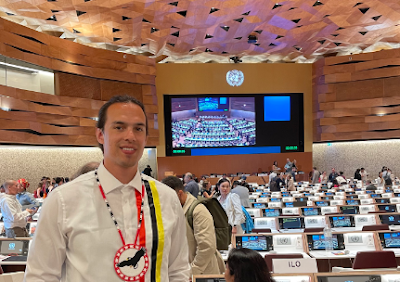
GENEVA -- Indigenous languages are on the verge of extinction in Russia. An ancient language in Japan is denied recognition by the government, while Native Americans struggle to recover from the torture in boarding schools that was meant to silence them. In Canada, efforts are underway to revitalize Anishinaabe after Native languages and culture were targeted with erasure in residential schools, presenters  told the United Nations Expert Mechanism on the Rights of Indigenous Peoples.

With Indigenous languages near extinction in Russia, an Indigenous youth from a reindeer herding community near the Arctic tundra, said newspapers are still  important here and are helping preserve the language, Nenets, among the endangered languages, in the vanishing north.

"Despite the decline in circulation of paper newspapers in the era of digitalization, our national newspaper retains an important role in the life of the people, clearly addressing their current agenda and giving ethnic journalists and language activists the opportunity to write in their native language," Nechei Serotetto, Indigenous youth from the Russian Arctic, told the United Nations Expert Mechanism.

"Moreover, the newspaper allows informing about twenty thousand Nenets of the Autonomous Okrug who are nomadic thousands of kilometers away and do not always have access to satellite internet coverage."

In Japan, speaking an ancient language was punishable by death.

Today, Japan refuses to recognize the language, the Lew Chewan/Okinawan languages, and its people. After Japan's annexation of the Lew Chew kingdom in 1879, the languages faced prohibition, Risako Sakai, ACSILs, told the United Nations.

"During WWII, the Japanese military ordered that speaking in Lew Chewan languages could result in execution, leading to the marginalization and near extinction of our native languages. In fact, the Japanese military executed Okinawans for speaking Indigenous languages, calling us “spy."

Josh Gandier. Photo Southern Chief's Organization, Censored News


"My own hope for this decade is to see the restoration, formation and protection of intergenerational connections between youths, language keepers and communities," said Southern Chiefs Organization's youth delegate Josh Gandier, Peguis First Nation.

February 6, 2024

Native Children Starved, Victims of Medical Experiments, in Boarding and Residential Schools


Fort Albany Sisters of Charity of Ottawa National Centre for Truth and Reconciliation

Native Children Starved, Victims of Medical Experiments, in Boarding and Residential Schools

By Brenda Norrell
Research by Dr. Michelle Cook, Dine'
Censored News, Feb. 6, 2024

Native children were starved during food experiments in residential schools in Canada, and left sick and untreated during medical experiments in boarding schools in the United States. Native women were sterilized without their consent by Indian Health Service. In IHS hospitals, the medical experiments range from controversial radioactive infusions to experimental vaccines.

January 22, 2024

Double Exposure: Genocide in Residential Schools, as Biden Genocide Case Begins in U.S. Federal Court

Blue Quills Indian Residential School


Double Exposure: Genocide in Residential Schools, as Biden Genocide Case Heads to US Federal Court

By Brenda Norrell, Censored News, Updated Jan. 21, 2024

The National Centre for Truth and Reconciliation in Canada released new records from residential schools, which were essentially prisoner-of-war camps where Native children were victims of genocide. At the same time, the Center for Constitutional Rights in the United States announced its case filed against President Biden for genocide in Palestine begins in federal court in northern California on Friday.

The National Centre for Truth and Reconciliation said the Oblates are transferring all outstanding records to the National Centre for Truth and Reconciliation. The first group of residential school records is now on its public website.

June 16, 2023

Peltier, Oak Flat and Enbridge Line 5: Priorities in UN Permanent Forum on Indigenous Issues Report


The U.N. Permanent Forum on Indigenous Issues urged UNESCO to step up the protection of world heritage sites to protect sites from the mining giant Rio Tinto, including Apaches Oak Flat. Rio Tinto blew up 46,000 years of Australian Aboriginals' history and sacred teachings when it blew up Juukan Gorge caves in Western Australia. (Panel of ancient rock art painting, Quinkan Cave near Laura, Cape York, Queensland, Australia)


By Brenda Norrell

Censored News

June 16, 2023


NEW YORK -- The release of imprisoned Leonard Peltier, the protection of Apaches sacred Oak Flat, and the halt of Enbridge's Line 5 were included in the final report of the United Nations Permanent Forum on Indigenous Issues. The murders of Indigenous in Nicaragua, the imprisonment of Australian Aboriginal children, cross-border crime in the Amazon, and the rights and safety of Indigenous journalists are in the report from the UNPFII's 22nd session held in New York, April 17 -- 28, 2023.


July 4, 2022

Exposing the Genocide: Torture Experiments, Trafficking and Mining


(Photo) The remains of Paiute children forced into a southern Utah boarding school in the early 1900s are believed to be buried in an unmarked cemetery in Panguitch, Utah.

Exposing the Genocide: Torture Experiments, Trafficking and Mining

For the Children Who Never Came Home

By Brenda Norrell
Censored News

Heart breaking, and gut wrenching, we are sharing the stories of the children who never came home.

The brainwashing, torture, trafficking, and drugging of children by the so-called elite -- politicians, Hollywood, and (disputed) royalty -- and CIA -- are being exposed in the Mohawk Mothers court case; Epstein articles; and the case of Tokata Iron Eyes, Lakota, daughter of Sara Jumping Eagle, pediatrician, and Chase Iron Eyes, attorney. 

Actor Ezra Miller remains in hiding with Tokata and police are unable to serve protective orders and warrants.

The Genocide

At the same time, many leaders of the movements now have COVID. On the northern border, Kanahus with the Tiny House Warriors was arrested at the border, charged and released.

The Mohawk Mothers continue their case in Ottawa Supreme Court, exposing the torture experiments of Canada and the U.S. CIA in the MK Ultra mind control experiments, the role of the band councils in genocide, and the search for the unmarked graves of the little ones, the children who never came home.

Mohawk Mothers told Aljazeera of the children who never came home from McGill University medical center, "I personally know of somebody who was taken there because he was 'unruly.'"

"They did a lobotomy on him and sent him back. And for 40 years, his family took care of him."

March 1, 2022

Location of 28 Mass Graves at Residential Schools in Canada: Published in 2008


Residential Schools in Canada

Mass Graves at former Indian Residential Schools and Hospitals across Canada

By Hidden from History 
Published at Atlantic Free Press
Contributed by Brenda Norrell
April 15, 2008
Updated on Censored News January 2023

Trigger warning for content. This list of 28 mass graves of Native children who died of starvation, disease, torture, and murder, at residential schools in Canada was published in 2008. 

The information was published by Hidden from History from historical data and survivor and eyewitness accounts. The children were stolen from their families by churches and government Indian agents. Parents who hid their children were to be imprisoned, by Canadian law.

Instead of being schools, these were militarized prison facilities where children were incarcerated and subjected routinely to beatings and abuse. -- Censored News.

Children to be asked in ceremony for permission to search for graves. Sept. 2021
https://www.cbc.ca/news/canada/sudbury/ceremony-residential-schools-ontario-1.6179800

Harriet Nahanee, an eyewitness to the murder of Maise Shaw on Dec. 24, 1946, at the Alberni School (1995.) Harriet, one of the first to speak out publicly, died of pneumonia and lung cancer after being jailed for activism to protect the environment in 2007.

A. British Columbia

1. Port Alberni:

Presbyterian-United Church school (1895-1973), now occupied by the
Nuu-Chah-Nulth Tribal Council (NTC) office, Kitskuksis Road . Gravesite is a series of sinkhole rows in hills 100 metres due west of the NTC building, in thick foliage, past an unused water pipeline. Children also interred at Tseshaht reserve cemetery, and in wooded gully east of Catholic cemetery on River Road.


Murder at the Alberni and Ahousat United Church Schools
Stanley Sam, an eyewitness to the beating death of Albert Gray in Nov. 1938 
at the Ahousat school (1996)

2. Alert Bay :

St. Michael’s Anglican school (1878-1975), situated on Cormorant Island offshore from Port McNeill. Presently the building is used by Namgis First Nation. The site is an overgrown field adjacent to the building, and also under the foundations of the present new building, constructed during the 1960s. Skeletons seen “between the walls”.

Murder at the Kuper Island Catholic School
Former Kuper Island student Bill Seward, whose sister Margaret
was "thrown from a third-story window by a nun" and died.

3. Kuper Island: Catholic school

(1890-1975), offshore from Chemainus. The land occupied by Penelakut Band. The former building is destroyed except for a staircase. Two grave sites:  one immediately south of the former building, in a field containing a conventional cemetery; another at the west shoreline in a lagoon near the main dock.

Update July 13, 2021: 160 graves found at Kuper Island:
https://www.theguardian.com/global-development/2021/jul/13/canada-unmarked-graves-british-columbia-residential-school

4. Nanaimo Indian Hospital:  Indian Affairs and United Church experimental facility (1942-1970) on Department of National Defense land. Buildings now destroyed. Gravesites are immediately east of former buildings on Fifth Avenue, adjacent to and south of Malaspina College.

Updates Nanaimo, Sept. 2021

https://www.cbc.ca/news/canada/british-columbia/fundraiser-vancouver-island-1.6176067

5. Mission: St. Mary’s Catholic school (1861-1984), adjacent to and north of Lougheed Highway and Fraser River Heritage Park. Original school buildings are destroyed, but many foundations are visible on the grounds of the Park.

In this area there are two gravesites: a) immediately adjacent to former girls’ dormitory and present cemetery for priests, and a larger mass grave in an artificial earthen mound, north of the cemetery among overgrown foliage and blackberry bushes, and b) east of the old school grounds, on the hilly slopes next to the field leading to the newer school building which is presently used by the Sto:lo First Nation. Hill site is 150 metres west of the building.

6. North Vancouver: Squamish (1898-1959) and Sechelt (1912-1975) Catholic schools, buildings destroyed. Graves of children who died in these schools interred in the Squamish Band Cemetery, North Vancouver.

7. Sardis: Coqualeetza Methodist-United Church school (1889-1940), then experimental hospital run by the federal government (1940-1969). Native burial site next to Sto:lo reserve and Little Mountain school, also possibly adjacent to the former school-hospital building.

8. Cranbrook: St. Eugene Catholic school (1898-1970), recently converted into a tourist “resort” with federal funding, resulting in the covering-over of a mass burial site by a golf course in front of the building. Numerous gravesites are around and under this golf course.

Update June 30, 2021: 128 Unmarked graves located at St. Eugene School. Survivor describes abuse endured by children.

9. Williams Lake: Catholic school (1890-1981), buildings destroyed but foundations intact, five miles south of city. Gravesites reported north of school grounds and under foundations of the tunnel-like structure.

Update January 2023: More graves found: Babies burned in incinerators after sexual abuse

10. Meares Island (Tofino): Kakawis-Christie Catholic school (1898-1974). Buildings incorporated into Kakawis Healing Centre. Body storage room reported in the basement, adjacent to burial grounds south of the school.

11. Kamloops : Catholic school (1890-1978). Buildings are intact. Mass grave south of the school, adjacent to and amidst orchard. Numerous burials witnessed there.

Update June 2021: 215 remains located in mass grave at Kamloops.
Survivor said Kamloops was a labor camp, with sexual abuse of students by school staff at night. Radio interview KPFA 2021.

12. Lytton: St. George’s Anglican school (1901-1979). Graves of students flogged to death, and others, reported under floorboards and next to the playground.

13. Fraser Lake: Lejac Catholic school

(1910-1976), buildings destroyed. Graves reported under old foundations and between the walls.

Sterilizations, abortions and medical experiments

United Church Sterilization Centre, Bella Bella BC
W.R. Large Memorial Hospital site of sterilizations and medical 
experiments between at least 1923 and 1969.


Alberta:

1. Edmonton: United Church school (1919-1960), present site of the Poundmaker Lodge in St. Albert . Graves of children reported south of former school site, under the thick hedge that runs north-south, adjacent to memorial marker.

2. Edmonton: Charles Camsell Hospital (1945-1967), building intact, an experimental hospital run by Indian Affairs and United Church. Mass graves of children from the hospital reported south of the building, near staff garden.

Update Edmonton Hospital, Aug. 7, 2021
https://edmontonjournal.com/news/local-news/search-for-unmarked-graves-at-former-edmonton-hospital-site-to-continue-this-month-after-first-survey-leaves-questions-unanswered

3. Saddle Lake: Blue Quills Catholic school (1898-1970), building intact, skeletons and skulls observed in the basement furnace. Mass grave reported adjacent to the school.

Update: Genocide at Blue Quills at Saddle Lake, Jan. 2023
Children murdered by pushing them down stairs and feeding them raw poisonous milk.

4. Hobbema: Ermineskin Catholic school (1916-1973), five intact skeletons observed in school furnace. Graves under former building foundations.

Update March 4, 2022
169 graves located at Grouard Mission site, Kapawe'no:


Manitoba:

1. Brandon: Methodist-United Church school (1895-1972). Building intact. Burials reported west of the school building. 2. Portage La Prairie: Presbyterian-United Church school (1895-1950). Children buried at nearby Hillside Cemetery.

3. Norway House:

Methodist-United Church school (1900-1974). “Very old” gravesite next to the former school building, demolished by United Church in 2004.


Ontario:

1. Thunder Bay: Lakehead Psychiatric Hospital, still in operation. Experimental centre. Women and children reported buried adjacent to hospital grounds.


.
St Anne’s Indian Residential School in Fort Albany. In the basement was an electric chair that was used to terrorize children. Many of the survivors are still trying to access their records in order to settle their case. ⁦
The Pope these records. (2022 update)

2. Sioux Lookout: Pelican Lake Catholic school (1911-1973). Burials of children in the mound near to the school. 3. Kenora: Cecilia Jeffrey school, Presbyterian-United Church (1900-1966). Large burial mound east of the former school. 4. Fort Albany: St. Anne’s Catholic school (1936-1964). Children killed in electric chair buried next to the school. 5. Spanish: Catholic school (1883-1965). Numerous graves.

6. Brantford: Mohawk Institute, Anglican church (1850-1969), building intact. Series of graves in the orchard behind the school building, under rows of trees.

7. Sault Ste. Marie: Shingwauk Anglican school (1873-1969), some intact buildings. Several graves of children reported on grounds of the old school.

Update: Document shows children buried at Shingwauk, their age and cause of death. 'The Shingwauk Files,' by Censored News, June 2021. https://bsnorrell.blogspot.com/2021/06/the-shingwauk-files-search-begins-for.html

Quebec:

1. Montreal: Allan Memorial Institute, McGill University, still in operation since opening in 1940. MKULTRA experimental centre. Mass grave of children killed there north of the building, on southern slopes of Mount Royal behind the stone wall.

Residential school survivors used in medical experiments filed lawsuits.

Hidden from History "Forced Abortions and Secret Burials - Port Alberni BC
-Catholic cemetery west of Port Alberni, across from the Alberni residential school, where children were buried in secret."
Hidden from History: "Forced Abortions and Secret Burials - Port Alberni BC
West Coast General Hospital, where forced abortions were performed on native students made pregnant by Alberni residential school staff, and where dead bodies from the school were stored under false death certificates."
http://canadiangenocide.nativeweb.org/

Saskatchewan

Update 2021: 
751 unmarked graves found at Cowessess First Nation residential school in Saskatchewan.


Update January 2023:
Star Blanket Cree Nation, Qu'Appelle Indian Residential School

An indigenous nation in Canada said it has discovered evidence of possible unmarked graves on the grounds of a former residential school.

Star Blanket Cree Nation said a ground-penetrating radar had revealed the jawbone fragment of a small child and more than 2,000 "areas of interest".

Areas for this most recent search were identified after testimonials from elders and former students of the former Qu'Appelle Indian Residential School.


Sources of list published in 2008 :


- Eyewitness accounts from survivors of these institutions, cataloged in Hidden from History: The Canadian Holocaust (2nd ed., 2005) by Kevin Annett. Other accounts are from local residents. See www.hiddenfromhistory.org

Documents and other material from the Department of Indian Affairs RG

10 microfilm series on Indian Residential Schools in Koerner Library, University of B.C.

- Survey data and physical evidence obtained from gravesites in Port Alberni, Mission, and other locations.

This is a partial list and does not include all of the gravesites connected to Indian residential schools and hospitals across Canada. In many cases, children who were dying of diseases were sent home to die by school and church officials, and the remains of other children who died at the school were incinerated in the residential school furnaces.

This information is submitted by The Friends and Relatives of the Disappeared (FRD) to the world media, the United Nations, and to the International Human Rights Tribunal into Genocide in Canada (IHRTGC). The IHRTGC will commence its investigations on

April 15, 2008, on Squamish Nation territory.

For more information on the independent inquiry into genocide in Canada being conducted by the IHRTGC, write to: genocidetribunal@yahoo.ca

10 April 2008
Squamish Nation Territory (“Vancouver, Canada”)

http://atlanticfreepress.com Powered by Joomla! Generated: 15 April, 2008, 15:34

June 28, 2021

The Shingwauk Files: Search Begins for Documents of Residential School Death Camps


The Shingwauk residential school dining hall circa 1890. (Children of Shingwauk Alumni Association/The Shingwauk Project)


The Shingwauk Files: Search Begins for Documents of Residential School 
Death Camps 

Across Canada, Native children were stolen from their families by the churches and government Indian Agents. Parents who hid their children were sentenced to jail. Native children died of starvation, disease, abuse, torture, medical experiments, and murder by church staff in these residential schools. Now, there is documentation of unmarked graves and mass graves that document the genocide. There are new demands for trials of those responsible like the Nuremberg trials.

Brenda Norrell
Censored News

Residential school survivors and their families in Canada are now identifying those responsible for the abuse, torture and murder of Native children in residential schools, in order to hold them responsible for genocide.

Mohawk Nation News said, "Each unmarked grave is a separate crime scene and criminal investigation. We know who did the crime. We want to know the specifics of the individuals involved, just like the Nuremberg trials."

Among the files now being examined are those of Shingwauk Residential School, an Anglican Church-run school in Sault Ste. Marie, in Ontario near the border of Canada and the United States. There are 110 children and staff buried in the cemetery. The students who died here, whose names are known, are shown below in memory.

March 7, 2014

Rage in the Desert: Tantoo Cardinal on Finding Voice

Tantoo Cardinal courtesy photo

Live from the Agua Caliente Native American Film Fest

First Nations Voices in the Cahuilla Desert Tonight

For the 50,000 children who never came home

By Brenda Norrell
Censored News Exclusive
March 6, 2014

Tantoo Cardinal in Palm Springs
Photo Brenda Norrell
PALM SPRINGS, Calif. -- "Rage" is not a word that most filmmakers and film festivals are comfortable with. Tantoo Cardinal was not afraid to use the word "rage" tonight. The Agua Caliente Native American Film Festival was not afraid to present a feature film tonight that centered on rage.

Rage is what Tantoo Cardinal felt as a young person in high school. Everywhere she looked, she saw Native people being abused and exploited. That rage fueled her drive, fueled her to find an outlet for that rage. In that quest, she found her voice in acting.

Rage is the message that flows through Moose River Crossing, the feature film tonight at the Agua Caliente Native American Film Festival. It is the rage of young girls and boys in Indian residential schools being raped by principals and priests. It is the rage against the tiny crosses that mark the graves of the 50,000 Indian children in Canada who never came home from residential boarding schools. It is the rage against the flashbacks of the abuse that take hold of peoples lives and come back like rivers, like floods. It is the rage of scars from leather straps on the back, the rage of looking and seeing those now drowning in addictions, alcohol addiction and sex addiction.

When the drama of First Nations voices and films came to the Cahuilla Desert tonight, there were no fairy tale endings in the cinema tonight.

In Moose River Crossing, by Cree filmmaker Shirley Cheechoo, there is a clarifying voice at the conclusion: The victims of residential school abuse must come together, tell their stories, and share their stories.

There is also this pointed conclusion: Speak the truth, speak one's own truth from Spirit, and this is where the power comes.

Tonight, the voices of the far north came to one of the hottest places in North America, the southern California desert.

Tonight's short films at the Agua Caliente Native American Film Festival featured some of the first films for First Nations that turned the industry around, Tantoo Cardinal told a large crowd tonight that appreciated both the humor and sorrow woven into those early films.

Three short films featured festival honoree Tantoo Cardinal, Indigenous actress from northern Alberta, Canada, who spoke of her early days, of both searching and acting. All three films are compelling, weaving complicated issues, and revealing the wide range of Tantoo Cardinal's acting and her own strength.

Blood River
When Tantoo Cardinal was asked what called out to her from those early films, she said it was the filmmakers themselves. Tantoo said Shelley Niro is an amazing artist, and Kent Monkman, Cree, has an incredible sense of humor. Shelley Niro directed Honey Moccasin and Kent Monkman directed Blood River.

In Blood River, Tantoo portrays a white adoptive mother, sporting a blonde wig.

"I think it is hilarious that I'm playing a white woman. It was a laugh," said Tantoo, pointing out that this was a turning of the tables on the whites who were always playing Indians in films.

Blood River, with its humor, also conveys the struggle of an adopted Native child searching for her mother, and the trauma for Indian children growing up in foster homes.

Memory directed by Cedar Sherbet, Kumeyaay, shown tonight, reveals an elderly alcoholic aunt, portrayed by Tantoo, returning for the memorial of a child who has drowned.

The issues of survival -- and the complex issues of family, forgiveness and rebuilding lives -- in the films are set against one underlying reality that Tantoo Cardinal described tonight.

Tantoo said that through their ancestry, Native people knew the truth. "We have known it was about the land."

Whether it is in the United States or Canada, the situation is the same. "It is the same animal," Cardinal said.

"Every government has tried to get rid of treaties, remove us, thin us out."

Now, people are coming together in the fight to protect the water, she said.

"Water is fundamental. If we don't have water, we don't have life," said Tantoo describing the threat of fracking to the water.

As for the rage that fueled her, she said being raised by elderly led her to avoid violence of any kind in the protest movements of the '70s.

As for the exploitation and abuse of Native people all around her, she said she barely made it out of high school, she felt so much rage and was so passionate.

"I heard a voice that each of us has been given a gift." It was then that she began her search, persevering in her quest to discover her own gift. In 1977, she turned down the first role offered because of the dialogue. When they agreed to change it, it was no better. Eventually, they removed all the dialogue.

"I was so happy," she said.

In the films that followed through the years, she portrayed a wide range of characters, including the owner of the Inukshuk Cafe in the off-beat and unpredictable Honey Moccasin, directed by Shelley Niro, and shown tonight.

"The reason I got into acting was to develop a voice."

The voice is not just her own, but an ever-evolving voice for Native people. It is this voice that sounded through the Cahuilla Desert tonight.

The Festival

The Agua Caliente Native American Film Festival is presenting important new Native feature films this week, including Star Wars Episode IV A New Hope, Dine' language with English subtitles, and Maina starring Tantoo Cardinal joined by an incredible cast of Native artists. A lecture by Chiricahua Apache Nancy Marie Mithlo, PhD, opened the festival on Tuesday night. Mithlo's talk was "Can You Hear Me? Silence as an Indigenous Representational Strategy in Film."

Richard M. Milanovich, the late chairman of the Agua Caliente Band of Cahuilla Indians, was a lover of film and each year attended the Native Film Fest. The Richard M. Milanovich Award for Distinguished Contributions to Indigenous Film establishes in his honor those who have distinguished themselves in Indigenous film.

The 2014 Award will be presented to Tantoo Cardinal on Saturday evening, March 8, during the 8 pm screening.

Indigenous films continue on Friday, Saturday and Sunday at Camelot Theaters, beginning at 5 pm each day.

Film schedulehttp://www.accmuseum.org/2014-Native-FilmFest

Article copyright Brenda Norrell. Please share the link. 
To publish in full contact: brendanorrell@gmail.com
http://bsnorrell.blogspot.com/2014/03/rage-in-desert-tantoo-cardinal-on.html