At the United Nations, Indigenous Human Rights Defenders Testify on Persecution and Treaties
GENEVA -- At the U.N. Expert Mechanism on the Rights of Indigenous Peoples, Indigenous youth and women are in the forefront, while Indigenous from around the world describe their struggle to be recognized by the governments in their homelands, and be heard and respected. Indigenous in Canada reported success today in treaty negotiations.

Australia Aborignals and Torres Strait Islanders: Women and Youth Testify
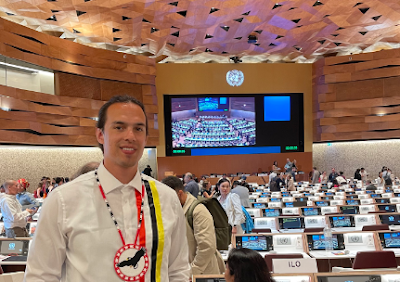
Aboriginal youths from Australia and Torres Islanders were among the strong youth voices at the United Nations today. The delegation shown here said biomedical research is being weaponized against their people; and is being carried out against them without free, prior and informed consent.
"Biomedical data must be wholly managed, stored, and owned by its respective communities. Indigenous people will always be the first scientists and health practitioners. The next 20 years must be defined by indigenous authority over our research, our data, and our health future," the youth delegate said.
This week, Indigenous youths testified that they must be recognized and involved in decision making at the United Nations.
"Biomedical data must be wholly managed, stored, and owned by its respective communities. Indigenous people will always be the first scientists and health practitioners. The next 20 years must be defined by indigenous authority over our research, our data, and our health future," the youth delegate said.
This week, Indigenous youths testified that they must be recognized and involved in decision making at the United Nations.

Exiled Russian delegate testifying.
Russia and Ecuador at the UN -- They're not giving up. Again today, exiled Indigenous from Russia and the Far North called for the release of two women imprisoned in Russia, U.N. participants and climate justice advocates, Daria Egereva and Natalia Leongardt, who have been behind bars for six months. The Russian Federation has repeatedly taken the floor attempting to discredit the delegation of exiled human rights defenders. Russia is demanding that they be silenced and removed from the sessions.
Ecuador: Delegates parents targeted
In a another wave of oppression for those speaking out at the U.N. Pacha Teran of Ecuador said yesterday that her parents home was attacked after she testified at the U.N. Expert Mechanism on the Rights of Indigenous Peoples in Geneva, which is broadcast globally by the U.N.
Teran is in the delegation testifying on the militarization and violence by the government of Ecuador security forces.
 |
| Colombia's women bear the greatest burden. Screenshot Censored News. |
COLOMBIA: Indigenous Women Carry the Greatest Burden
"How many rights can a people lose before the world recognizes it?" Colombia's Indigenous delegate from the Ethnic Commission for Peace in Defense of Territorial Rights asked the U.N.
"This is the question we bring today on behalf of indigenous people and particularly women in Colombia. Colombia has borne the brunt of decades of fights and ethnic communities are currently trapped between armed leaders murdered with impunity."
"Boys and girls suffer forced recruitment in a persistent fashion. The women bear the brunt of this. They are the most displaced and have the greatest violation of their collective rights."
The dismantling of the peace agreement has resulted in a loss of hope.
The peace agreements included an indigenous historic chapter. Eight years later, only 13 percent of those commitments have been fully complied with.
"Prior consultation, which is a mandate in the constitution, continues to be ineffective. And in less than a month, a government which has dismantled the peace agreements has taken over. And as a result, there is a loss of hope."
"The communities are the guardians of the environmental rights protecting all of our territories where the state is absent. Food sovereignty of thousands of families depends on this. And in the territories which are most hit by the conflict, it is the communities and community leaders, in their majority women, who ensure the guardianship of this for the next generation to avoid the war that has been our scourge."
While Colombia prepares for a new president, Indigenous Peoples said the situation is urgent.
"Experts, we would like to ask for an urgent recommendation to protect indigenous communities and their women leaders before the 7th of August when the government is to change in Colombia."

Red River Metis Ambassador Clement Chartier
Red River Metis of Manitoba, Canada, described the negotiations with Canada that resulted in a decade of reconciliation, which led to over $3 billion in funds for Red River Metis. Red River Metis Ambassador Clement Chartier said Canada embraced the U.N. Declaration on the Rights of Indigenous Peoples, during Trudeau's administration, and began implementing it. Red River Metis now have a Treaty for final ratification in process in Canada.

Red River Metis Ambassador Clement Chartier
Red River Metis of Manitoba, Canada, described the negotiations with Canada that resulted in a decade of reconciliation, which led to over $3 billion in funds for Red River Metis. Red River Metis Ambassador Clement Chartier said Canada embraced the U.N. Declaration on the Rights of Indigenous Peoples, during Trudeau's administration, and began implementing it. Red River Metis now have a Treaty for final ratification in process in Canada.
During the U.N. Expert Mechanism on the Rights of Indigenous Peoples today in Geneva, Indigenous described their struggles to be recognized and heard in their home countries.
The B.C. Treaty Commission in Canada reported success as it moves forward with modern day treaty negotiations for self-governance for Native Nations in B.C.


Racism in Argentina and the southernmost region of South America
Racism has not disappeared for Indigenous Peoples here, and it is now twenty years after the U.N. Declaration on the Rights of Indigenous Peoples. She said whether they are in their countries or in neighboring countries, there is racism.
"In our cities, we continue to be identified primarily by the color of our skin, our traits, or our national origin rather than the rights that the Declaration recognizes, we hold."
"Such social profiling, which is facilitated increasingly by biometric technologies and facial recognition, is limiting access to rights and leading many people to hide their Indigenous identity, not because they're ashamed, but because they need to survive."
"Therefore, we would like to suggest that in monitoring opinion number 18 of 2025 on the rights of Indigenous peoples to data, we include the status of mobility or on the move and racial profiling and algorithmic profiling incidents as categories, ventilated ones, not— and an intersecting approach."
"States also need to take measures to prevent racial profiling, including Argentina. The rights of Indigenous peoples need to support us where we live, work, and move, and they should also ensure that migration does not mean that we are invisible, and being Indigenous should be a source of pride."

AFRICA: An Indigenous Ogani delegate described how the lack of recognition for Indigenous in Ethiopia and Nigeria has resulted in destruction mining and oil extraction, during the discussion on the U.N. Declaration on the Rights of Indigenous Peoples, UN DRIP.
"As we prepare to celebrate the 20th anniversary of the adoption of the UN DRIP,
it is saddening to report that many countries in Africa, particularly Ethiopia and Nigeria have not implemented UN DRIP and are yet to recognize indigenous people in their countries."
"Denying indigenous people amounts to denying their collective rights. Recognition of indigenous people are not given privilege, but an existential issue.
"The UN Special Rapporteur on the rights of indigenous people have identified lack of
recognition as one major issue that contributes to indigenous people's exclusion in Africa."
The lack of recognition results in large scale mining operations in the Oromiyo territory in Ethiopia, and oil extracting on Ogoni, Nigeria, where extraction has been taking place without the people's free, prior and informed consent.
"Furthermore, these attractive activities have been destroying the forest and contaminating waters of Indigenous communities in Ethiopia and Nigeria."
"We call on the Expert Mechanism to reinforce its effort for the endorsement of UN and recognition of indigenous people in Africa. Ethiopia and Nigeria should
recognize and ensure the full participation of Indigenous people in decision making process affecting their land and resources."
Indonesia
Indigenous from Indonesia point out that the reality in their homelands, and what the government of Indonesia says in the United Nations sessions are not the same. Indigenous point out that the mining that the Indonesian government claims it has stopped is actually proceeding, and a pipeline is doing further damage.

AFRICA: An Indigenous Ogani delegate described how the lack of recognition for Indigenous in Ethiopia and Nigeria has resulted in destruction mining and oil extraction, during the discussion on the U.N. Declaration on the Rights of Indigenous Peoples, UN DRIP.
"As we prepare to celebrate the 20th anniversary of the adoption of the UN DRIP,
it is saddening to report that many countries in Africa, particularly Ethiopia and Nigeria have not implemented UN DRIP and are yet to recognize indigenous people in their countries."
"Denying indigenous people amounts to denying their collective rights. Recognition of indigenous people are not given privilege, but an existential issue.
"The UN Special Rapporteur on the rights of indigenous people have identified lack of
recognition as one major issue that contributes to indigenous people's exclusion in Africa."
The lack of recognition results in large scale mining operations in the Oromiyo territory in Ethiopia, and oil extracting on Ogoni, Nigeria, where extraction has been taking place without the people's free, prior and informed consent.
"Furthermore, these attractive activities have been destroying the forest and contaminating waters of Indigenous communities in Ethiopia and Nigeria."
"We call on the Expert Mechanism to reinforce its effort for the endorsement of UN and recognition of indigenous people in Africa. Ethiopia and Nigeria should
recognize and ensure the full participation of Indigenous people in decision making process affecting their land and resources."
Censored News Original Series: UN Expert Mechanism
'Keeping It Alive' the Beauty of Ancient Languages, Path to Memory and Identity
Indigenous at UN Expose AI Data Centers and Racially Biased Misinformation
At the UN, Indigenous Testify on Persecution and Treaties
UN Expert Mechanism on the Rights of Indigenous Peoples Begins in Geneva
Copyright Brenda Norrell, Censored News 2026



.jpeg)