Indigenous Peoples and Human Rights

November 9, 2021

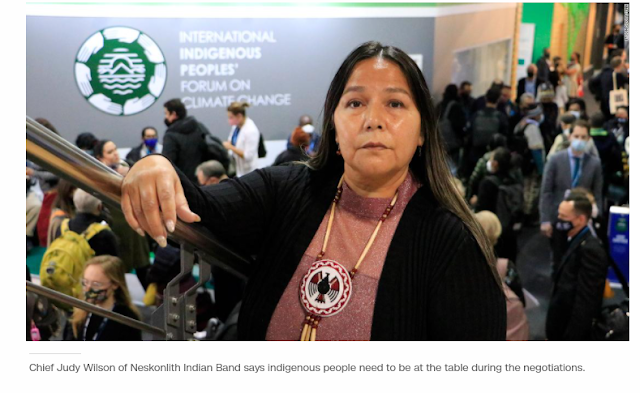
Indigenous at COP26: 'We're not just somebody to look at'

CNN: Chief Judy Wilson of Neskonlith Indian Band said at COP26: said at COP26: "We're not just somebody to look at and say, 'Oh, you know, there's a presence of Indigenous people.' If you're not hearing our voices, and we're not at the table -- and we're not -- if you're not listening to us, then that's just for show," she said. "ou're talking about our land, you're talking about our water, you're talking about our trees for carbon offsetting ... you should be talking to the indigenous people, because that's whose land it is."

Wilson said she found the way the world leaders' summit was conducted particularly upsetting -- and a good reflection of how climate decisions are made.

"You walk in the room, that's no place for you. When the G20 speeches were going on ... all the wealthier countries, they did their speeches, they said what they're going to do, and then oh, what they might do to help the underdeveloped countries, then they left," she said.

"They didn't stay to hear the whole discussion with Barbados, with Bolivia, all the other countries that [have] solid climate action plans, what they're going to do for their country and what they needed help with," she said. "They weren't in the room to hear it. So to me, that's disrespectful because, you know, if you're going to give your presentation, and you're there to hear others, you should be sitting there listening yourself."
Read article at CNN:


Indigenous activists say the legacy of colonialism has limited their access to COP-26
NPR
Ruth Miller, Alaska: "But, of course, you can't relocate your grandparents' graves. You can't relocate your ancient sacred sites. You can't adapt to the places that are lost due to climate change. This past year, when I was forced to watch our sitka, our salmon dying in our streams of heatstroke, it was heartbreaking."

November 8, 2021

Peoples Summit for Climate Justice COP 26


http://priceofoil.org/2021/11/02/cop26-civil-society-tells-biden-to-leave-fossil-fuels-in-the-ground/

COP26 CoalitionINSIDE OUTSIDE ep7: After the extraordinary protests on Saturday,
a closer look at the People's Summit for Climate Justice, which runs through until Thursday. 

Democracy Now! 'Activists at COP26 Honor 1,000+ Environmental Defenders Killed Since Paris Accord'


"Colombia is the most dangerous country to be a land defender -- and no one cares."
https://www.democracynow.org/2021/11/8/memorial_for_murdered_earth_defenders


Part 1: Activists at COP26 Honor 1,000+ Environmental Defenders Killed Since Paris Accord — 1 in 3 Indigenous
Part 2: The Greenwashing of COP26: Fossil Fuel Lobbyists Make Up Biggest Delegation at U.N. Climate Summit

Activists held a memorial in Glasgow for those unable to attend this year’s U.N. climate summit: 1,005 land and environmental defenders who have been murdered since the 2015 Paris Agreement. One in three of those defenders killed was an Indigenous person. This comes as 2020 was the most dangerous year on record for environmental and land defenders. We speak with Andrea Ixchíu, a Maya K’iche’ leader, journalist and human rights defender based in Guatemala.
Ixchíu says that the Guatemalan government, influenced by transnational corporate interests, has launched an assault on Indigenous land defenders: “They [Indigenous leaders] are not allowed to be in their communities defending their land and their territory because of the militizariation.” Speaking on COP26, Ixchíu says, “We do not just want to be observers,” and “If you want to create more solutions to the climate crisis, it’s really important to give land back to Indigenous communities.” 
We’re also joined by Global Witness senior adviser Louis Wilson, who helped organize the memorial and discusses the cases of murdered South African activist Fikile Ntshangase, who was a leading force in the fight against the Tendele coal mine before she was killed last October, and Óscar Eyraud Adams, a Mexican water activist killed last September as he fought for the water rights of the Indigenous peoples impacted by the excessive use of aquifers by large beer and wine companies.

Precious Waters: Tribes, Indigenous Peoples, file petition to strengthen federal mining rules


Precious waters


Tribes, Indigenous groups, conservation organizations file petition to strengthen federal mining rules

By Earthworks
Beyond Nuclear International
Censored News


Tribes, Indigenous groups and conservation organizations filed a rulemaking petition on September 16 with the U.S. Department of the Interior to improve and modernize hardrock mining oversight on public lands. The proposed revisions aim to safeguard critically important lands across the West and Alaska, including sacred lands and their cultural resources, vital wildlife habitat, and invaluable water resources.

“It’s long past time to reform the nation’s hardrock mining rules, end generations of mining-inflicted injustice to Indigenous communities, and chart a new course for public lands stewardship toward a sustainable, clean energy economy,” the petition states. “For far too long, mining companies have had free rein to decimate lands of cultural importance to tribes and public lands at enormous cost to people, wildlife, and these beautiful wild places of historic and cultural significance. The harm is undeniable, severe, and irreparable. Reforming these rules will prevent more damage, help us transition to green infrastructure, and leave a livable planet to future generations.”