Watch on YouTube at
November 21, 2020
OAK FLAT: Wendsler Nosie's call to action, Nov. 2020
Watch on YouTube at
Rosebud Lakota and Fort Belknap file federal lawsuit over KXL pipeline permit, Nov. 18, 2020
ROSEBUD SIOUX AND FORT BELKNAP CONTINUE KXL FIGHT TO PROTECT LAND AND PEOPLE
By Native American Rights FundNovember 18, 2020
Categories: Environmental Protection (Climate Change), Native Lands, Religious Rights (Religious Freedom, Sacred Places, Repatriation), Tribal Sovereignty and Jurisdiction
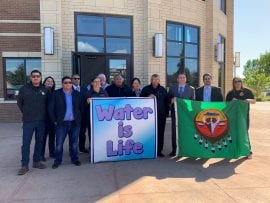
At US District Court, Great Falls MT, September 2019.
On November 17, 2020, the Rosebud Sioux Tribe and the Fort Belknap Indian Community filed a federal lawsuit against the United States Department of Interior (DOI) and the Bureau of Land Management (BLM) over their issuing of the KXL permit. Among other things, the complaint describes:
- Although, the pipeline’s proposed path crosses the plaintiff tribes’ homelands, the tribes have not been consulted as required by law and DOI policy.
- In granting the right-of-way, the BLM failed to analyze and uphold the United States’ treaty obligations to protect the Tribes lands and natural resources. The government failed to even evaluate an alternate route to avoids tribal treaty lands.
- The government’s analysis does not meaningfully address how an influx of out-of-state construction workers will affect the health, welfare, and safety of tribal members, and in particular Native women and children.
- The agencies have not considered the effects of the COVID-19 pandemic on either health and safety or the global oil markets.
- The 2019 supplemental environmental impact statement has numerous issues and shortcomings. Even its maps do not give enough detail to show impacts on Indian lands.
- In their permit application, TransCanada agreed to abide by tribal laws and regulation, which they have failed to do.
NARF Staff Attorney Matthew Campbell explained, “Before we allow a foreign company to build another pipeline to haul dirty tar sands across any American soil, we should be taking a hard look at the possible impact on American land, water, health, and safety. For tribal lands, the treaties absolutely require this sort of review. In issuing the Keystone XL permit with shoddy and superficial analysis, the federal government not only didn’t do its job, it did not follow the law.”
#HonorTheTreaties
Learn more about the Tribes fight to protect their homeland and people.
November 20, 2020
Un-Dam the Klamath: Dam Removal Update and Celebration Nov. 20, 2020
If anyone would like to talk please let us know. The Yurok and Karuk Tribes plan to present along with the Klamath River Renewal Corporation, the dam removal entity. Then we are hoping to hear from additional Tribes and organizations and the Klamath and Trinity River water protectors, including the elders and fishing families, that have engaged in nearly two-decade of advocacy and actions to make this happen.
By Dan Bacher
SACRAMENTO – On November 17, leaders from the Yurok and Karuk Tribes, the Governors of California and Oregon, and executives from Berkshire Hathaway and PacifiCorp unveiled a new agreement to remove four Klamath River dams, including two located in California and two in Oregon.
In their new agreement, the states of California and Oregon will partner with the Klamath River Renewal Corporation (KRRC) to assume liability for the dam removal project, transferring the license to operate the dams from PacifiCorp.


