Indigenous Peoples and Human Rights

April 20, 2015

Ecological Destruction Doesn’t Equal Diné Sovereignty
Ecological Destruction Doesn’t Equal Diné Sovereignty

coal-does-not-equal-sovereignty

By Klee Benally
French translation by Christine Prat

In 2009 Joe Shirley Jr., then president of the Navajo Nation issued a press release stating, “Unlike ever before, environmental activists and organizations are among the greatest threat to tribal sovereignty, tribal self-determination, and our quest for independence.” In order to protect coal mining and energy interests on the Navajo Nation, he stated that environmental activists were “unwelcome” on the reservation.
Shirley’s position seemed contrary to his previous work to protect Dooko’osliid, one of four sacred mountains for Diné, and ban uranium mining, all of which was accomplished because of and alongside environmentalists. But the issue was really over the Navajo Nation’s historical dependence on coal.
At the time, the Mojave Generating Station, a power plant in Nevada that was burning coal and pumping water from strip mines on Black Mesa, had been shut down for a few years and the fight over Desert Rock Energy, a massive coal fired power plant proposed in the Four Corners area, was raging on. Desert Rock was subsequently shut down thanks to community resistance brought on by Doodá Desert Rock. Shirley’s proclamation was a clear demonstration and commitment that the Navajo Nation political body is accountable to coal mining and energy interests rather than the Diné.
Navajo Nation Council Speaker Lorenzo Bates recently affirmed that commitment and upped the rhetorical and political ante with his written testimony presented before the U.S. Senate Committee on Indian Affairs that the “war on coal is a war on the Navajo economy and our ability to act as a sovereign Nation.”
Bates stated that the coal industry is responsible for “60% of [Navajo Nation’s] General Revenues.” and that “These revenues represent our ability to act as a sovereign nation and meet our own needs.”
Days before his statement, the Navajo Transitional Energy Company (NTEC) lost a district court battle with environmental groups over attempted expansion of the Navajo Mine, which was recently purchased from BHP and feeds coal to the notoriously toxic Four Corners Power Plant. In 2012 the U.S. Office of Surface Mining (OSM) approved expansion of the mine but environmental groups including Diné Care filed suit, forcing a new environmental review that properly evaluates mercury risks to public health and the environment. The Navajo Nation is appealing the decision.
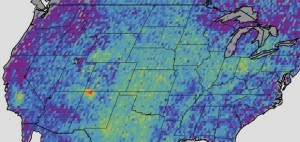
US methane emissions were documented from 2003-2009. The red spot above the Four Corners indicates the highest concentration. Image Credit:  NASA/JPL-Caltech/University of Michigan
US methane emissions were documented from 2003-2009. The red spot above the Four Corners indicates the highest concentration. Image Credit:
NASA/JPL-Caltech/University of Michigan
While Navajo Nation politicians lobby and litigate for the coal industry, a 2,500-square-mile cloud of methane hovering over the Navajo Nation in the Four Corners area, is being investigated by NASA researchers who have stated, “the source is likely from established gas, coal, and coalbed methane mining and processing.” Methane is the second most prevalent greenhouse gas emitted in the United States and can be up to 84 times more potent than carbon dioxide.
There are currently more than 20,000 natural gas wells and thousands more proposed in and near the Navajo Nation in the San Juan Basin, a geological structure spanning approximately 7,500 square miles in the Four Corners. The US EPA identifies the San Juan Basin as “the most productive coalbed methane basin in North America.” In 2007 alone, corporations extracted 1.32 trillion cubic feet of natural gas from the area, making it the largest source in the United States. Halliburton, who“pioneered” hydraulic fracturing in 1947, has initiated “refracturing” of wells in the area. Fracking wastes and pollutes an extreme amount of water. A single coalbed methane well can use up to 350,000 gallons, while a single horizontal shale well can use up to 10 million gallons of water.
The San Juan Basin is also viewed as “the most prolific producer of uranium in the United States.”
Uranium is a radioactive heavy metal used as fuel in nuclear reactors and weapons production. It is estimated that 25% of all the recoverable uranium remaining in the country is on the Navajo Nation. Although uranium mining is banned on the reservation, Navajo politicians have recently sought to allow new mining in areas already contaminated by the industry’s toxic legacy. In 2013 Navajo Nation Council Delegate Leonard Tsosie proposed a resolution to undermine the ban, his efforts were shut down by Diné No Nukes, a grassroots organization “dedicated to create a Navajo Nation that is free from the dangers of radioactive contamination and nuclear proliferation.” There are more than 2,000 estimated toxic abandoned uranium mines on and around the Navajo Nation. 22 wells that provide water for more than 50,000 Diné have been closed by the Environmental Protection Agency due to high levels of radioactive contamination. The recent push for nuclear power as “clean energy” has made the region more vulnerable to new uranium mining, including an in situ leach mine (which uses a process similar to fracking) right next to Mt. Taylor, another mountain of the four Diné holy mountains.
Politicians on the Navajo Nation want us to believe that dependence on extremely polluting power plants and strip mines that have caused forced relocation of more than 20,000 Diné from Black Mesa and severe environmental degradation, is “sovereignty”. The Navajo Nation affirms its role as a domestic dependent nation that serves U.S. and corporate interests at the costs of our health and destruction of Mother Earth. This isn’t sovereignty, it’s a resource colony with a political entity established to sustain resource exploitation. According to Navajo Nation Oil and Gas Company’s (NNOGC) website, “In 1923, a Navajo tribal government was established primarily for the Bureau of Indian Affairs to approve lease agreements with American oil companies, who [sic] were eager to begin oil operations on Navajo lands.” You can’t get any more explicit than that.
In representing the Navajo Nation, Bates added a halfhearted greenwashing attempt in his testimony by stating that NTEC “ … is mandated to transition our Nation into our energy future by investing no less than 10% of its profits into alternative and renewable energy development.” Even if green economics (or more clearly green capitalism) was a viable step out of this unsustainable madness, why is the Navajo Nation’s role still assumed to be one that exploits the environment to feed corporate profits and maintain unsustainable ways of life?
A green economy does not end colonial relations with resource extractive industries, it advances them. The ongoing battle to protect the sacred grounds of Oak Flat from Resolution Copper is a nearby example. The sacred site, located in Arizona on “public” lands stolen from San Carlos Apache Nation, has been privatized by Arizona politicians for copper mining even though the area had been federally protected from resource extraction since 1955. The front page of Resolution Copper’s website states, “Copper from the proposed mine will help wire a rapidly growing world and drive the new green economy, powering everything from wind turbines to electric cars.” Apache folks joined with other Indigenous Peoples are still occupying Oak Flat.
The commodification of nature will continue to position us in an unending war against Mother Earth. Sacred places, such as the San Francisco Peaks, Mt. Taylor, Grand Canyon Confluence, Mt. Graham, Oak Flat, Mt. Tenabo, Yucca Mountain, Medicine Lake, Mauna Kea, Hickory Grounds, Black Mesa,  South Mountain, Red Butte, Bear Butte, Black Hills, and many more are the front lines in the struggle for Indigenous Peoples cultural survival and vitality and are heavily targeted by these exploitative industries.
The wholesale destruction of Mother Earth and her beings for energy consumption and profit is anti-Indigenous and, therefore, anti-Indigenous sovereignty.
Bates sounds more like a coal industry lobbyist than a proponent of sovereignty when stating that our “future is dependent” on coal. In the face of global climate catastrophe, if we keep mining and burning coal, if we choose to live lives wedded to the destruction of the air we breathe, water we drink, and land we grow food from–we will have no future.
Here is a link to a my commentary and Shirley’s press statement from 2009: www.indigenousaction.org/democracy-unwelcome-on-navajo-and-hopi-nations/
Klee Benally, Indigenous Action Media

Censored News Mailbox: News and Events April 20, 2015

Photo above by Supai Waters, Havasupai: Tribal event to halt drug abuse and child abuse April 2015

Gwich'in Sarah James on air with AIM West Tony Gonzales
Photo above: "In the studio at KPFA in Berkeley on radio show Across Indian Land with special guest in the studio is Ms. Sarah James, from Arctic Village, 100 miles north of Arctic Circle, in Alaska. Sarah spoke about need for permanent protection to the ANWR in northern Alaska, and recognize the peoples of that region, too!" -- Tony Gonzales, AIM West.

.

Upcoming Events

Albuquerque April 25, 2015 Lakotas 'Crying Earth Rise Up' Film


NAU, Flagstaff, Ariz. April 21, 2015


Dr. Julian Kunnie's book just released 'The Cost of Globalization'
.
Relatives and Friends:

Greetings of Peace, Wholeness, and Justice.

I received copies of The Cost of Globalization: Dangers to the Earth and Its People from McFarland a few days ago. The book is now available from the publisher. See attached flyer. Please circulate widely. I will do my best to circulate copies gratis wherever needed, including to struggling community and college libraries. Kindly send me addresses in such instances. Thank you. In Honor of and in Dedication to Mother Earth, our Original Mother,
Julian

Environmental Advocates in El Paso
to Speak-Out Against  Fracking, April 21, 2015


El Paso, TX, April 20, 2015- Local environmental advocates, El Paso Naturally, The West Texas Water Protection Fund & El Paso Equal Voice Network are calling attention to House Bill 40 & 539, which passed in the house on Friday, and Senate Bill 1165, which will ban fracking bans and fine municipalities that attempt to limit fracking within their city limits. 

Hydraulic Fracking is a technique, which involves injecting a cocktail of chemicals deep underground to break up the rocks around oil and gas deposits, has raised health and safety concerns because of contamination surrounding water supplies and wildlife risks.

The public is invited to participate in Earth Day Actions next week at:
       Monday, April 20th @ 9:30am, El Paso County Commissioners@ Court House
500 East San Antonio Room 303 on Sign-Up & Speak-Up @ Public Comment.
       Tuesday, April 21st @ 8:00am, El Paso City Council, 300 North Campbell; Sign-Up & Speak-Up @ Public Comment. Sign up here: http://legacy.elpasotexas.gov/muni_clerk/signup_form.asp
       Wednesday, April 22nd @ 12:30pm , ‘GASLAND’ film screening & discussion in UTEP Liberal Arts Building, Room 108; free & open to the public; UTEP, 500 W. University Ave.
TorchLight Energy Co. has recently began drilling test wells on land which the UT System has leased to the company just a few miles outside El Paso for the sole purpose of fracking. More than 2,000 people have signed a petition circulating on change.org addressing The University of Texas System demanding they Stop Fracking Next to El Paso. It states, “Fracking endangers the health, safety and welfare of people, pollutes the air and ground and utterly destroys ecosystems and permanently contaminates underground aquifers with toxic compounds and consumers billions of gallons of water.” El Paso residents are concerned about the threat of well contamination as well as health and environmental damage to our community if Hydraulic Fracturing is permitted in areas near our water supply.  Local environmental activist, Judy Ackerman states, “Water is our most vital resource. We cannot live without water. All the people should have a say in how our water is used, not only those with money and power.”

The advocacy group, to include El Paso Naturally, The West Texas Water Protection Fund and El Paso Equal Voice Network presented the petition to City Council seeking to pass a Resolution, which was sent to legal review and denied by the mayor’s office. City Council Representatives have not responded to the request for a resolution. When advocates asked for an Earth Day Proclamation, it was denied, as well.  City Council candidate, Josh Dagda stated, “It’s a short term boost for a longterm problem.  We have to always look at the long-term.”

On March 202015, President Obama set new federal rules on fracking companies, finally requiring them to reveal which hazardous chemicals they use to frack; yet these new rules only apply to federal lands, not state lands. “Obama administration officials hope that the federal rules will serve as a de facto standard for state legislatures grappling with their own regulations.[1]

House Bill 40, which, revokes the  “authority of a municipality or other political subdivision to regulate an oil and gas operation;” passed last week in the House and will be voted on in the Senate, SB 1165.  These bills give unlimited legal authority for oil exploration, despite City Councils attempts to limit and/or ban oil companies.  These bills were written in reaction to Denton’s recent ban on fracking. “The people of Denton exercised their democratic right to keep a risky industrial process out of their community—and now big oil and their friends in high places are trying to take it away,” said Daniel Raichel, attorney at the Natural Resources Defense Council. “The interests of a powerful industry should never take priority over the health and safety of American families. Texans should be able to keep dangerous activities and chemicals away from their homes, schools, and hospitals—just as hundreds of other communities across the country have already done.”[2] 

UTEP student organizations will participate in an Earth Day Action at UTEP on Wed, April 22nd to raise awareness to the dangers of fracking and demand that UT System divest from oil companies.


For Immediate Release:
Students host Earth Day Press Conference and Film
@ UTEP to Oppose Fracking in El Paso

El Paso, TX, April 21, 2015- UTEP students and environmenal advocates are hosting a Press Conference & Film Screening at The University of Texas at El Paso, to call attention to the recent lease of land, just a few miles east of El Paso, to Torchlight Energy Company, for the sole purpose of Hydraulic Fracturin, known as fracking. 

Hydraulic Fracking is a technique, which involves injecting a cocktail of chemicals deep underground to break up the rocks around oil and gas deposits, has raised health and safety concerns because of contamination surrounding water supplies and wildlife risks.

The public is invited to participate in the following Earth Day Actions:
       Wednesday, April 20th @ 11:30am, PRESS CONFERENCE- hosted by UTEP student organizations with local environmental advocates  calling on The University of Texas System to Divest from Oil & Gas Companies and Invest in Renwable Clean Energy.
       Wednesday, April 22nd @ 12:30pm , ‘GASLAND’ film screening & discussion in UTEP Liberal Arts Building, Room 108; free & open to the public; UTEP, 500 W. University Ave.
As many as 22 universities n the United States have taken a stand to protect the environment and have divested from fossil fuel, oil & gas companies, to include: Stanford University, CA; Naropa University, CO; Prescott College, AZ; Hampshire College, MA; & Humboldt State University, CA, to name a few.[1]

TorchLight Energy Co. has recently began drilling test wells on land which the UT System has leased to the company just a few miles outside El Paso for the sole purpose of fracking. More than 2,000 people have signed a petition circulating on change.org addressing The University of Texas System demanding they Stop Fracking Next to El Paso. It states, “Fracking endangers the health, safety and welfare of people, pollutes the air and ground and utterly destroys ecosystems and permanently contaminates underground aquifers with toxic compounds and consumers billions of gallons of water.” El Paso residents are concerned about the threat of well contamination as well as health and environmental damage to our community if Hydraulic Fracturing is permitted in areas near our water supply.  Local environmental activist, Judy Ackerman states, “Water is our most vital resource. We cannot live without water. All the people should have a say in how our water is used, not only those with money and power.”

On March 202015, President Obama set new federal rules on fracking companies, finally requiring them to reveal which hazardous chemicals they use to frack; yet these new rules only apply to federal lands, not state lands. “Obama administration officials hope that the federal rules will serve as a de facto standard for state legislatures grappling with their own regulations.[2]

Students & local environmental advocates, El Paso Naturally, The West Texas Water Protection Fund & El Paso Equal Voice Network are calling attention to House Bill 40 & 539, which passed in the house last week, and Senate Bill 1165, which will ban fracking bans and fine municipalities that attempt to limit fracking within their city limits. Senator Jose Rodriguez gave a statement regarding the detrimental effects of SB1165:

"SB 1165 is a bill that seeks to impose the state's authority on a city's basic function of passing rules and regulations that keep its residents secure. It flies in the face of notions of local control expressed by members of the Legislature about the right of communities to make decisions that are in the best interest of residents.

There is ample evidence of the harmful effects of fracking activities, especially those that take place adjacent to residential communities, and there is no good reason for the state to keep municipalities from passing reasonable ordinances that protect private property and health. 

Further, the state's Legislative Budget Board notes that prohibiting cities from keeping oil and gas projects away from homes would diminish property values, and thus property taxes collected. So not only is the state infringing upon a city's ability to protect its residents' health, it's also potentially willing to do so at a cost to the city's budget.

Essentially, the Legislature seeks to assert its authority to protect the profits of oil and gas companies, from which the state government itself profits through royalties. This is the epitome of big government and big business trampling the rights of Texas homeowners while harming Texas communities' ability to protect Texans' health, safety and welfare." -Senator Jose Rodriguez

UTEP student organizations will participate in an Earth Day Action at UTEP on Wed, April 22nd to raise awareness to the dangers of fracking, current legislation and to demand that UT System divest from oil companies.

The film screening will be held at the UTEP Liberal Arts Building, Room 108 @ 12:30pmGasland is a 2010 American documentary written and directed by Josh Fox. Nominated for an Academy Award for Best Documentary in 2011, the film focuses on communities in the United States affected by natural gas drilling and, specifically, a method of horizontal drilling into shale formations known as hydraulic fracturing or fracking.

April 19, 2015

10th Circuit Court Rejects Navajo Coal Mine Emergency Motion


10th Circuit Court Rejects Navajo Coal Mine Emergency Motion

By Shiloh Hernandez, Western Environmental Law Center 
Colleen Cooley, Diné Citizens Against Ruining Our Environment 
Mike Eisenfeld, San Juan Citizens Alliance
Taylor McKinnon, Center for Biological Diversity 
Nellis Kennedy-Howard, Sierra Club 
Rachel Conn, Amigos Bravos 

English/Dutch translation by Alice Holemans NAIS

DENVER— Two days after a federal district court halted coal mining within a newly expanded area of New Mexico’s Navajo Mine, mine operators filed an emergency motion asking the 10th Circuit Court of Appeals to allow that coal mining to resume. The appeals court on Thursday denied that motion, saying that the Navajo Mine’s owner, the Navajo Transitional Energy Company, “failed to make the requisite showing” justifying their request to restart coal mining.
The order giving rise to the emergency motion was signed by Judge John L. Kane on April 6. Judge Kane’s order balanced economic, public health, environmental and other public-interest concerns in vacating a 2012 decision by the U.S. Office of Surface Mining Reclamation and Enforcement to expand the Navajo Mine. The order halted mining in the expansion area, known as “Area IV,” pending a new environmental review that properly evaluates the impacts of mercury pollution from burning coal for electricity to public health and the environment.
Plaintiffs in the litigation are Diné CARE, San Juan Citizens Alliance, Amigos Bravos, Center for Biological Diversity and Sierra Club. They are represented by the Western Environmental Law Center. 
Thursday’s 10th Circuit ruling is available here.
The April 2015 remedy is available here. Press release here.
The March 2015 court ruling is available here. Press release here.
Background
Navajo Mine is located in San Juan County, N.M., on the Navajo Nation. The Four Corners Power Plant, which burns coal exclusively from the Navajo Mine, was built in 1962 and provides electricity to California, Arizona, New Mexico and Texas. Historically, the Four Corners Power Plant was the largest coal-fired power plant source of nitrogen oxides (NOx) in the United States. NOx is associated with respiratory disease, heart attacks and strokes. In recent years Four Corners retired a quarter of its coal capacity to address this NOx pollution. While helpful, 1,500 megawatts of coal power still poisons communities and environment, and impedes clean energy transition efforts. 
The legal action brought under the National Environmental Policy Act, challenged the Office of Surface Mining’s 2012 decision to expand strip-mining operations by 714 acres to provide Four Corners with coal through 2016. That expansion was proposed in the wake of Diné CARE v. Klein (Diné CARE), 747 F. Supp. 2d 1234 (D. Colo. 2010). In that case, the U.S. District Court for the District of Colorado ruled that a previous proposal to strip mine all 3,800 acres of Area IV North violated NEPA and ordered OSM to revisit its analysis under the Act.
The March 2015 decision pivoted off mercury pollution concerns. Mercury pollution is a potent neurotoxin. Because of mercury pollution, including from the Navajo Mine and Four Corners complex, Colorado and New Mexico discourage fish consumption in the region. Federal studies show that 64 percent of endangered Colorado pikeminnow in the San Juan River contain levels of muscle tissue mercury that impair fish reproduction. In addition, the Navajo Mine and Four Corners complex create serious climate, public health and ecological issues.
Shortly after OSM approved the 2012 Navajo coal-mine expansion, it initiated another environmental review to address coal mining and combustion operations beyond 2016 and, presumably, those operations’ legacy of pollution to the region. A draft environmental review for those post-2016 operations was released in 2014.
Unfortunately, that review was deeply flawed. However, if those flaws are fixed, the final environmental review would help address chronic legacy pollution issues caused by the Navajo Mine-Four Corners complex and help spark a transition away from coal and towards clean energy.


Contacts: Shiloh Hernandez, Western Environmental Law Center hernandez@westernlaw.org
Colleen Cooley, Diné Citizens Against Ruining Our Environment  ccooley22@gmail.com
Mike Eisenfeld, San Juan Citizens Alliance mike@sanjuancitizens.org
Taylor McKinnon, Center for Biological Diversity tmckinnon@biologicaldiversity.org
Nellis Kennedy-Howard, Sierra Club nellis.khoward@sierraclub.org
Rachel Conn, Amigos Bravos rconn@amigosbravos.org


Dutch translation by Alice Holemans, NAIS Gazette


* NAVAJO COAL MINE- URGENTIE MOTIE AFGEWEZEN
DoorBy Shiloh Hernandez, Western Environmental Law Center 
Colleen Cooley, Diné Citizens Against Ruining Our Environment 
Mike Eisenfeld, San Juan Citizens Alliance
Taylor McKinnon, Center for Biological Diversity 
Nellis Kennedy-Howard, Sierra Club 
Rachel Conn, Amigos Bravos 


Vertaald door NAIS: www.denaisgazet.be

NavajoCoalmine.jpg
Denver- Twee dagen nadat een federaal districtshof steenkoolontginning binnen een pas uitgebreid gebied van New Mexico’s Navajo Mine had stilgelegd, legden mijnexploitanten een urgentie motie voor aan het 10th Circuit Court of Appeals met de vraag om de steenkoolontginning te mogen hervatten.
Het beroepshof heeft donderdag die motie verworpen, omdat de eigenaar van de Navajo mijn, deNavajo Transitional Energy Company “ niet de vereiste bewijzen kon leveren” om hun verzoek tot het herstarten van steenkoolontginning te rechtvaardigen.

Het bevel dat de aanzet gaf voor de urgentie motie werd op 6 april ondertekend door rechter John L. Kane .
Het bevel van rechter Kane bracht evenwicht in economische, volksgezondheid, milieu en andere openbare belangen, door het verwerpen van een beslissing uit 2012 van de ‘US Office of Surface Mining Reclamation and Enforcement’ (OSM) voor uitbreiding van de Navajo mijn.
De rechter heeft de ontginning in het uitbreidingsgebied, bekend als “Area IV”, stilgelegd in afwachting van een nieuwe milieustudie die de impact van kwikpollutie door koolverbranding voor elektriciteit, op de volksgezondheid en het milieu naar behoren evalueert.
Aanklagers in de rechtszaak zijn: Diné CARE, San Juan Citizens Alliance, Amigos Bravos, Center for Biological Diversity and Sierra Club.
Zij worden vertegenwoordigd door de Western Environmental Law Center. 


Background
Navajo Mine bevindt zich in San Juan County, N.M., op de Navajo Nation.
De ‘Four Corners’ krachtcentrale, die uitsluitend kolen van de Navajo Mine verbrandt, werd in 1962 gebouwd en voorziet California, Arizona, New Mexico en Texas van elektriciteit.
Historisch was de Four Corners krachtcentrale, de grootste door kolen aangedreven centrale, de bron van stikstofoxiden (NOx) in de Verenigde Staten.
NOx wordt in verband gebracht met luchtwegenaandoeningen, hartaanvallen en beroertes.
In de laatste jaren heeft Four Counters de NOx pollutie aangepakt door een kwart van zijn kolencapaciteit te verminderen.
Ondanks deze stap in de goede richting vergiftigen 1.500 megawatts van koolverbranding nog steeds de gemeenschappen en het milieu, en belemmert het de inspanningen voor transitie van schone energie.
De juridische procedure onder de National Environmental Policy Act (NEPA), vecht de beslissing aan van de Office of Surface Mining (2012) voor de uitbreiding van strip- mining operaties door 714 acres (2 889 455.49 m2) om Four Corners van steenkool te voorzien na 2016.
Die uitbreiding werd voorgesteld in de nasleep van Dine’ Care v. Klein (Diné CARE) 747 F. Supp. 2d 1234 (D. Colo. 2010).

In die zaak besliste het US Districtshof voor het District van Colorado dat een voorgaand voorstel voor strip -mining van de 3.800 acres (15 378 054.4 m2) van Area IV North een overtreding was van NEPA en gaf het bevel aan OSM om zijn analyse te herzien onder de NEPA.

De beslissing in maart 2015 wentelde de kwikpollutie af.
Kwik pollutie is een krachtig neurotoxine.
Vanwege de kwikpollutie afkomstig van zowel de Navajo Mine als van Four Corners, raden Colorado en New Mexico ten stelligste visconsumptie in het gebied af.
Federale studies tonen aan dat in 64 percent van de bedreigde Colorado pikeminnow (karper) in de San Juan rivier, er in verschillende lagen van de spiermassa kwik aangetroffen werd dat de oorzaak is van de vermindering van de voortplanting .
Daarenboven creëren de Navajo Mine en Four Corners ernstige klimaat, gezondheid en ecologische problemen.
Kort nadat OSM de 2012 uitbreiding van de Navajo steenkoolmijn goedkeurde, werd een andere milieubeoordeling ingeleid om steenkoolmijnen en verbrandingoperaties na 2016 aan te pakken en, vermoedelijk, ook de nalatenschap van deze pollutie operaties in het gebied.
Een ontwerp voor de milieubeoordeling voor deze post- 2016 operaties werd in 2014 vrijgegeven.
Helaas vertoonde deze beoordeling wel wat mankementen..
Maar hoe dan ook, wanneer die mankementen weggewerkt zullen zijn, dan zal de definitieve beoordeling helpen om de problemen van de chronische pollutie -nalatenschap van Navajo Mine-Four Corners weg te werken en helpen om een transitie van steenkool naar schone energie te verwezenlijken.

Shiloh Hernandez, Western Environmental Law Center hernandez@westernlaw.org
Colleen Cooley, Diné Citizens Against Ruining Our Environment  ccooley22@gmail.com
Mike Eisenfeld, San Juan Citizens Alliance mike@sanjuancitizens.org
Taylor McKinnon, Center for Biological Diversity tmckinnon@biologicaldiversity.org
Nellis Kennedy-Howard, Sierra Club nellis.khoward@sierraclub.org
Rachel Conn, Amigos Bravos rconn@amigosbravos.org