Indigenous Peoples and Human Rights

December 11, 2017

Ninth Circuit Court Allows Desecration of Moadag at Gila River


9th Circuit Court Allows Desecration of Moadag
December 9, 2017
Contact: Andrew Pedro

Apedro7556@gmail.com
Censored News

After years of opposition from the Gila River Indian Community (GRIC), both on the community and tribal government levels. The first lawsuit against the Arizona Department of Trasportation and the Federal Highway Administration by GRIC and Protecting Arizona’s resource and children(PARC) was conjoined by the district court judge Diane Humetewa. She is Praised for being the native American federal court judge. Yet she allowed construction to happen during the court proceedings, dismissing injunctions to halt construction until the case was over. In the end she ruled in favor of ADOT to continue construction of the freeway in the summer of 2016.
GRIC and PARC filed to appeal the ruling which lead to the 9th circuit court, the 3-judge panel rejected all arguments from PARC and GRIC. The court also barely addressed the arguments of Moadag(South Mountain) being a sacred place. This issue was brought to attention not only by GRIC but also in an amicus curia brief from the Inter-tribal council of Arizona which is comprised of 21 tribes, all saying the south mountain is a sacred place. On December 8th, the 9th circuit court of appeals ruled in favor of the Arizona Department of Transportation and the Federal Highway Administration allowing the ongoing construction of the South Mountain Loop 202 freeway. In a press release from GRIC they say they are considering further court review options.
In a recent meeting in GRIC, there was a presentation on Traditional Cultural Property (TCP) Enhancement and Evaluation for the freeway. There were four specific sites identified within ADOT’s right of way area that were considered TCP. These places are very sacred places for the O’odham and Piipassh.  Even though these sites do not lay in the blasting area, they are in close proximity and the vibrations from the blasts will affect them, the presenter said, “the results could be catastrophic.” While those are just few places they are other ancient trails and petroglyph sites that do lay in the blasting area. ADOT’s mitigation is to remove any rock art and place them somewhere else nearby.

 “anti-freeway fight appears dead” was the title of an article that came from Ahwatukee Foothills News on December 9th. It’s easy to look at this as a dead issue, being a settler, you can leave and find somewhere else to live. For us as O’odham this is our home, these places we call sacred are extensions of our identity, from mountains, water, and the land itself. Our very existence means the fight isn’t dead, it is not over until every O’odham is gone.

Sandoval County commissioners ordered oil and gas study they don’t plan to use


Pena Blanca Town Hall - Sandoval County Commissioner Holden-Rhodes; Oil & Gas Ordinance


Why did some Sandoval County commissioners order a $62,000 oil and gas study that they don’t plan to use? 

Contact: Mike Neas, Placitas resident, mikneas@aol.com
Miya King-Flaherty, Sierra Club Rio Grande Chapter Public Lands Fellow
miya.king-flaherty@sierraclub.org
Censored News

Why is the county spending $62,000 to pay for an oil and gas resource assessment of Sandoval County if it does not plan to use it?

In July 2016, the county entered into an agreement with New Mexico Institute of Mining and Technology costing taxpayers $62,009.07. Services include assessing potential oil and natural gas resources throughout Sandoval County as well as mapping aquifer distribution and depth to understand the effects of modern drilling on groundwater (which 90 percent of New Mexicans depend on for their drinking water in Albuquerque Basin Aquifer). 

On Nov. 29, District 1 Sandoval County Commissioner James Holden-Rhodes released a public letter to his constituents outlining his concerns over inadequate water protection in the oil and gas ordinance currently under consideration in Sandoval County. In his letter, Holden-Rhodes wrote, “it needs to be forcefully stated that any drilling in this area poses an extremely high risk for contamination of the drinking water aquifers...”

While the New Mexico Tech Petroleum Recovery and Research Center is the research arm for the oil and gas industry in NM that trains students to work in oil, gas and other extractive industries, it is still critical to have its mapping and aquifer-impact information informing any oil and gas ordinance in order to safeguard residents’ drinking water. 

At the Nov. 16 County Commission meeting, Chair Don Chapman said the New Mexico Tech Assessment was only a “review” likely to be done by a junior geologist that will simply review data and provide a report to the county. He added that the report will not likely inform drafting the oil and gas ordinance and will be based on geology, not aquifer or surface-water distribution. 

“The Sandoval County Commission has not adequately addressed and assessed all aspects of future oil and gas development in the County prior to voting on an oil and gas ordinance,” said Sandoval County resident Mike Neas. “And they blatantly ignore the only scientific assessment they have commissioned at a taxpayer cost of $62,007.09.”

Commissioners Holden-Rhodes and Eichwald moved to table the ordinance until the assessment is complete and the commission has ample time to review it. The motion died in a 3-2 vote. The report is due in May 2018. 

In 2005, Chair Chapman retired from his previous work experience as VP of Global Sales from Dover Chemical Corporation--a company that sells drilling mud additives, which are known chemicals used for horizontal fracking.

Before the meeting, geologist Donald Phillips submitted comments to the commissioners that summarized the general geology of Sandoval County and risks for contaminating drinking-water aquifers from horizontal drilling and fracking. In summary, the report showed high risks for contaminating aquifers in the Albuquerque Basin and extremely high risks on the eastern side of the Albuquerque Basin.

“Due to the heavily faulted nature of the Albuquerque Basin in Sandoval County, unconventional drilling (which includes horizontal drilling and hydraulic fracking) poses a significant threat to the quality of drinking water aquifers,” said geologist Donald Phillips. “In many locations, the Mancos Shale (proposed drilling target) is in direct fault contact with drinking water aquifers.  Elsewhere, the Mancos Shale is heavily faulted.  Such fault zones provide natural geologic conduits for oil, gas, and chemically-laced fracking fluids to move upward and contaminate aquifers.” 

In his letter, Holden-Rhodes called for his constituents to contact all county commissioners and request they table voting on the ordinance until the commission has had ample time to analyze the NM Tech study.

The commission is expected to vote on a motion to publish and post the ordinance at the Dec. 14 meeting. The commissioners could take a final vote on the ordinance as early as January 2018.

Community meeting with Commissioner Holden-Rhodes, December 9th: https://www.youtube.com/watch?v=P1qLmsHsAnY
.

December 7, 2017

The Presidents' Spies -- Trump plan for private spies is same old COINTELPRO and Operation Chaos


Russell Means

The Presidents' Spies -- Trump plan for private spies is same old COINTELPRO and Operation Chaos

By Brenda Norrell
Censored News

The Trump administration's plan to hire private spies to stalk enemies is not new. COINTELPRO and Operation Chaos, during the Johnson and Nixon administrations, carried out the same Presidential stalking.

Russell Means, Lakota, the American Indian Movement, and other Native Americans were stalked during Operation Chaos, which is exposed less often than COINTELPRO.

Buffy Sainte Marie was among those targeted by U.S. presidents. Buffy said she found out that President Johnson was responsible for putting her out of the music business in the United States.

The article that I wrote was censored for seven years by Indian Country Today, where I was a staff writer. When it was finally published, before I was terminated, the portion about uranium mining on Pine Ridge was censored by Indian Country Today.

Buffy said even shipments of her records were disappearing. She discovered that she was targeted because of her anti-war stance, and song Universal Soldier.

"I found out ten years later, in the 1980s, that Lyndon Johnson had been writing letters on White House stationary praising radio stations for suppressing my music," Buffy said at Dine' College on the Navajo Nation in 1999. http://bsnorrell.tripod.com/id99.html

Now, the Intercept reports: THE TRUMP ADMINISTRATION is considering a set of proposals developed by Blackwater founder Erik Prince and a retired CIA officer — with assistance from Oliver North, a key figure in the Iran-Contra scandal — to provide CIA Director Mike Pompeo and the White House with a global, private spy network that would circumvent official U.S. intelligence agencies, according to several current and former U.S. intelligence officials and others familiar with the proposals. The sources say the plans have been pitched to the White House as a means of countering “deep state” enemies in the intelligence community seeking to undermine Donald Trump’s presidency. https://theintercept.com/2017/12/04/trump-white-house-weighing-plans-for-private-spies-to-counter-deep-state-enemies/

Censored News previously exposed Operation Chaos, targeting Russell Means, Lakota, the American Indian Movement, and other Native Americans who traveled abroad.

Operation Chaos targeted American Indian Movement

Attorney William Kunstler with Russell Means
Photo by Maddy Miller
Operation Chaos targeted American Indian Movement

Russell Means said Indian Nations are "living in the belly of the monster, and the monster is the United States."

By Brenda Norrell

Censored News
English and Dutch
Dutch translation by Alice Holemans, NAIS at:
http://www.denaisgazet.be/nieuws/operatie-chaos-richtte-zijn-pijlen-op-de-american-indian-movement

In 1967 President Johnson created Operation Chaos to spy on the American Indian Movement, Black Panthers, student movements and anti-war movements.
The CIA operation gathered documents on 7,200 US citizens, tracking their contacts with so-called 'dissidents' in other countries.
Although a great deal has been exposed about COINTELPRO, very little has been written about Operation Chaos.
There is only one mention of Operation Chaos spying on the American Indian Movement in Wikileaks, and the document is not available online. 
However, other documents on the Internet reveal the purpose of Operation Chaos, a highly classified, secret intelligence project of the CIA. 
Agents targeted US activists interaction with people in other countries, stating they were suspicious that the unrest at home was coming from abroad. However, in the end, agents discovered there was plenty of unrest originating within the US, including the movement against the Vietnam War.
The agents were segregated from other CIA agents and the first targets were the Peace Movements and African American movements. Then, the American Indian Movement and occupiers of Wounded Knee were targeted. 
The report below reveals how the CIA exceeded its authority with domestic spying of Operation Chaos in the 60s and 70s.
http://www.aarclibrary.org/publib/church/rockcomm/pdf/RockComm_Chap11_CHAOS.pdf
.

Operation Chaos document with history: http://www.aarclibrary.org/publib/church/rockcomm/pdf/RockComm_Chap11_CHAOS.pdf 


AIM focus of US government spying prior to Wounded Knee

American Indians involved in the anti-war movement were targeted by spying during the 1960s and 1970s. The US carried out domestic operations, as revealed when the US targeted Buffy Sainte Marie. There were also foreign operations, which focused on AIM and travel to Europe.

During an interview at Dine' College, Buffy Sainte Marie said President Johnson put her out of the music business because of her stance against the Vietnam war and song, 'Universal Soldier. 'http://bsnorrell.tripod.com/id99.html

The US cables reveal that the State Department was focused on spying on Russell Means.
The US State Department took notice and sent out a cable when Russell Means, Lakota, said a delegation to Eastern Europe planned to "ram the human rights issue down President Carter's throat." https://wikileaks.org/plusd/cables/1977STATE226024_c.html
Means promised to expose the genocide of American Indians in Europe and seek support for the ongoing "foreign occupation" in the US. The US was also concerned that the delegation to Europe in 1977 would use "Iroquois passports," according to the US spy cable.
One document in Wikileaks shows that after Wounded Knee, the American Indian Movement was planning an Indian Treaty Convention near Mobridge, South Dakota, in 1974. The US was concerned that Bolivia and Mexico would attend. "The USG (United States government) would regard official participation in this event by any foreign government as inappropriate." The US continued to try and find out who was coming. https://wikileaks.org/plusd/cables/1974STATE101850_b.html
The US State Department was monitoring Russell Means, as shown below.
https://wikileaks.org/plusd/cables/1977STATE237305_c.html
The American Indian Movement's relationship with Libya also created alarm and accusations in the US State Department, as revealed in the cables.
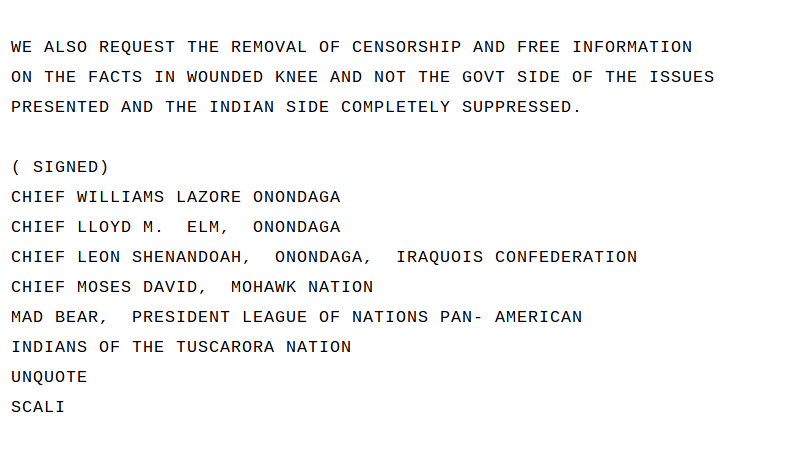
Earlier, in 1973, the Six Nations Iroquois Confederation engaged the UN and responded to the request from Wounded Knee to serve as peace mediators during the Wounded Knee occupation. 
These words ring true today as the mainstream media presents a biased version of the real story in Palestine.
In January of 1974, the US State Department became alarmed when Soviet journalists were planning to travel to Minneapolis. The US tracked them to see if they were there to cover the trial of those who occupied Wounded Knee. Once again, the US feared the American Indian Movement's ability to gain global support and contacts. The US also tracked unfavorable news coverage on Indian and human rights issues published in other countries. https://wikileaks.org/plusd/cables/1974STATE012511_b.html
                                                                               
One Wikileaks document is from Geneva in 1977, the statement on Discrimination and Indigenous Rights, which also refers to the sterilization of women without consent. The cables also show that the US tracked comments of Russell Means regarding the sterilization of Indian women in the US without their consent.

Read more about US spying on American Indians and First Nations at: http://indigenousresistancejuly2014.blogspot.com/2014/08/texas-spies-ponder-mohawks-stratfor.html

For permission to repost this article contact brendanorrell@gmail.com
Copyright Brenda Norrell

'Dakota Access Pipeline Tries to Sue Environmental Groups Out of Existence' by ACLU


Dakota Access Pipeline Company Tries to Sue Environmental Groups Out of Existence

DECEMBER 6, 2017 | 1:00 PM
ACLU


If you want to experience 2017 in a nutshell, check out the billion-dollar lawsuit filed by an oil and gas company against Greenpeace and other environmental groups for their roles in the Standing Rock protests.

In a 231-page complaint filed by Donald Trump’s old law firm, Energy Transfer Partners, the company behind the Dakota Access Pipeline, claims that Greenpeace and its partners are engaged in a criminal network of fraud and misinformation. The paranoiac complaint, which includes references to “wolfpacks of corrupt” environmental nongovernmental organizations and describes Greenpeace as a “putative Dutch not-for-profit foundation,” would be amusing if it weren’t so dangerous.

It leverages the RICO Act, a statute that was meant for mob prosecutions, and defamation law to wage a scorched-earth campaign against nonprofits that spoke out against the pipeline’s construction near the Standing Rock Sioux Reservation in North Dakota. Fortunately, as we argue in a friend-of-the-court brief filed yesterday with a coalition of public interest groups, the First Amendment prohibits companies from suing their critics out of existence.

ETP’s lawsuit rests on two theories, neither of which holds water.

First, it argues that Greenpeace and the other defendants are engaged in a broad-based conspiracy to defraud the public by defaming the company. But many of the statements ETP alleges as false or defamatory — such as website posts stating that the tribal consultation and environmental review were rushed and lacked proper consultation — are clearly protected opinions on matters of vital public concern. Other offending statements, such as a post by the Sierra Club’s Executive Director stating “it has never been a question of whether a pipeline will spill but only of when the next disaster will happen,” don’t seem very unreasonable, given last month’s 5,000-barrel spill at the Keystone pipeline in South Dakota. ETP can’t demand punishment for this kind of core political speech just because it doesn’t like the message.

ETP’s second legal argument fares no better. It argues that, because Greenpeace and the other defendants are allegedly engaged in a vast “illegal Enterprise” to persecute ETP, they should be held liable for the allegedly unlawful actions of totally unrelated groups that also happen to oppose the Dakota Access Pipeline. For example, ETP alleges that the hacktivist group Anonymous is a “front” for Greenpeace and the other defendants, but this wild accusation is based on nothing more than the observation that Anonymous targeted the same entities being protested by the defendants.

DROP CHARGES AGAINST PEACEFUL PROTESTERS

TAKE ACTION NOW

If accepted, ETP’s theories would make any advocacy group liable for the actions of every fellow traveler, no matter how disconnected. For example, if the ACLU filed a lawsuit challenging a government surveillance program, ETP’s theory of liability could make us civilly, and perhaps even criminally, liable for the actions of any hacker that attempted to take down the program.

If the courts have any sense, this case won’t get to trial. But ETP doesn’t need to win in court to do major damage. Defending major lawsuits like these against deep-pocketed corporations is extremely expensive, time consuming, and stressful, particularly for cash strapped nonprofits. Even if they survive, advocacy groups have to divert serious resources away from their missions to litigate these issues. That’s why it’s important for courts to dismiss these cases early, before things get really expensive.

Protesters and advocacy groups should never have to fear the weight of groups like ETP as a condition for expressing their First Amendment rights. The court should see this lawsuit for what it is and toss it.