Indigenous Peoples and Human Rights

August 29, 2019

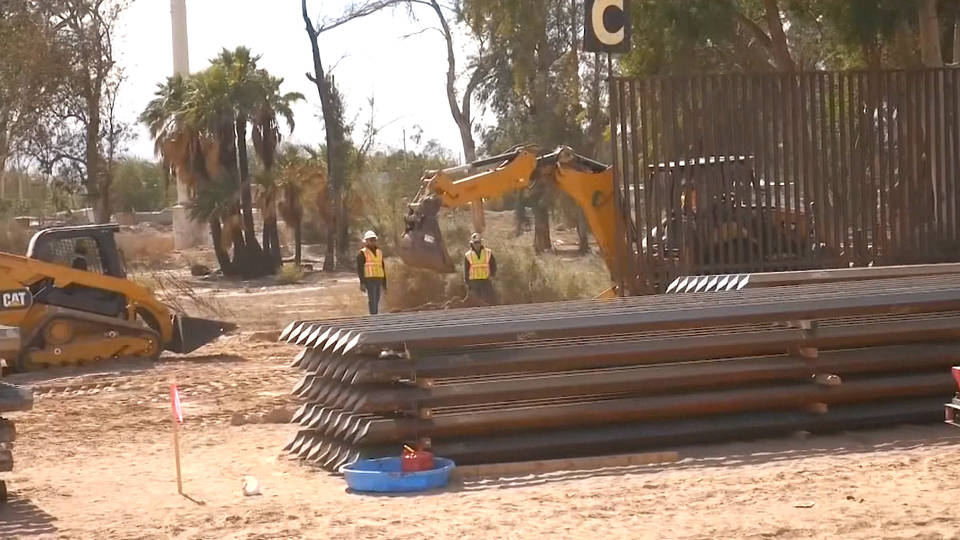
Trump's Monster: Bulldozers Now Ripping Through Organ Pipe Cactus National Monument


Trump's Monster Border Wall: Catastrophic to Endangered Species and Precious Water in Sonoran Desert: Bulldozers Now Ripping Through Organ Pipe Cactus National Monument
Located east of Lukeville, Arizona, and near the western border of the Tohono O'odham Nation.


Screenshots by Censored News of video at Organ Pipe by Center for Biological Diversity.
Watch video below:
Center for Biological Diversity


ALERT: Trump’s wall is being built through Organ Pipe Cactus National Monument. Bulldozers are ripping a scar through the most spectacular Sonoran desert ecosystem on the planet. Endangered species, Native American sacred sites and protected wilderness are under immediate threat.

More:
The UK Independent: Trump's plan to detain migrant children indefinitely while denying them vaccines is ethnic cleansing in plain sight.

Below: High Country News: 'Where wildlife is up against a wall'
.

Democracy Now! Trump Ordered Aides to Speed Up Border Wall Construction, Promising Pardons for Illegal Acts

Trump Ordered Aides to Speed Up Border Wall Construction, Promising Pardons for Illegal Acts

HEADLINEAUG 28, 2019
H3 trump border wall construction immigration 2020 election
Democracy Now!
In other immigration news, The Washington Post is reporting President Trump has ordered his staff to speed up the construction of his border wall before the 2020 election — even if it means breaking the law. Trump reportedly told aides he will pardon them if they face any legal repercussions related to the request, which could including seizing private land, expediting billions of dollars of construction contracts and ignoring environmental regulations. Trump reportedly dismissed concerns over the implications of circumventing appropriate procedures, including by using eminent domain, telling staffers to just “take the land”.
More at Democracy Now:
https://www.democracynow.org/2019/8/28/headlines/trump_ordered_aides_to_speed_up_border_wall_construction_promising_pardons_for_illegal_acts

August 28, 2019

Big Mountain: Standing with Mauna Kea and celebrating end of dirty coal monsters

Photo by Ethan Sing
Photo by Ethan Sing

Standing Strong
'Great gathering for resistors at the Benally stronghold marking the occasion of the Black Mesa strip mine and Navajo Generating Station power plant closure and planning for more victories for people land and wilderness in the Americas and solidarity with other blossoming struggles like Mauna Kea and all other indigenous-led movements to fight the devastation of the Trump nightmare.' -- August 2019, Photographer Ethan Sing


Article by Brenda Norrell
Censored News
Louise Benally of Big Mountain in among Censored News Revolutionary Native Women Writers. Louise spoke out against the bombing of Iraq on the day it was bombed by the United States, comparing it to the atrocities of the Dine' walking, suffering and dying on the Longest Walk to imprisonment. Louise remembered her ancestors at Fort Sumner, Bosque Redondo.
Indian Country Today censored Louise's voice and refused to publish a retraction. Louise continues to resist relocation at Big Mountain, orchestrated by Peabody Coal, energy barons, and politicians. Read about Revolutionary Native Women Writers at Censored News: https://bsnorrell.blogspot.com/2018/08/revolutionary-native-women-writers.html
Uncensored: Louise remembers her ancestors and the Longest Walk when Iraq is bombed: Censored by Indian Country Today: http://bsnorrell.tripod.com/id78.html
Louise described the endless struggle against relocation, Peabody Coal and livestock seizures. Now, there is no rain, the food is not coming back, and windmills are dry. Louise spoke during the Dine' CARE, Dine' Citizens against Ruining our Environment, gathering at Dilkon on the Navajo Nation in 2018.
During decades of struggle, the traditional Hopi have joined the Dine' of Big Mountain resisting relocation. They all realize that Peabody Coal's relocation is a land grab, a land grab for coal to make electricity for other people, other places.
During an interview at Dine' CARE's Peoples Convention -- with Dine' CARE celebrating 30 years of protecting environment -- Louise described the resistance to colonization and mining since the 1960s at Big Mountain on Black Mesa.
Speaking with Spirit Resistance Radio, Louise said in 1968 Peabody Coal came in and began developing the land for coal resource extraction to make electricity for other people, not Navajos.
"So the rest of the U.S. would have electricity and water at their pleasure," Louise said.
The legislation was drafted in 1974 that called for the relocation of more than 10,000 Navajos and over 200 Hopis.
The U.S. drew lines without the consent of local communities.
"My community decided not to move," Louise said.
Big Mountain teamed up with traditional Hopi and opposed it, and knew it was just a land grab.
"Most of my elders are no longer here."
Louise said people talk about Dine' of Black Mesa in the past tense, but they are still there.
"We are still here. We continue to live our way of life."
"We continue to practice our traditional ways of oneness with nature."
Louise said they struggle and do everything they can to get this land grab reversed.
Louise said Navajo Generating Station near Page might close in 2019.
"We are hoping it will," she said, adding that it is time for solar to replace coal-fired power plants.
The whole Four Corners has oil and gas wells, coal mining, and there are seven power plants in the region. All this is causing a lot of greenhouse gasses, she said.
"We're impacted, we have a lot of health issues," Louise said, describing the toxins and contaminated waters.
"A lot of people lost their lives struggling against these different diseases and toxifications of the air, water, and the environment."
"There are no regulations on these coal-fired power plants."
Now, there is the drought.
"We had no winter in 2017," Louise said, adding that there was very little rain.
"The land is basically dying."
"We don't have green grass."
It is devastating. Our food didn't come back. We hope and pray that they will shut these coal-fired power plants down."
The struggle has been endless.
Joining the gathering at Dine' CARE, Louise said they are all practitioners of the old ways, and it doesn't matter what label people wear.
"We have to unify and stand together in the best way we can."
The water table has dropped, and the aquifer is not providing enough water for the windmills.
The water around Peabody Coal is contaminated, and the people are hauling their water from there.
Louise said Dine' could dig into the ravines at Big Mountain when she was a child, and by morning there would be water coming out.
But that doesn't happen anymore.
The water has been drained in the aquifer for the electricity that is now going to southern Arizona.
"The drought is so severe, and there is no water in some of these windmills."
"Water is life, everything requires water to live."
She said the corporations want all of the water, there is no conversation about leaving water for the people.
"People don't want to know the reality," Louise said, explaining that Dine' people are not fully involved in the conversation about what is happening, and the discussion of water for the future, 20 or 30 years from now.
Louise lives 15 miles from the coal mine, and she has no electricity, no power, and because they are resisting, they have no social services from the Navajo Nation, the U.S. government or anyone else.
"They are trying to starve us out."
Now Hopi rangers are "stealing our animals." That is the peoples' food, she said.
"We are not allowed to grow food. We have so many laws stacked against us."
Louise encouraged people to come out. She said she can be messaged on Facebook, Louise Benally.
Louise said there are many needs and people can help. She needs a vehicle to haul water, and windows for her home.
Her root cellar roof collapsed because Hopi rangers drove over it.
There is currently a resistance camp that people can come to.
Describing how the Navajo Nation government is an arm of the U.S. federal government, Louise said the Navajo Nation government "is in bed" with the corporations, signing away the resources with leases.
"We are saying 'No.'"
Because of this resistance, the Navajo Nation government "doesn't want to do anything for us."
"They are an entity of the federal government."
Traditional Dine' are land-based people and are different from the Navajo Nation government, which is an entity of the U.S. federal government, she said.
The IRA Indian governments are what has always been working with the corporations to sign the energy leases.
And United States' taxpayer dollars are making these corporate deals possible, she said.
In conclusion, Louise said, "Pray for us to have rains."

Navajo Water Contamination more Horrific than Flint's -- By Brenda Norrell, Censored News

Navajo water has long been contaminated by Peabody Coal mining on Black Mesa, Cold War uranium spills and strewn radioactive tailings.
Recently, the US EPA poisoned the Animas and San Juan Rivers with a gold mine spill. The spill devastated Navajo farmers who depend on the water to irrigate their crops.
Further, the U.S. government knew when it relocated Navajos from Black Mesa to the Sanders, Arizona, area that radiation from the Church Rock, N.M. uranium spill on July 16, 1979, would poison the water when it flowed down the Rio Puerco wash to the Navajo Nation and Arizona communities near Flagstaff.
Today, tests confirm the radioactivity in the drinking water in the Sanders area, at the Navajo Nation's southern border.
In the Four Corners region on the Navajo Nation, three dirty coal-fired power plants poison the water with runoffs, one near Page, Arizona, and two near Farmington, N.M.
The dirty coal electricity lights up Phoenix, Tucson and other cities. Meanwhile, Navajos suffer from coal mining and power plant pollution. Many Navajos have no running water and are forced to haul their water long distances.
The media, both in Indian Country and the mainstream media, have failed to expose the truth.
The public remains unaware of the extensive pollution and corporate exploitation on the Navajo Nation.
From Robert Seals:
"My name is Robert Seals. I have been following the Flint, Michigan water crisis story and wish to shine a light on another water contamination story that is much older and just as horrific as Flint's.
"The Navajo Black Mesa water supply has, for decades, been destroyed by Peabody Mining Company. The wells have been drained to make a slurry in order to pipeline coal and the remaining water supply is contaminated with uranium which is now leaching into the Colorado River."
"This is the short version of the little known story that desperately needs to be told. There has been no potable water on the reservation for decades. When a city like Flint is in crisis, everyone gets agitated/involved. However, there is no one talking about the tragic situation that has been taking place on the Navajo Black Mesa and no one is being held accountable for this travesty. The spokesperson for Black Mesa is Louise Benally. She will give you the complete story."
(louisebenally6@gmail.com)
Here is a brief statement from Louise: "Our water has been impacted since the 1950s on to today. When different minerals were discovered on the Navajo Reservation in the 1940s-1950- through to this day (now 2016), groundwater has been used to extract uranium."
"The ground and surface waters have been used and released back into holding ponds and/or released into the surface waters. Coal Mining on Black Mesa used water to transport coal for 276 miles and continued pumping groundwater for pushing Black Mesa Coal to Laughlin, Nevada. Today there are holding ponds that are not monitored at Black Mesa which seep into the runoffs/into the surface waterways- headwaters.
"There is a lot of contamination on our reservation, in most of the regions, including New Lands in Sanders, Arizona. There is no water that is safe for people to drink."
"In the western agency area, there has been no safe drinking water since the 1950s, after the uranium companies moved on. Black Mesa water is being pumped for Peabody Coal Company's mining operation. The contamination is currently seeping into the Colorado River."
https://bsnorrell.blogspot.com/2016/01/navajo-water-contamination-more.html


Copyright Brenda Norrell, Censored News, may not be used without permission.


.

August 27, 2019

Quitobaquito Springs -- Border Wall Construction Destroying Sacred and Fragile Sonoran Desert Ecosystem


Photos above copyright by the photographer
 Quitobaquito Springs
              By Brenda Norrell
               Censored News

Quitobaquito is a rare oasis in the desert that supplies life-sustaining water to many animal species, as shown here. This Sonoyta mud turtle is found nowhere else in the world. Nearby, as shown below, border wall construction has already started near Lukeville, Arizona.
Trump is using diverted military funds to build this monster, the border wall, and has eliminated all laws protecting endangered and sacred places and species. In this fragile Sonoran Desert, it is a crime against nature, a crime against all life forms.
These expensive pieces of a border wall -- between the long border stretch from east Texas to the California coast -- are targeting the most fragile regions, and will only serve to push migrants into more deadly zones. Instead of halting immigration, these pieces of the border wall will be no more than a symbol of white nationalism and destruction.
Ofelia Rivas, Tohono O'odham who lives on the border nearby on the Tohono O'odham Nation, asked, "Where are the Water Protectors?"
"Sources say each foot of border wall will require 2 cubic yards of concrete. A yard of the concrete takes 39 gallons of water. This means each mile of wall = 411,840 gallons of water," Rivas told Censored News.
As the monster construction is ongoing nearby, the photographer, a border resident, explained that the border vehicle barrier, shown in the top photo, is already in place and the enormous wall is not needed here, in this fragile zone.
"The vehicle barrier seen in the background allows wildlife to move freely across the southern border in Organ Pipe Cactus National Monument. It keeps vehicles from driving across the border that could be very damaging to the sensitive environment."
Arizona Republic Raphael Carranza photos below: Trump uses diverted military funds to build border wall near Lukeville, Arizona, this week.


SAVING THE SONOYTA MUD TURTLE
The Center for Biological Diversity said, "The Sonoyta mud turtle has evolved as an aquatic species in one of the driest parts of the Sonoran Desert. With webbed feet and an innate ability to swim, this turtle depends heavily on what little water remains in the Southwest. The easiest way to identify a Sonoyta mud turtle is by its location since it's the only turtle inhabiting its very small range. The U.S. population has been reduced to a single reservoir within the Organ Pipe Cactus National Monument, named Quitobaquito Springs. In Mexico, these turtles inhabit a couple of small, still-flowing sections of the Rio Sonoyta."
Among the rare creatures found at Quiobaquito Springs is the endangered pupfish.
"The largest body of water at Organ Pipe Cactus National Monument is Quitobaquito springs and pond, home to the Quitobaquito pupfish," writes Wild Sonora.
"The cultural significance of the Quitobaquito area dates to approximately 11,000 B.P. (before present)."The pond is the home of the Quitobaquito spring snail, the Sonoyta mud turtle, and the desert caper plant. This is the only spot in the United States where these species can be found naturally occurring," the National Park Service said.
"The desert caper supports the caper butterfly (ascia Howarthi) that is only found coexisting with the plant. The Quitobaquito spring snails are so small that they are hard to find."
"You can sometimes spot the snail, about the size of a grain of black pepper, in the spring-fed streams serving the pond. Quitobaquito is also the only place where the Sonoyta mud turtle is found in the United States and has been deemed a candidate for protection under the Endangered Species Act."

Call and/or write your Congressional Representatives and Senators and ask them
1. To stop the funding for this wall.
2. To repeal section 102 of the Real ID Act that dismisses decades of protective environmental, public health, and safety laws passed by congress.
FYI - Section 102 of the Real ID Act of 2005 waives 28 environmental and other laws (listed below) during a national emergency or under a threat of a terrorist attack. Since #45 declared an emergency at the border in order to get funding for the wall, the builders do not have to abide by laws that are required by all other types of construction.
Laws waived...

1)The National Environmental Policy Act

2)The Endangered Species Act

3)The Clean Water Act

4)The National Historic Preservation Act

5)The Migratory Bird Treaty Act

6)The Migratory Bird Conservation Act

7)The Clean Air Act

8)The Archeological Resources Protection Act

9)The Paleontological Resources Preservation Act

10)The Federal Cave Resources Protection Act

11)The Safe Drinking Water Act

12)The Noise Control Act

13)The Solid Waste Disposal Act

14)The Comprehensive Environmental Response, Compensation, and Liability Act

15)The Archaeological and Historic Preservation Act

16)The Antiquities Act

17)The Historic Sites, Buildings, and Antiquities Act

18)The Farmland Protection Policy Act

19)The Coastal Zone Management Act

20)The Federal Land Policy and Management Act

21)The National Wildlife Refuge System Administration Act

22)The National Fish and Wildlife Act

23)The Fish and Wildlife Coordination Act

24)The Administrative Procedure Act

25)The River and Harbors Act

26)The Eagle Protection Act

27)The Native American Graves Protection and Repatriation Act

28The American Indian Religious Freedom Act


Organ Pipe nature photos: copyright by photographer, published with permission at Censored News