Indigenous Peoples and Human Rights

November 26, 2015

Mohawk Nation News 'Onondaga Field Day'


ONONDAGA FIELD DAY

mnnlogo1

Please post & distribute.
MNN. Nov. 25, 2015. This was written about the attack of the rotino‘shonni at Onondaga on May 18, 1997, by the New York State Troopers. It was published in the Akwesasne Phoenix on December 19, 2004. I added this as MNN was not yet online:pack
“Something strange and unexpected happened on May 18th 1997. My daughter in Kahnawake had planned a trip to Onondaga. Just before she left her companion backed out. She came to my house to ask what to do. I told her she shouldn’t go alone. So I jumped in the car to help care for my 3 year old granddaughter. We left at 9:00 a.m. It was a beautiful sunny day. honour
People from all Six Nations of the Iroquois Confederacy were gathering at Onondaga to celebrate the rescinding of the compact between Governor Pataki and the Onondaga Chiefs and others.
We arrived at Onondaga around noon. We happen to notice many New York State Police cars parked at various locations in Nedrow, the nearby town. We could not figure out why they were there. We commented on this, “Hey, look at all those police cars! Can’t be for us! Naw!” floyd crow westerman
Soon we arrived at Ronnie Jones property right along Interstate 81. People were talking about all the cops they saw. “We aren’t doing anything”, they said. “So it must be for something else!” “I wonder what’s happening.”
The Peoples’ fire, lit several weeks earlier, was burning brightly. Marie Peters had started a small ceremonial fire for the thanksgiving ceremony.
A huge billboard on the property had been taken over by the Onondagas who wrote their own messages on them. Men, women and children, were milling around. Food was being brought to the site and placed on picnic tables. Benches and chairs were set in groupings.
Media people with cameras and notebooks were scattered through the crowd. The people being interviewed were happy about what we were celebrating. There was no sign of the chiefs who objected to Pataki rescinding the accord. matrix
My daughter and I did not know some of these people. We knew the Papineau family and some of the people from Kahnawake. I stood on the side of the road and watched cars going by, slowing down to take a flyer from the hands of the people. The flyers outlined the tax issue. Most non-natives were supportive of our victory. No traffic was ever stopped.
My daughter was taking photos throughout. My granddaughter was playing with the other children. The weather was as beautiful in Onondaga as it had been in Kahnawake. At a certain point, the traffic stopped. I saw the New York State Troopers coming down the road in rows with sticks in their hands. Four troopers marched in front following the directions of a native wearing red ribbons on his shirt. He was from the Onondaga chiefs council.
When they got closer, they stood on the road, turned into a formation facing the people who were gathered about the ceremonial fire. The ceremony had just begun about two minutes earlier. They marched towards us in a “V” formation, right through a shallow ditch along the highway. Another group of troopers appeared on the road behind them, marching steadily down the road toward us. rushmore
At first I did not move. I was studying them. I could not believe they were coming for us. When I realized what was happening, I froze. The troopers started to beat the first persons they encountered with their batons. Suddenly everyone jumped into action. I looked around for my granddaughter. She had been placed in a van with other children and driven away.
My daughter was standing on a picnic table taking pictures. The troopers were moving in her direction, beating everyone in their path. “Get off the table”, I yelled. “Get out! Get out quick”, I was screaming at her. She finally jumped down, ran for her car and took off. Her car was parked on the access road behind the property, parallel to Interstate 81. I jumped into a friend’s moving car while he was backing out.
The New York State Troopers were not wearing their badges. We were unlawfully harassed during a sacred ceremony. I saw our men, women and children being beaten for no reason or provocation. The troopers focused on some individuals, giving them particularly vicious beatings. Four cops grabbed an older man and held him down, while another trooper grabbed his chin and yanked it, trying to break his neck. I could see their sticks in the air as they continued to strike the people. I saw people being lead away. Others were running through the bushes fearing for their lives.
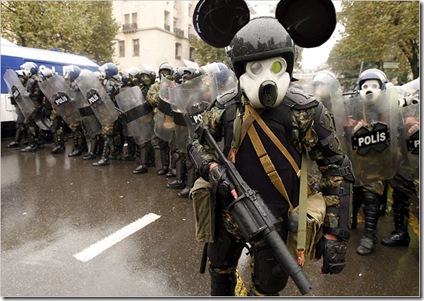
Disguised reinforcements.
People were being grabbed, hit and hurt. Children were being knocked over and pushed around. Elders were being beaten. Elder Grandpa Bear, wearing a black Navajo style hat, was chased by the troopers. He took off. All I could see was his hat running through the bushes. When I ran onto the roadway, many women were hiding in the bushes with their children.
My friend in the car had a cell phone and I called my office [Canadian Alliance in Solidarity with the Native Peoples] in Toronto. I asked the CASNP worker to send out a communiqué worldwide that we were being attacked by New York State Troopers, that many people were hurt, and that many had been arrested. The attack was unprovoked. The people at the thanksgiving ceremonial meeting had no weapons. I went to the home of an Onondaga person and faxed more details to my home. Another daughter sent this out everywhere alerting everyone of this violent attack.
It was hours before I managed to relocate my daughter and granddaughter in Onondaga. I rode around the territory here and there trying to find them. Finally, I went to the restaurant and waited. Eventually they showed up.

This is a police state.
Jack knows it’s a police state.

A court case was started seeking damages. The lawyer from Syracuse did not contact us for quite a long time. The question is – will New York State recognize our right to an exemption to their taxation so long as they “beat the dog s**t out of us periodically?” Someone should go into business designing modern ghost shirts with beaded flak vests with matching beaded helmets!”
All I can say is this was a very spooky day for me, as Dusty Springfield sings: “I get confused. I never know where I stand. And then you smile and hold my hand. Love is kind of crazy with a spooky little boy like you. Spooky!” [[Spooky].
MNN Mohawk Nation News kahentinetha2@yahoo.com or more news, to donate and sign up for MNN newsletters, go to www.mohawknationnews.com More stories at MNN Archives. Address: Box 991, Kahnawake [Quebec, Canada] J0L 1B0 thahoketoteh@hotmail.com for original Mohawk music visit https://soundcloud.com/thahoketoteh


November 25, 2015

Troy Fletcher, Yurok Tribe's Visionary Leader, Passes Away

.
 Photo of Troy Fletcher courtesy of the Yurok Tribe

Troy Fletcher, Yurok Tribe's Visionary Leader, Passes Away 

by Dan Bacher 
Censored News
Troy Fletcher, a visionary leader of the Yurok Tribe, passed away suddenly of a heart attack at the age of 53 on the evening of Friday, November 20. 

I first met Troy nearly 20 years ago at a Fish and Game Commission hearing when he was the director of the Yurok Fisheries Program. From that first time I talked to Troy, I watched him play the key leadership role in building bridges between the Tribe and commercial fishermen, recreational anglers, environmentalists, farmers, other tribes and federal and state government officials who were often in conflict with one another. 

Troy, who became the Executive Director of the Tribe, was one of the rare people who could truly see the "big picture" of fishery and environmental restoration - and what was necessary to restore the Klamath Basin and Pacific fisheries. 

Photos Yaqui Water Defenders in Tucson

.


Yaqui Mario Luna Romero, falsely imprisoned in Mexico for one year,
speaks to Pascua Yaqui Nation in Arizona. Luna was abducted
and Mexico refused to release him for one year, even after judges
ordered his release.


Yaqui from Sonora, Mexico, address Pascua Yaqui Nation in Arizona
Yaqui water rights defenders from Sonora, Mexico, spoke out in defense of their rights to water of 
Rio Yaqui. When Mexico constructed the Independence Aqueduct to divert Rio Yaqui water to the City of Hermosillo, Yaqui responded with a highway barricade. The highway water rights blockade, on a busy coastal trucking route, began in 2013 and continues.

By Jose Matus
Indigenous Alliance without Borders
Censored News

PASCUA YAQUI NATION -- Mario Luna Romero and the Rio Yaqui Kovanaos Community Forum was held on Saturday, November 21. The Elder Kovanao blessed and greeted all of us in his Native tongue. 
Mario Luna Romero gave a report on the water blockade. He reported on the filing of court documents with the federal Mexican Court. The court has ruled in favor of the Yaquis. He also reported on he filing of the water defense petitions with the Inter-American Human Rights Commission, which they have gone before a couple of times. No decision has been made as of now because it is a slow process.
The group of eight from Rio Yaqui were very happy to be here and to share their story, the plight of Rio Yaqui and the historical survival story of the struggle of the Rio Yaqui Sonora, Mexico Yaquis.
It was a very informative and good event. They were greeted by a small crowd that came to meet them, participate, support and listen.
Jose Matus
Indigenous Alliance without Borders
I sincerely thank the following people that help set-up and cleaned after the event: Thalia Gomez, Paul Hernandez, David Jaimez, Roberto Rodriquez, Mary-Lou Aguirre. To the many friends and supporters who donated money to help with lodging and meals for our invited Yaqui guest, to Rosemary Tona-Aguierre for all the good and tasty food and others that donated sweet bread/water. Thanks to Mary Lou for Aguirre for the very good cake! At last but not least, to Adam for video taping the event.

American Indian Movement: Hidden history, sovereignty and resistance


The American Indian Movement's annual west coast conference reveals atrocities of California Indian missions, and honors Darrell Standing Elk, while urging clemency for Leonard Peltier
By Brenda Norrell
SAN FRANCISCO -- The AIM West Conference revealed the true history of the California Indian Missions. It is a history of slavery, beatings and murder. It is a history that the Pope refused to recognize when he honored the brutal priest Junipero Serra.
Valentin Lopez, Chairman of the Amah Mutsun Tribal Band of Costanoan Ohlone Indians, described the true history of slavery and cruelty, beatings and murders, of the California Indian missions.
Lopez chronicled the history and opposition to the recognition of Junipero Serra as a Saint, during the American Indian Movement's annual West Coast Conference here this weekend.
"We can't depend on the Catholic Church to tell the truth." He said the state of California can not be depended on to tell the truth.
"We need to tell our own truth."
Lopez said the beatings and atrocities of California Indians carried out by Junipero Serra were carried out with the moral authority of the Pope.
"That does not come from the Creator. That comes from evil."
The annual AIM West Conference began by honoring Darrell Standing Elk, Lakota, and urging clemency for Leonard Peltier, now 71, who has spent his life in prison.
Jean Whitehorse, Dine’ (Navajo) spoke on termination, relocation and sterilization by the US government. Speakers discussed protection of Native American sacred places and burial places, using the social media and the ongoing organizing by Indigenous Peoples for the UN climate summit COP21 in Paris.
Sovereignty was also a focal point.
Tohono O’odham human rights activists and Mohawk Warriors spoke out on sovereignty.
Mike Wilson, Tohono O'odham, described documenting the abuse by the US Border Patrol and an increase in violence toward O'odham by border agents along the border of the United States and Mexico.
"The Tohono O'odham tribal government has completely surrendered to the US Homeland Security,” Wilson said.
Wilson said people ask him why -- if the Tohono O’odham is sovereign -- is the US Border Patrol on the Tohono O’odham Nation.
"In Indian country, we are not sovereign nations, we are not even sovereign people,” Wilson said.
"If we were truly sovereign, why do we have Border Patrol, as far as I'm concerned it is an occupying army in Indian country."
Mark Maracle, Mohawk Warrior, responded on the issue of sovereignty.
Maracle said that Mohawks do not wait for anyone to tell them that they are sovereign.
"You don't have sovereignty unless you assert sovereignty,” Maracle told Censored News.
“The United States and Mexico are not sovereign nations.”
“We tell them we are sovereign. We don’t wait for them to tell us that we are sovereign. We tell them. If you want sovereignty, you have to make sacrifices.”
Maracle said Mohawks have stood up against the state police, federal agents and all forms of government.
“We keep reminding them that this land belongs to us."
Maracle said he is speaking because he was given the right to speak by the Mohawk clan mothers.
Read more of their comments:
-- Day 1: Honoring Darrell Standing Elk, urging clemency for Peltier,
and speakers
-- Day 2: Hidden Atrocities: California Indian Missions and Doctrine of Discovery
-- Response: Mohawk Warrior Mark Maracle interview and Tohono O'odham human rights activist Mike Wilson speak out on sovereignty
-- The 2014 video archives are streaming until the 2015 video archives are posted.

For permission to repost this article brendanorrell@gmail.com
Please share our links.