Indigenous Peoples and Human Rights

November 29, 2017

'COINTELPRO and TigerSwan Tactics -- Infiltrators, Rumors and Destruction of Sacred' by Lakota Jean Roach

Standing Rock Water Protectors
Oglala to Standing Rock -- COINTELPRO and TigerSwan Tactics are the same: Infiltrators, Rumors and Destruction of Sacred 
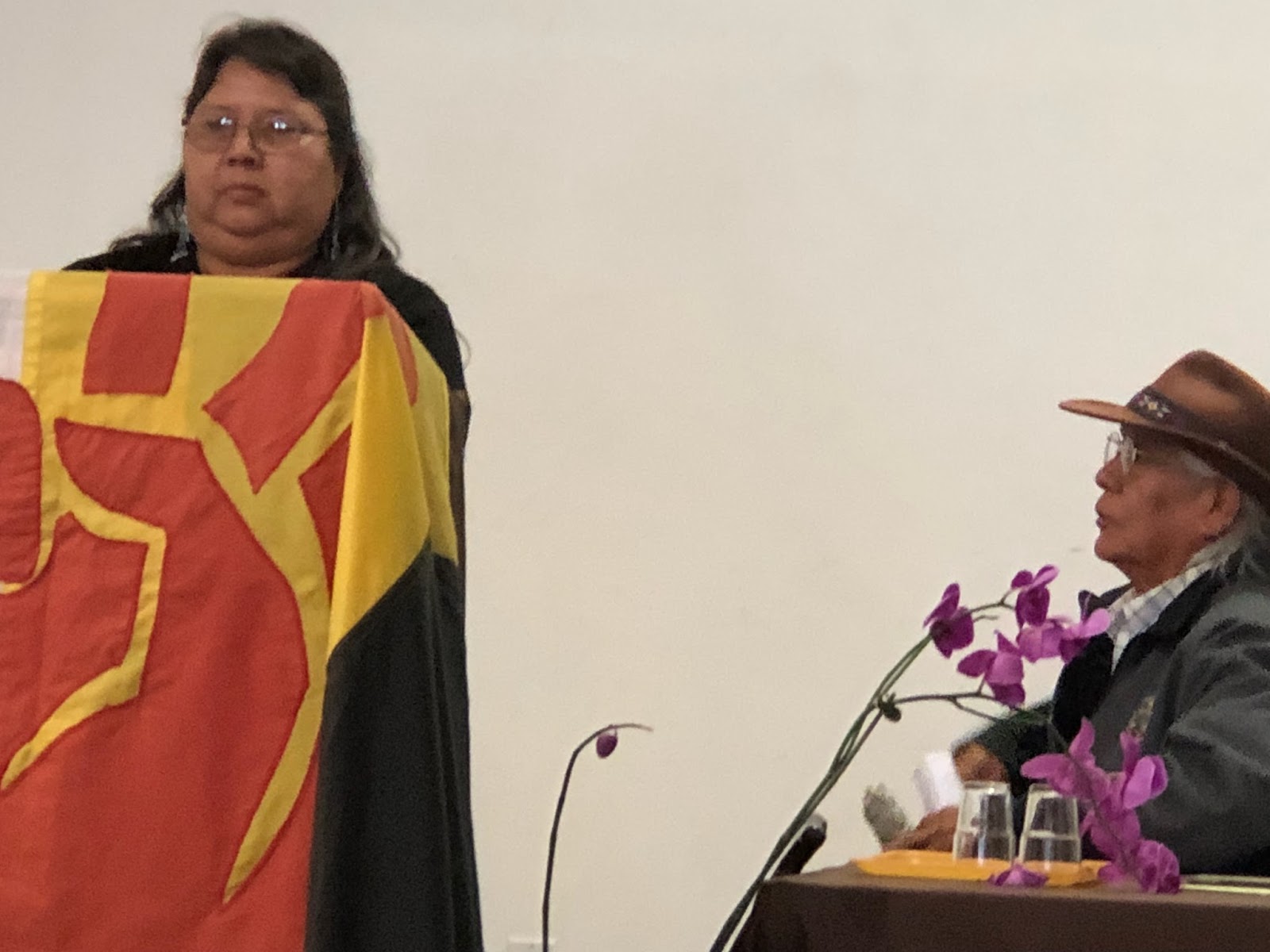
Jean Roach and Lenny Foster
AIM West 2017
Photo Karen Wright
Understanding this war is part of the struggle -- Jean Roach, Lakota

Article by Brenda Norrell
Audio by Govinda, Spirit Resistance Radio
Censored News

.

SAN FRANCISCO -- Jean Roach, Lakota from Cheyenne River Sioux Nation, representing the offices of Leonard Peltier, described the United States ongoing genocidal war against Native Americans.
The COINTELPRO tactics used at Oglala, South Dakota, resulting in the prison sentence of Leonard Peltier, were the same tactics used by TigerSwan at Standing Rock.
These tactics targeting Native Americans continue to resulting in large numbers of political prisoners.
"I've been friends with Leonard for many years. Me and my brother were survivors of the Oglala fire fight," Jean said during the AIM West Annual Conference, held here Nov. 20 -- 21.
Pointing out the long genocidal history of the United States, she said, "The water protectors are political prisoners. Way back in the 1800s, we have prisoners of war. We have the Dakota 38."
"What happened to the water protectors, what happened to the American Indian Movement, specifically in Oglala, South Dakota, show the same tactics being used," she said.
Jean described the tactics of infiltrators, rumors and the desecration of the sacred.
"We have infiltrators coming into our movements."
What happened during the Oglala firefight, was the same as what happened in Standing Rock. "They sent people in to disrupt."
Jean said sometimes people stand back a little when they talk about Leonard Peltier, but the attacks were the same at Oglala as at Standing Rock. During the 1970s, Lakotas  were protecting the elders and the sacred at Oglala.
In both cases, there were people who started a lot of rumors.
At Oglala, they attacked a spiritual camp. The people there were armed to defend the elders, who were being shot when they prayed in their own way. They were being killed, shot, ran over, Jean said of Oglala and surrounding communities on Pine Ridge.
When Oglala was attacked by the FBI, "They kicked in our sweatlodge."
In Oglala, they abused the spiritual items, the same way they did at Standing Rock.
It was the same when water protectors camped at Standing Rock defended the sacred, and the precious water of the Missouri River.
Morton County "peed on" sacred items.
"We are dealing with this colonization, this genocidal practice that has been going on."
Jean described how FBI misconduct and a racist judge in South Dakota led to the conviction of Leonard Peltier after the Oglala fire fight.
"They set up Peltier."
"They took Myrtle Poor Bear to Canada to tell lies, who does that?" she asked.
The U.S. government falsified witnesses and changed the charges against  Leonard Peltier.
They couldn't charge all those under 18 at Oglala, but they picked on the adults, she said.
Now, in the Dakotas, racist judges continue to imprison the defenders of the sacred.
"It is so ironic that we are back in court where Leonard was convicted with this biased and racist judge," Jean said.
Jean pointed out that Dino Butler and Rob Robideux were acquitted on these charges that Leonard Peltier was convicted on. In the case of Butler and Robideux, the court found they acted in self defense because they were attacked at Oglala.
Yet, Leonard Peltier was convicted on the charges in the court of a racist judge in South Dakota.
"He would just spin around in his chair when anything was mentioned about FBI misconduct," she said of the Peltier trial.
"Right now we are facing the same system."
The COINTELPRO practices used against them in Oglala were continued by TigerSwan in Standing Rock. Both were used to "attack us for prayer."
"Look how strong our prayers are," she said, pointing out the power of prayer and non-violent direct action.Understanding this war is part of the struggle, she said
Jean said Leonard has just had major surgery. "Leonard, needs some support. Where is everybody""
"I don't want people to forget we have prisoners in this genocidal war."
She urged people to send postcards to Leonard.
"I don't want him to die in prison. We all need to act."
During his introduction, Tony Gonzales, AIM West coordinator, said all people are now feeling what Indians have always felt. We are all now in that Spiritual Movement, he said.


Article copyright Brenda Norrell, Censored News, may not be republished without permission, or used for revenues or commercial purpose.

November 27, 2017

Madonna Thunderhawk -- 'Time to set up camp after pipeline bursts in South Dakota'


Madonna Thunderhawk photo by Karen Wright, AIM West 2017
From Alcatraz to the Black Hills, Wounded Knee, and Standing Rock, the struggle is continuous, it is now. Fight the fight at home. -- Madonna Thunderhawk, Lakota, Cheyenne River, South Dakota

Article by Brenda Norrell
Audio by Govinda of Earthcycles
Photo by Karen Wright
Censored News

SAN FRANCISCO -- Madonna Thunderhawk, Lakota, from Cheyenne River in South Dakota, described her time on Alcatraz, with the American Indian Movement in South Dakota, and at Oceti Sakowin at Standing Rock as an elder advising the youths, during the AIM West Conference.
Urging people to fight the fight at home, Madonna said it is time to set up camp where the Keystone pipeline just burst in South Dakota. The elders must have the backs of the young people, she said.
Recalling her time in the movement, Madonna said that she came to San Francisco in the '60s,
"I left my young heart in San Francisco," she said, speaking at AIM West's annual conference on Monday, Nov. 20.
It was on Alcatraz that she became involved in the Red Power movement. Just before going to Alcatraz, she was part of the Black Hills resistance and they took over Mount Rushmore.
John Trudell came to the Black Hills and said they needed help on Alcatraz.
The year was 1969 and it was the second year of the Occupation at Alcatraz. Trudell told them in the Black Hills that the fanfare was done and the cameras were gone at Alcatraz. Although most of the support just came on weekends, as most had jobs, still, there were young people, teenagers occupying Alcatraz.
Trudell told Madonna they needed help organizing.
Madonna recalled that it was at Alcatraz in 1969 where she first met Cuny Dog from Pine Ridge, South Dakota, a longtime AIM brother.
"That was where I first got involved," Madonna said of Alcatraz.
When she returned home from Alcatraz, she became involved in the American Indian Movement.
While at Alcatraz in 1969, she helped organize a school and got the kitchen going. This helped when she went home to South Dakota and started organizing with AIM.
Since she was around 30, she was considered "older" at Alcatraz.
During those earlier years of the movement in South Dakota, people just wanted AIM to come and listen to their problems. Along with this, there was always the problem of how to feed 200 people in the AIM caravan.
"That's how we learned how to organize, how to move people."
They also learned how to listen.
They learned "not just how to hear people stories, but how to listen," Madonna said.
"With the American Indian Movement, it was a family movement."
She said it was like a family, because they knew that the elders always had their backs.
"That was our validation."
"We weren't the 'good Indians.' We were always rocking the boat. But we always knew that the elders had our back."
"That was the strength of the American Indian Movement."
She said she spent six months at Oceti Sakowin at Standing Rock as an elder, to have the backs of the young people.
"That's what the elders did for us."
Today, Madonna is working with grandparents.
These days, grandparents are raising grandchildren. Some great-grandmothers are raising great-grandchildren. The drug culture and meth culture is rampant and it is affecting us, she said.
She said it's OK to fly all over, and do what she is doing here in San Francisco, but, she said, "You need to walk your talk."
"I've earned the right to speak."
She said its OK to go fight a pipeline, but you have to go home and fight the fight.
The grandmothers are in it for the long fight against social services to keep the children in the community.
"You have to be in it for the long haul. The work is continuous."
She said there is a place in the movement for all ages.
"When you are fighting for the survival of your people, there is a place for everybody, it doesn't matter how old you are,"' she said.
When she was leaving this time for San Francisco, her four-year-old great-granddaughter asked, "Are you going to camp?"
Madonna said, she stopped, because she had just heard about the Keystone  pipeline bursting in South Dakota.
"That's why we stood up and fought DAPL. We knew that was what was going to happen," she said of the resistance to Dakota Access pipeline at Standing Rock.
Madonna said of course the burst of the Keystone pipeline and the leaking oil is being downplayed in the media and by TransCanada.
"When I go home, I am going to camp," Madonna said.
"If we have to set up tents again where that spill was, we've got to do it."
"Whatever we've got to do, we've got to do it."
"It is an ongoing struggle."
Madonna said it doesn't matter how many people are present at the AIM West gathering, because with the help of social media, the word will get out. "That is the audience today."
She thanked Govinda Dalton from Earthcycles for broadcasting live at AIM West and Oceti Sakowin in Standing Rock. She also thanked Tony Gonzales for pulling together the AIM West conference each year in San Francisco.
Madonna said the Occupation of Wounded Knee showed them that they had the attention of the world.
Then, at Standing Rock, there was the realization that the strength of the camps came from the Indigenous from throughout the hemisphere and the world.
"Every Indigenous People of the hemisphere came."
"They brought their flag."
"That is our strength now. We have to stop recognizing borders."
Boundaries, she said, are part of the colonizer-settler mentality,
"Our DNA is all the same. We better pull it together."
She shared how recently that her granddaughter was going to a student gathering at the college. As it turned out, she said it was the food, the Mexican food, that drew her there.
The students with Mexican fathers, it turned out, brought the best food. Madonna said as an organizer she realized, "We can start building right there." The opportunities are there, she said, for building bonds between the Eagle and the Condor.
"That is our strength."
"I choose to look at the positive. For all of those young people, the Eagle and the Condor will mean something. We better get on it now."
Transnational corporations are running politics, global politics, she said.
"If we don't stop messing around, and start organizing, in our own hemisphere, what are we doing? Are we just spinning our wheels?"
"Anyway, its at the top of my bucket list," Madonna said at the AIM West gathering.

TransCanada's Keystone pipeline burst in November and leaked 210,000 gallons of oil about three miles southeast of the town of Amherst.

Article copyright Brenda Norrell, Censored New. No portion may be used for revenues or commercial purposes. Audio available for like-minded radio stations. Contact:
brendanorrell@gmail.com

Dakota Ride -- Water Walk and Run 2017


Dakota Ride/ Water Walk and Run
In Honor of Women and Children from historical trauma — past & present. This journey will embrace All lives lost of our women MMIW and children and also from the toxic spills.
When: December 9th Youth Councils will be running from a safe area of recent bitumen oil spill site to the Sisseton Wahpeton Tribal Headquarters.
*Will resume the 10th from headquarters @8:30 to SWO Memorial Park to begin Ride & Water Walk
December 10th, 2017 - 26th @ Mankato Memorial site
Woc’ekiua Kag’a Prayers with our sacred fire. Circle up of horses and walkers.
Where: Sisseton Wahpeton Oyate Memorial Park - Sisseton, SD @ 9:00 a.m.
Route:
Our journey will follow closely to the route our ancestors took when they fled the bloodshed in Dakota Uprising — Maps will be passed out.
* 12/10 begins at Sisseton Wahpeton Memorial Park - Sisseton, SD.
* 12/20 joining up in Birch Coulee with 38+2 Riders (that Ride begins 12/10 @ Crow Creek) >
* 12/26 Meet up with 38 Runners from Ft Snelling @ Mankato Memorial Site - time TBA
Invitation:
*We encourage Water Walkers to participate to heal our 4-direction waterways that affect all people (Continental Divide spreading of contamination. We invite all our relations who want change for our people.)
*Bring a vial of water from your territories to add to our Mni Wic’oni pale for healing prayers.
*Send vial if you can not attend with history:
Water walk, Po box 686, agency Village, SD 57262
*Sharon Day will assist with ceremony and blessing of Water Walk. Including Memorial prayers for MMIW.
How can you help?
Donate meals through pot luck — hay — feed — warm clothing
DONATE through: (our umbrella)
https://dakotawicohan.org/donate/
Indicate: for RIDE & Water Walk
Run sign up on Dec 9 -10: grassrope04@gmail.com
Water Walk sign up info: whiteeagle57501@msn.com for more info.
38 Dakota Memorial Run info: Ft. Snelling, St Paul, Dec 25th, gather 10pm.
Contact Šišokaduta email: sisokaduta@me.com
For more information please call:
Julian Boucher — 605-268-1484
W.A.T.E.R.
We All Take Environmental Responsibility
facebook.com/DakotaPrayerRideandWaterWalk/
All s’unka (dogs) welcome — must have shots — leash control.
No alcohol, drugs, profanity & cruelty to animals. Treat one another with respect.
For assurance in safety and well-being —
Sex offenders are asked to stay away — this is to ensure children participation.