
Nov. 23, 2020


Censored News
Osiyo,
Since the COVID-19 pandemic first reached Cherokee Nation, our people have worked together to protect Cherokees. We have seen heroic actions and hard sacrifices by our health care workers, staff and volunteers who distributed food and economic assistance, and all those who gave up in-person social and family time to help keep us safe.
I am grateful for those sacrifices that have saved Cherokee lives and prevented even greater suffering, especially for our treasured elders. I have tried to support those efforts by following the best public health recommendations available. That is why I issued an executive order in May mandating masks at Cherokee Nation properties. I also made sure that, whenever possible, our employees could stay at home without losing a paycheck, and our Cherokee families and communities would be supported through this crisis.
Unfortunately, Cherokees cannot defeat this virus alone. The harsh reality is that COVID-19 is spreading faster than ever across our reservation, the state and the whole country. Cherokee Nation has 4,322 total cases and 35 deaths within our health system. Hospitals are reaching capacity at alarming rates, including at Cherokee Nation’s W.W. Hastings Hospital in Tahlequah. In addition, 89 Oklahomans, including some Cherokees whom I consider dear friends, tragically died due to complications from COVID-19 in the past week.
These hospitalizations and deaths were preventable. Many more hospitalizations and deaths are still preventable. Our health experts at Cherokee Nation, in Oklahoma and around the United States have told us that face coverings help reduce the spread of this disease. Cherokee Nation and local leaders around the state have listened to the public health experts, but it is simply not enough. Cities with mask ordinances are reporting lower rates of transmission, but the virus doesn’t care about municipal or reservation boundaries. We need uniformity across the state to stop COVID-19.
I was glad to see Oklahoma Governor Kevin Stitt recently announce some new measures to slow the virus. Requiring masks in state facilities and instituting an 11 p.m. curfew for restaurants and bars are positive steps. These will help, but they are not enough. I have called on Governor Stitt to issue a statewide mask mandate and urge you to do the same.
It is long overdue for the state of Oklahoma to enact a statewide mask mandate. The Centers for Disease Control recommends it, the White House Coronavirus Task Force recommends it, and the Oklahoma State Medical Association recommends it. Already, 35 other states have statewide mask mandates, including every one of Oklahoma’s surrounding states except Missouri. Statewide mandates were most recently adopted in Utah and North Dakota. This is not a partisan or a political issue; it is a matter of life and death.
I have heard some hesitancy about mask mandates and other public health measures out of concern that they could hurt the economy. But this is a false choice. We will never truly get “back to business” while this virus threatens our friends and families. It appears likely that an effective vaccine will arrive next year, and that makes it even more important to prevent unnecessary suffering and death for the next few months. Our economy will bounce back strongest if we save as many lives as possible today.
From the beginning of this pandemic, I have pledged that Cherokee Nation’s response would be guided by medical science and compassion. Now I am urging our state and our country to follow the Cherokee way: When times get tough, put your community ahead of yourself. Mask mandates and other proven public health measures are overdue.
Wado,

Categories: Environmental Protection (Climate Change), Native Lands, Religious Rights (Religious Freedom, Sacred Places, Repatriation), Tribal Sovereignty and Jurisdiction
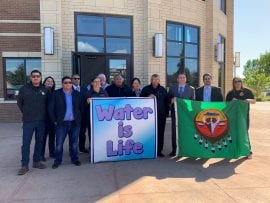
At US District Court, Great Falls MT, September 2019.
On November 17, 2020, the Rosebud Sioux Tribe and the Fort Belknap Indian Community filed a federal lawsuit against the United States Department of Interior (DOI) and the Bureau of Land Management (BLM) over their issuing of the KXL permit. Among other things, the complaint describes:
NARF Staff Attorney Matthew Campbell explained, “Before we allow a foreign company to build another pipeline to haul dirty tar sands across any American soil, we should be taking a hard look at the possible impact on American land, water, health, and safety. For tribal lands, the treaties absolutely require this sort of review. In issuing the Keystone XL permit with shoddy and superficial analysis, the federal government not only didn’t do its job, it did not follow the law.”
#HonorTheTreaties
Learn more about the Tribes fight to protect their homeland and people.

By Dan Bacher
SACRAMENTO – On November 17, leaders from the Yurok and Karuk Tribes, the Governors of California and Oregon, and executives from Berkshire Hathaway and PacifiCorp unveiled a new agreement to remove four Klamath River dams, including two located in California and two in Oregon.
In their new agreement, the states of California and Oregon will partner with the Klamath River Renewal Corporation (KRRC) to assume liability for the dam removal project, transferring the license to operate the dams from PacifiCorp.

