Indigenous Peoples and Human Rights

November 5, 2021

Free Maddesyn George who killed her attacker: Virtual press conference Nov. 8, 2021


Leading Scholars Call for End of Prosecution of Colville Tribal Member Maddesyn George: George’s Prosecution is Part of the Larger Crises of Murdered and Missing Indigenous Women and Abuse-to-Prison Pipeline

 Campaign to Free Maddesyn George
Contact: freemaddesynevents@gmail.com
Censored News

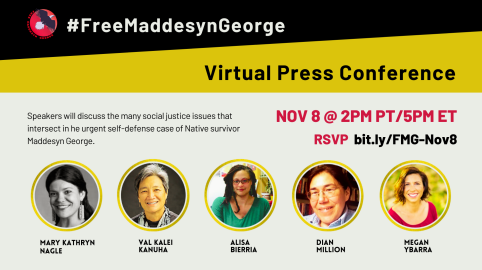
On Monday, November 8 at 2 p.m. PT/5 p.m. ET, leading scholars of violence against Indigenous women and families and the criminalization of domestic and sexual violence survivors will address the urgent self-defense case of Maddesyn George at a virtual press conference.

Among the featured speakers are attorney and award-winning playwright Mary Kathryn Nagle and professors Val Kalei Kanuha (University of Washington), Alisa Bierria (University of California Los Angeles), Dian Million (University of Washington), and Megan Ybarra (University of Washington).

Maddesyn George is a young Native mother from the Colville Reservation in Washington State and a survivor of domestic and sexual violence. She is being prosecuted by the United States Attorney’s Office for the Eastern District of Washington for acting in self-defense against a white man who raped and threatened her. After being incarcerated for more than a year, facing multiple charges, and fearing the unknowns of a jury trial, George accepted a deal from the prosecutors that included pleading guilty to voluntary manslaughter and a charge of drug possession with intent to distribute. Now, prosecutors are recommending a punishment that significantly exceeds the sentencing guidelines for these charges: a prison term of 17 years and lifetime state supervision. George’s sentencing hearing is set for November 17.

The case has inspired a broad-based grassroots campaign of Indigenous and anti-violence organizers to fight for her freedom. Nearly 8,000 individuals and 80 social justice organizations from around the country have endorsed a call for the charges to be dropped before George’s sentencing hearing.

In response, prosecutors have doubled down on discrediting and minimizing George’s account of rape, using her criminal record and the fact that she took drugs and cash from her attacker to deny her victimization claim. At the same time, they have willfully ignored the deceased’s criminal record of violence against multiple women. As George’s attorney told the Intercept, "What the prosecutor is telling is a story of robbery by a drug-addicted

Native woman, playing into stereotypes about substance use and Native people to undermine her claim of self-defense.”

George’s supporters argue that her survival actions prevented her from becoming another MMIW statistic. Indeed, Washington State ranks second highest in the country for missing and murdered Indigenous people, according to the Urban Indian Health Institute. And yet, for acting in self-preservation, Maddesyn is being punished––she has become one of the many survivors from colonized, racialized, and otherwise marginalized communities that have been ensnared by the “abuse-to-prison pipeline.”

It is not too late for the Department of Justice to reverse course, and George’s supporters implore them to do so. George should be reunited with her now 19-month-old daughter and community and provided with resources for recovery and healing.

Registration required for Zoom link to press conference: http://bit.ly/FMG-Nov8. A press kit will be emailed to journalists upon registration.


The Intercept’s Coverage of Maddesyn George’s Case from 10/8/21: https://theintercept.com/2021/10/08/maddesyn-george-self-defense-rape/?utm_campaign=theintercept&utm_medium=social&utm_source=twitter 

Short Documentary on Maddesyn’s Case: https://vimeo.com/600554722 

Campaign website: www.freemaddesyn.com

Change.org petition: www.change.org/freemaddesyngeorge

Organizational endorsement list: https://tinyurl.com/yr88taa3


Organizational Endorsements

Last updated October 26, 2021.


Abused Deaf Women’s Advocacy Services (WA)

Accountable Communities Consortium (WA)

AGE UP (All Girl Everything Ultimate Program) (WA)

All of Us or None – Eastern WA

American Indian Science and Engineering Society at UCLA 

API Chaya (WA)

Asian Counseling and Referral Service (WA)

Big Picture Learning Native American Initiative

Black and Pink Seattle/Tacoma

California Coalition for Women Prisoners

Christian Peacemaker Teams (International)

Coalition Ending Gender-Based Violence (WA)

Collective Justice (WA)

Columbia Criminal Justice Coalition (NY)

Communities of Color Coalition (WA)

Communities United for Restorative Youth Justice (CA)

Connecticut Alliance to End Sexual Violence

Critical Resistance – Portland (OR)

Domestic Violence & Sexual Assault Services (WA)

Dove Project (WA)

Eastside Legal Assistance Program (WA)

Fight Toxic Prisons (National)

Florida Council Against Sexual Violence

ForFortyTwo (WA)

Free Food From Jupiter (WA)

Free Hearts (TN)

Free Them All WA

Friends of Little Saigon (WA)

Gender Justice League (WA)

Hualapai Tribe (AZ)

INTERIM CDA (WA)

Journal of Prisoners on Prisons (Canada)

Kern County Participatory Defense (CA)

Legal Voice (WA)

LifeWire (WA)

Love + Protect (IL)

Mariposa House (WA)

Michigan Solidarity Bail Fund

Minnesota Coalition Against Sexual Assault

Missing and Murdered Native Americans (WA)

Missing & Murdered Indigenous Women Washington

Mother Nation (WA)

Multi-Communities (WA)

Native Women's Collective (CA)

New Beginnings (WA)

New Connections (WA)

New Mexico Coalition of Sexual Assault Programs

New York State Coalition Against Sexual Assault

No New Jails DC Coalition

No New Washington Prisons

Participatory Justice (WA)

Peer Reentry Navigation Community Bail Fund (WA)

Pillars of the Community (CA)

Project Harja (NY)

Radical Women Seattle

Reimagine Safety (WA)

Resilience (formerly Rape Victim Advocates) (IL)

Seattle Community Fridge

The Sentencing Project (Washington, D.C.)

Sovereign Bodies Institute (CA and MT)

South & East King County Mutual Aid (WA)

South Philly Participatory Defense Hub

Study and Struggle (MS)

Support Ho(s)e Collective (IL)

Surge Reproductive Justice (WA)

Survived and Punished (National)

Toronto Abolition Convergence

TRU Unity (WA)

University Beyond Bars (WA)

Vashon-Maury SURJ - Showing Up for Racial Justice (WA)

Washington Coalition of Sexual Assault Providers

Washington State Coalition Against Domestic Violence

Women Who Choose to Live (Ottawa)

Young Women's Freedom Center (CA)

YWCA of Walla Walla (WA)


November 3, 2021

Climate Crisis Film Festival Features Indigenous Films


Telling the Story of Climate Change

Watch films for free anytime Nov. 1 -- 14, 2021. Register at:
The UK's Climate Action Film Festival features more than 60 films from 30 countries!


Virtual Climate Crisis Film Festival Brings BIPOC Documentaries to COP26

Films from the front lines of climate change showcase voices missing from the summit

By Christian Thorsberg | Oct 31 2021

This year’s international COP26 summit is considered by many as the last chance for governments to agree on crucial climate policies that reduce carbon emissions and limit global temperature rise before the planet is set on the path to irreversible climate change. Taking place in Glasgow from October 31 to November 12, the mostly in-person conference is set to host over 200 countries, NGOs, businesses, faith groups, and other governing bodies. But the summit has been widely criticized for being inaccessible to those who are already experiencing the impacts of the climate crisis. For small countries and BIPOC communities and activists, particularly those in the Global South, where the first and most drastic effects of extreme weather are occurring, vaccine inequality and travel costs are barriers to seats at the proverbial table. 

This troubling inequity is very much on the mind of Susanna Basso, artistic director and cofounder of the Climate Crisis Film Festival (CCFF). “The most vulnerable communities have the least to do with carbon emissions,” Basso says. “For them not to be included at COP26 is particularly worrying. The least we can do as a festival is to give over our platform, showcase [these communities], and pass the mic.”  

Accessible online from November 1 through November 14, the festival’s program includes over a dozen films from BIPOC filmmakers on the front lines of climate change around the world, including shorts, mid-length, and feature-length documentaries from Pakistan, Niger, Brazil, Denmark, the United States, Panama, Chile, and New Zealand. The films, and the greater “festival ethos,” Basso says, are linked by the theme of “intersectionality.” The documentaries that were selected, in addition to their artistic power and gripping visuals, Basso says, confront climate change through the lens of social justice, gender inequality, politics, and the economy. 

the climate crisis film festival

The Climate Crisis Film Festival (CCFF) is the UK’s first climate action film festival.

Pioneering, aspirational, grassroots and youth-led, our diverse and eye-opening programming focuses on channeling constructive collective action and providing an intersectional analysis of climate, politics, economics and social justice

The CCFF was started in the summer of 2019 by three 26 year old friends wanting to contribute to what at the time felt like London’s climate awakening.

We felt like existing environmental film festivals across the world were too broad in their scope to tackle climate change head-on and that there was space for a film festival that was laser-focused on the climate crisis and which dissected it through a social, political and economic lens — that is, from an intersectional angle.

We felt a great excitement for what we saw as a ‘new wave of environmentalism’ — at the time we didn’t have the perfect words to describe it, but 3 years on, intersectional environmentalism is on the rise and we’re proud to have been a champion of the concept from the get-go.

October 31, 2021

Zapatistas Bring Autonomous Struggle to Scotland


Autonomy, Self Reliance and Dignity

Article by Brenda Norrell

Censored News

Zapatistas from Chiapas, on the Journey for Life, were welcomed to Scotland. The delegation met with 15 organizations and discussed autonomous governments and the role of women.

The delegation of more than 170 Zapatistas that arrived in Vienna, Austria, are traveling through Europe in small groups and have already joined struggles in the Far North with Sami in Finland and Russia, and supported struggles in France, Germany, Italy, Switzerland, Greece, Ireland, the Netherlands, Basque homelands, and the struggles of migrants and Kurdish women.

The first delegation of Zapatistas arrived from Chiapas by ship, crossing the Atlantic, arriving first in Portugal and then Spain.

Zapatistas are sharing their message of resistance to capitalism and their history of autonomous government, as they battle exploiters, government oppression, and corporate theft of their homelands for mining and development in Chiapas.

October 30, 2021

Tohono O'odham Ofelia Rivas Speaks in Defense of Territories, Honduras Conference, Day 2


Tohono O'odham Ofelia Rivas addresses Day 2 of the National Meeting of Peoples and Communities in Defense of their Territory in Honduras, with testimony from the regions of Buenos Aires, Rio de Janeiro, Mexico City, Bogota, Los Angeles and Madrid. 

By Ofelia Rivas, Tohono O'odham
English/Espanol
Translation by Alejandro Aguilar
Censored News
Oct. 30, 2021

In Indigenous cultures there is no negotiation in sacred matters of the tangible and intangible, as recommended, acknowledgement and legal recognition of original people and original lands will begin an understanding of the extent of ancestral obligations and levels of responsibilities that are continually disrupted by all levels of government and the privatizing of lands deeply related to original peoples.

All and all the view has been antiquated racist and ignorance. Indigenous peoples, the original people, have been ignored and all inherent rights as an individual, a group and a distinct cultures are violated. The original peoples are disappeared, executed and re-categorized at the government, corporations and political whim for their benefit.

In the reality, Indigenous ways of life have long been compromised through forced relocation and immigration caused by governments and corporations taking over land.

In moving towards a sustainable healthy community all Indigenous peoples must uphold their sacred ceremonies and original foods and languages. The world has continually been altered, but the natural world remains the same. Indigenous people, the original are apart of the natural world. All Indigenous people stand strong, the natural world is our ally and it is our obligation to do whatever we can to continue to support it.

Much respect to all the land defenders and water defenders that gave their lives. I personally was imprisoned at Tapachula, Mexico immigration prison for my actions in defense of the people and land.

Government and corporations are only machines that we can disperse, we are here today as we are capable of understanding this technology. I challenge the university students to uphold their obligation to the people:

1. Develop a people friendly accessible data base of regional proposals of extraction and other developments. 2. Develop a watch dog organization with accessible data to inform the people on processes and legal rights. 3. Develop a list of pro bono or affordable legal assistance.

Day 1: In Defense of Territories, Conference in Honduras


Espanol

Día viernes

Declaraciones de Ophelia Rivas, nación tohono o’odham, noroeste de México / suroeste de Estados Unidos.

Impactos del gobierno y de las corporaciones en los pueblos indígenas, 1. Reconocimiento legal por parte del gobierno de los territorios de los pueblos originarios. 2. Inclusión en propuestas e informes de investigación de impacto ambiental. 3. Plena autoridad legal en la participación y la toma de decisiones finales. Previa falta de preaviso en reuniones iniciales, falta de reconocimiento y reconocimiento de las autoridades tradicionales. Los pueblos indígenas acceden a la tecnología para la participación plena, telefonía, servicios de internet y traducción de material. Un proceso para el pleno consentimiento informado de los pueblos indígenas. La violación del gobierno y las corporaciones de los derechos de los pueblos indígenas bajo las leyes internacionales.

Derechos indígenas a la tierra, la cultura y las personas; mujeres, niños y hombres. Todos los pueblos indígenas tienen derecho a vivir y existir sin conflictos ni privación de derechos. Las regulaciones para la pandemia hacen cumplir los derechos individuales de protección y protección para la población en general. Signatarios de derechos indígenas por estados, México y otros países en las Naciones Unidas, derechos indígenas, desarrollados por los pueblos indígenas.

Día sábado

Cuáles son las estrategias comunicativas que deben desarrollarse para promover el patrimonio tangible e intangible de los pueblos originarios y afroamericanos para el fortalecimiento económico y el buen vivir

Respuesta de Ophelia Rivas, de la nación tohono o’odham a la primera pregunta:

En las culturas indígenas no hay negociación en asuntos sagrados de lo tangible e intangible. Como se recomienda, el reconocimiento y reconocimiento legal de los pueblos originarios y las tierras originarias, iniciará un entendimiento de la extensión de las obligaciones ancestrales y niveles de responsabilidades que son continuamente interrumpidos por todos los niveles. de gobierno y la privatización de tierras profundamente relacionadas con los pueblos originarios.

Comentario de Alejandro Aguilar, antropólogo del INAH en el norte de México:

En primer lugar, decidir si esto es lo que queremos hacer. Después de ello, generar una “política patrimonial”, para la formación de una “conciencia patrimonial”, pero pensando desde la gente, desde el patrimonio tradicional de los pueblos, herencia de sus mayores. No es lo mismo cuando gente externa se apropia del patrimonio de un pueblo “patrimonializándolo”, al proceso en que un pueblo adquiere conciencia de su propia herencia e identidad.

¿Cuál ha sido el papel de los actores sociales y políticos y económicos en la promoción del patrimonio tangible e intangible de los pueblos originarios en el marco del modelo de desarrollo predominante?

Respuesta de Ophelia Rivas

Todo y todo el punto de vista ha sido racista anticuado y con ignorancia acerca de los pueblos indígenas, los pueblos originarios han sido ignorados y todos los derechos inherentes como individuo, grupo y culturas distintas son violados. Los pueblos originarios son desaparecidos, ejecutados y recalificados por el gobierno, las corporaciones y el capricho político para su beneficio.

¿Cómo avanzar hacia las sociedades sostenibles que procuran tener una relación armoniosa con la naturaleza y respetuosa de los saberes ancestrales?

En la realidad, las formas de vida indígenas se han visto comprometidas durante mucho tiempo por la reubicación forzada y la inmigración causada por gobiernos y corporaciones que se apoderan de la tierra.

¿Quiénes y porqué deben ser los actores principales que impulsen una política cultural inclusiva e integradora?

Los pueblos originarios son la autoridad con asuntos relacionados con la cultura, tales como ceremonias, lugares sagrados y tangibles e intangibles. En la práctica anterior de los gobiernos y contratistas de los gobiernos, los grupos políticos que representan ilegalmente a los pueblos originarios han desorientado y mal informado al gobierno para su propio beneficio. En el caso de una operación de extracción de oro en la tierra de O'odham, un no O'odham era el negociador que representaba a un individuo.

Sin que los pueblos indígenas creen una organización de vigilancia para acceder a las propuestas de extracción en sus regiones, seguiremos estando mal informados y mal representados.

¿Cuál ha sido o debe ser el rol de las comunidades integradas en los territorios culturalmente afines para la defensa y promoción de su patrimonio cultural?

¿Cómo avanzar hacia sociedades sostenibles que busquen tener una relación armónica con la naturaleza y respetuosa de los conocimientos ancestrales?

¿Quiénes y por qué deberían ser los principales actores que promueven una política cultural inclusiva e inclusiva?

Respuesta

Para avanzar hacia una comunidad saludable y sostenible, todos los pueblos indígenas deben mantener sus ceremonias sagradas y sus alimentos e idiomas originales. El mundo se había alterado continuamente, pero el mundo natural sigue siendo el mismo, los pueblos indígenas, los originales son parte del mundo natural, todos los pueblos indígenas se mantienen firmes, el mundo natural es nuestro aliado y es nuestra obligación hacer todo lo posible para continuar apoyándolo.

Mucho respeto a todos los defensores de la tierra y defensores del agua que dieron sus vidas.

Yo personalmente estuve preso en la prisión de inmigración de Tapachula, México, por mis acciones en defensa del pueblo y la tierra. El gobierno y las corporaciones son solo máquinas que podemos dispersar, hoy estamos aquí porque somos capaces de entender esta tecnología.

Reto a los estudiantes universitarios a cumplir con su obligación con la gente; 1. Desarrollar una base de datos accesible y amigable para las personas de propuestas regionales de extracción y otros desarrollos. 2. Desarrollar una organización de perros guardianes con datos accesibles para informar a las personas sobre los procesos y derechos legales. 3. Desarrolle una lista de asistencia legal pro bono o asequible.


Gracias

Copyright Ofelia Rivas, Censored News. May not be reproduced without permission.