Indigenous Peoples and Human Rights
Showing posts with label activists. Show all posts

August 5, 2016

TransCanada and Peabody Coal spying with the feds


In this deceptive world of U.S. and corporate spying, land defenders and human rights activists are targeted, private corporations and U.S. agents are intertwined, young people are duped and go to prison, and federal agents use romance to spy on, and manipulate, peaceful protesters.

By Brenda Norrell
Censored News

TransCanada and Peabody Coal have been spying on activists in a toxic, dark world where private corporations and the U.S. government act in collusion, an attorney reveals in a news article on Earth First newswire.
In this deceptive world, private corporations and federal agents are intertwined, young people are duped and go to prison, and U.S. agents use romance to spy on, and manipulate their targets.
The article, Informants, Green Scare Snitches, and Surveillance: Interview with Lauren Regan, CLDC.

The real danger of these covert operations within the United States is that people are vulnerable. They get duped by these operators and schemes, and in the end they go to prison.
Now, by way of the Freedom of Information Act, the facts are being exposed of how corporations and the U.S. government target peaceful protesters, criminalize them, and send them to prison.
In the article, attorney Lauren Regan explains, "TransCanada was giving powerpoint presentations to FBI offices and local law enforcement agencies along the [Keystone] pipeline route. We actually got their whole powerpoint presentation, which included photos of lead organizers, and all of the federal terrorist crimes that they were encouraging local DA’s to use against activists, and things like that. Some of it we actually got through their own stupidity." 
Then there's Peabody Coal: "The way a lot of them work, say Peabody Coal for instance, they know they can’t have in-house spies. Because if that gets back to them, they get in trouble. So they set up and fund a separate private entity that is half-PR firm and half-security firm. In order for that entity to remain operational they have to produce information that Peabody Coal wants to hear, and they have to be validating their own job."
Facebook is referred to as 'facecrack,' and there is a caution. There's no need to create drama on facecrack when you know infiltrators are headed someone's way.
When a known infiltrator was headed to the Buffalo Field Campaign in Montana, here's what they did.
"We were able to call them, and I remember I faxed a black and white photo of the person to them, and said 'hey this person may be heading in your direction, keep your eyes out.' And they did, and they were able to shoo him on.'"

Earth First trial in Prescott exposed FBI entrapment


Meanwhile, in Arizona, it was the Earth First trial in Prescott that revealed how a federal agent romanced his target, entrapped environmentalists and sent them to prison in 1991.

The trial was an expose in federal misconduct in the early 1990s. 
Alongside Mike Lacey, founder of Phoenix New Times, I was among the reporters in the courtroom.
The trial was an introduction into FBI and U.S. misconduct in this dark world of spying, manipulation and entrapment, where the federal government is never prosecuted for entrapment.
Besides the romancing undercover FBI agent, the U.S. also sent an old boyfriend into a home as a babysitter to spy on one woman, planting a spy device in her bedroom. She had a new boyfriend at the time.
Without the romancing undercover FBI agent, there would have been no charges or trial. The U.S. attempted to turn every joke on the defendants tapped phone into a crime.
When the so-called "monkey wrenchers," named after Ed Abbey's book, didn't have a ride to do their monkeying around, the undercover FBI agent gave them a ride. He drove them out  there. Most of those on trial went to prison. Peg Millet out ran the agents at the scene, but later turned herself in.
At the time, I was a stringer for AP. When the trial was over, I question the prosecutor about planting an old boyfriend in someone's home as an undercover agent. "Wasn't he a sleaze?" I asked.
"All informants are sleazes," she said.
At New Times, Lacey had fun with the prosecutor Asst. US Attorney Roslyn Moore-Silver. In one article, Lacy wrote that she came into the courtroom, grabbed her balls and shot the judge a high five.
Lacey went a step further and sent the prosecutor flowers when she had an accidental fall after the trial. She sent them back.
While it was fun at times in that Prescott courtroom, it no doubt was not fun for those well-meaning activists who went to prison while attempting to make a difference in the world.

Corporate bottom-feeders laughing all the way to the bank


These days, the entrapment is more sophisticated and the spying permeates everyone's lives, from the street corner, to cell phones to Internet e-mails and chats.

With new laws now, those manipulated and entrapped are sent to prison for even longer terms.
Snitches are often those who are arrested and are trying to avoid jail time, or those in prison wanting early release. They are willing to send others to prison.
The private corporations found a way to turn all this into money.
Protecting disastrous mining means money to the corporations, and mega dollars roll into new spy corporations. The private prisons and security firms are making fortunes.
Since the media in the U.S. has collapsed -- with most reporters flopped in their easy chairs and plagiarizing from the web -- this dark world is now a vacuum for bottom-feeders.
The film industry too has been compromised. It is now a vehicle to promote bogus wars, U.S. targeted assassinations, and the fantasy world of U.S. news and policy.

Time has brought the gift of truth


The environmentalists who were once demonized in the backrooms of news rooms, who were once vilified by the sell-outs, are now beginning to be recognized as front runners protecting the land, water and air.

As water is vanishing, lands are poisoned, and the air is dark, the world is beginning to appreciate the struggles of the land defenders.
Indigenous Peoples continue to be assassinated by corporations around the world as they defend their lands from mining and destruction. In North America, Native Americans with few resources bear the burden of defending the land, water, and air.
Today they carry on.


Also see The Guardian: Undercover cop fathered children with activists
https://www.theguardian.com/uk/2012/jan/20/undercover-police-children-activists

January 27, 2016

O'odham Voice against the Wall Distinguished Speaker Series Feb/March 2016

O'odham Voice against the Wall features activist John Zerzan, professor and author Dr. Julian Kunnie, O'odham poet Ruben Cu:k Ba'ak, Navajo poet Laura Tohe, Acoma Pueblo poet, professor and author Simon Ortiz and O'odham human rights activist Ofelia Rivas
Feb. 27 -- March 26, 2016
Cat Mountain Lodge, Tucson, Arizona


March 28, 2015

Activists 'Shut Down' Nestlé Water Bottling Plant in Sacramento

Photo of protest in front of the Nestlé Waters bottling plant in Sacramento on March 20 by Dan Bacher.
Activists 'Shut Down' Nestlé Water Bottling Plant in Sacramento 

by Dan Bacher
Censored News
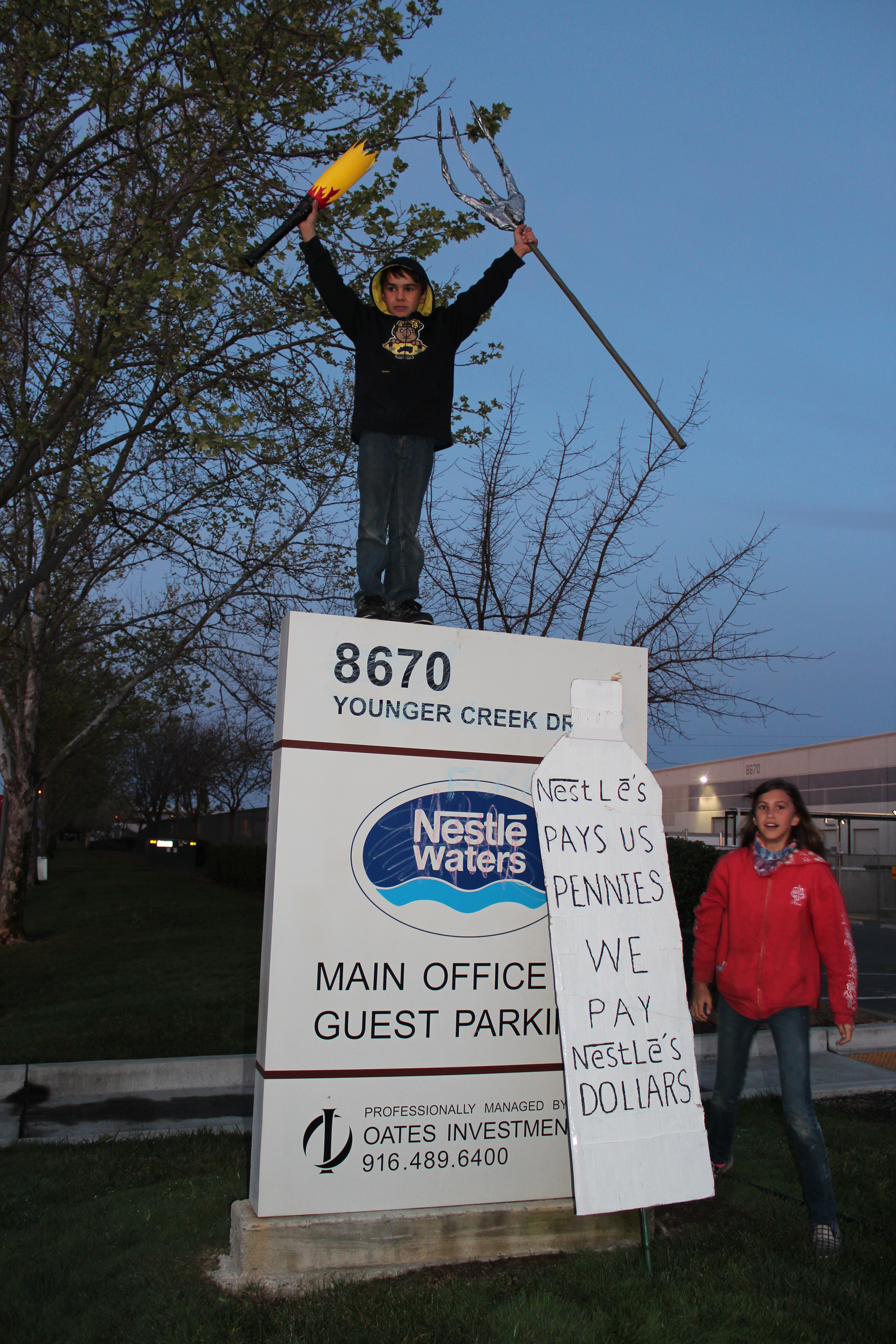
Environmental and human rights activists, holding plastic “torches” and “pitchforks,” formed human barricades at both entrances to the Nestlé Waters bottling plant in Sacramento at 5:00 a.m. on Friday March 20, effectively shutting down the company's operations for the day. 

Members of the “Crunch Nestlé Alliance" shouted out a number of chants, including “”We got to fight for our right to water,” “Nestlé, Stop It, Water Not For Profit," and “Agua Para Quien? Para Nuestra Gente!” 

The protesters stayed until about 1 pm, but there were no arrests. 

Representatives of the alliance said the company is draining up to 80 million gallons of water a year from Sacramento aquifers during a record drought. They claim Sacramento City Hall has made it possible through a "corporate welfare giveaway." 

“This corporate welfare giveaway is an outrage and warrants a major investigation,” Coalition spokesperson Andy Conn said. “For more than five months we have requested data on Nestlé water use. City Hall has not complied with our request, or given any indication that it will. Sacramentans deserve to know how their money is being spent and what they’re getting for it. In this case, they’re getting ripped off.” 

Lola Ellis of 99 Rise Sacramento, who spoke on the bullhorn at the protest, said, “Nestlé’s bottling of water in Sacramento is unsustainable in the current state of drought. We really don’t’ know how much water they are taking from the aquifer and that is a scary thing.” 

“The water needs to be used for the local community. If there is not enough water for the local community, the Nestlé corporation should not be making a profit,” she emphasized. 

The coalition protested what they call Nestlé's “virtually unlimited use of water” while Sacramentans (like other Californians) who use a mere 7 to 10 percent of total water used in the State of California, have had severe restrictions and limitations forced upon them. 

The coalition is calling on Nestlé to pay rates commensurate with its enormous profit, or voluntarily close down. 

“Nestlé pays only 65 cents for each 470 gallons it pumps out of the ground – the same rate as an average residential water user. But the company can turn the area's water around, and sell it back to Sacramento at mammoth profit,” according to a news release from the activists. 

They said Sacramento officials have refused attempts to obtain details of Nestlé's water use. Coalition members have addressed the Sacramento City Council and requested that Nestle’ either pay a commercial rate under a two tier level, or pay a tax on its profit. 

A call to the Sacramento City Department Utilities about the details of Nestle’s water use hadn’t been returned as of press time. 

But according to Fox 40 News, “In 2014 Nestlé says it used 50 million gallons from the Sacramento Municipal Water Supply, which they say is a fraction of one percent of total water demand within the city of Sacramento.” 

“Nestle can claim any amount of water they want, but we haven’t seen any documentation of the amount of water they’re using,” said Bob Saunders, also with the Crunch Nestlé Alliance. "We do know they’re allowed to take up to 80 million gallons per year.” 

Mauro Oliveira, known as "Red Sun," showed up at the protest with his children, including Rise, Aren and Mahai'a, and connected the battle of local activists against Nestlé with the struggle of Indian Tribes, family farmers, grassroots environmental activists and fishermen to stop fracking, the Shasta Dam raise, and Governor Jerry Brown’s Bay Delta Conservation Plan (BDCP) to build the twin tunnels, the most environmentally destructive public works project in California history. 

“This whole idea of bottling water goes against Indigenous Peoples' concept of water is sacred," said Oliveira. "The 20,000-year-old water in aquifers belongs to the last generation on earth. We don’t have the right to tap into this water.” 

“The Governor said we should conserve, but millions of gallons of fracking waste are being reinjected into the aquifer in California. The Governor talks out of both sides of his mouth. Polluting our water supplies is a violation of human rights," said Oliveira. 

Raiding pristine water from a National Forest stream 

The bottling plant in Sacramento is not the only one in California. A recent investigation in the Desert Sun found that Nestlé Waters North America has been pumping water from pristine streams of the San Bernardino National Forest with little to no oversight by the U.S. Forestry Service. (http://www.desertsun.com/story/news/2015/03/05/bottling-water-california-drought/24389417/) 

“Nestle Waters North America holds a longstanding right to use this water from the national forest near San Bernardino,” according to the Sun. “But the U.S. Forest Service hasn't been keeping an eye on whether the taking of water is harming Strawberry Creek and the wildlife that depends on it. In fact, Nestle's permit to transport water across the national forest expired in 1988. It hasn't been reviewed since, and the Forest Service hasn't examined the ecological effects of drawing tens of millions of gallons each year from the springs.” 

On its website, Nestlé claims that it is committed to “environmental stewardship.” (http://www.nestle-watersna.com/en/about-nestle-waters) 

“36 years of experience promoting healthy hydration, Nestlé Waters North America has 15 leading U.S. and Canadian bottled water brands,” according to the company. “The company’s commitment to environmental stewardship, especially in the areas of water use, packaging and energy, as well as its dedication to partnering in the communities where it operates, have led Nestlé Waters to achieve the number one bottled drinking water position in the U.S.” 

Activists disagree strongly with the company’s claims of commitment to "environmental stewardship." In October, the “Crunch Nestle” coalition released a "White Paper" highlighting predatory water profiteering actions taken by Nestle’ Water Bottling Company in various cities, counties, states and countries. 

Most of those great “deals” yielded mega profits for Nestle’ at the expense of the public. Additionally, the environmental impact on many of those areas yielded “disastrous results,” the paper stated. 

Nestlé is currently the leading supplier of the world’s bottled water, including such brands as Perrier and San Pellegrino, and has been criticized by activists for human rights violations throughout the world. 

Nestlé Waters says it has 7,500 employees and 29 bottled water facilities across the U.S. and Canada, and annual revenues were $4.0 billion in 2012, up 6.8% from 2011. 

For example, Food and Water Watch and other organizations blasted Nestlé’s "Human Rights Impact Assessment" in December 2013 as a "public relations stunt." 
(http://www.foodandwaterwatch.org/pressreleases/organizations-denounce-nestles-new-human-rights-impact-assessment-as-a-public-relations-stunt-us-version/) 

“The failure to examine Nestlé’s track record on the human right to water is not surprising given recent statements by its chair Peter Brabeck-Letmath challenging the human right to water,” said Wenonah Hauter, Executive Director of Food & Water Watch. She noted that the company famously declared at the 2000 World Water Forum in the Netherlands that water should be defined as a need—not as a human right. 

Watch Nestlé's CEO declare water “food that should be privatized, and not a human right”: http://http://www.globalresearch.ca/nestle-continues-stealing-worlds-water-during-drought/5438880 

More recently Brabeck-Letmathe, after facing international criticism for his remarks, reversed course and now said he thinks that "water is a human right and that everyone, everywhere in the world, has the right to clean, safe water for drinking and sanitation." (http://www.nestle.com/aboutus/ask-nestle/answers/nestle-chairman-peter-brabeck-letmathe-believes-water-is-a-human-right?gclid=CPX_jpydycQCFQaTfgodFjAA0Q) 

But activists continue to cite the company's bad human rights record, noting that Nestlé workers who have protested unjust labor conditions at the corporation’s facilities in Colombia have been assassinated by paramilitary death squads. 

"In November 2013, Colombian trade unionist Oscar Lopez Trivino became the fifteenth Nestlé worker to be assassinated by a paramilitary organization while many of his fellow workers were in the midst of a hunger strike protesting the corporation’s refusal to hear their grievances," according to the groups. 

Taking the water from aquifers throughout the world and the deaths of workers protesting Nestlé policies are not the only violation of human rights that activists charge the corporation with. Groups including the International Baby Food Action Network (IBFAN) and Save the Children claim that the promotion of Nestle infant formula over breastfeeding has led to health problems and deaths among infants in less economically developed countries. 

“They’re a despicable company with death built into their business plan,” summed up Conn. 

For more information about the Crunch Nestlé Alliance, contact Andy Conn (530) 906-8077 camphgr55 (at) gmail.com or Bob Saunders (916) 370-8251 

The Drought and The Tunnels 

The Sacramento protest took place just days after Jay Famiglietti, the senior water scientist at the NASA Jet Propulsion Laboratory/Caltech and a professor of Earth system science at UC Irvine, revealed in an op-ed in the LA Times on March 12 that California has only one year of water supply left in its reservoirs. (http://touch.latimes.com/#section/-1/article/p2p-83043355/) 

The protest also made the news as Governor Jerry Brown continues to fast-track his Bay Delta Conservation Plan (BDCP) to build the peripheral tunnels to ship Sacramento River water to corporate agribusiness, Southern California water agencies, and oil companies conducting fracking operations. 

The $67 billion plan won't create one single drop of new water, but it will take vast tracts of Delta farm land out of production under the guise of "habitat restoration" in order to irrigate drainage-impaired soil owned by corporate mega-growers on the west side of the San Joaquin Valley. 

The tunnel plan will also hasten the extinction of Sacramento River Chinook salmon, Central Valley steelhead, Delta and longfin smelt, green sturgeon and other fish species, as well as imperil the salmon and steelhead populations on the Klamath and Trinity rivers. The peripheral tunnels will be good for agribusiness, water privateers, oil companies and the 1 percent, but will be bad for the fish, wildlife, people and environment of California and the public trust.
§In front of the plant
by Dan Bacher Friday Mar 27th, 2015 4:01 PM

Protesters form a "barricade" in front of the bottling plant in Sacramento. Photo by Dan Bacher.
§Aren Oliveia
by Dan Bacher Friday Mar 27th, 2015 4:01 PM

Aren Oliveira holds up a "torch" and "pitchfork." Photo by Dan Bacher.
§Crunch Nestlé
by Dan Bacher Friday Mar 27th, 2015 4:01 PM

Protesters at the Nestlé bottling plant in Sacramento just after sunrise. Photo by Dan Bacher.
§Faygo speaking
by Dan Bacher Friday Mar 27th, 2015 4:01 PM

Faygo, local activist, speaking at the protest. Photo by Dan Bacher.
§Delphine Brody
by Dan Bacher Friday Mar 27th, 2015 4:01 PM

Delphine Brody, local activist, on the bullhorn. Photo by Dan Bacher.
§Water is not a commodity
by Dan Bacher Friday Mar 27th, 2015 4:01 PM

Protesters stayed in front of the plant from 5 a.m. to 1 p.m. Photo by Dan Bacher.

February 9, 2015

Behind the Story: FBI repression of anti-fossil fuel activists


Letter to Censored News


Hi Brenda,
"My name is Sasha, and I am a co-founding moderator of the EF! Newswire.
Last month I published a story through the Defending Dissent Foundation about state repression of anti-fossil fuel activists in Cascadia:
The story was immediately posted in The Ecologist, CounterPunch, the
Global Justice Ecology Project, Green Is the New Red, and Earth Island
Journal, among other publications.
Then it was picked up on by Becky Kramer, writing for the Idaho
Spokesman-Review:
Then it made its way to AP, through which it was disseminated to Oregon
Public Broadcasting, Washington Times, Houston Chronicle, and other
national newspapers:
And just today the story was recast by the Canadian Press, where it made
its way to the Globe and Mail, and other international sites:
The story behind the story is actually quite interesting. The
Idaho-based anti-megaloads group Wild Idaho Rising Tide (WIRT) has 
been fighting megaloads since 2011, and I got the scoop about megaloads
coming through Oregon from a WIRT activist, Helen Yost. I put up an
article about the megaloads in Oregon, headlined "Be the First Line of
Defense Against Megaloads," and a meeting was organized among
environmentalists around the area here in Portland. I had varying
degrees of involvement with the campaign as both a journalist and
activist, and have also been marginally involved in the same capacity
with Portland Rising Tide. I submitted a story idea about state
repression of anti-fossil fuel movements here to Brenda last year after
my pal Arun Gupta gave me the reference, and we were working on the
story for about a month when it seemed as though it had gone cold. There
just wasn't enough about FBI visits, and I frustratedly put down my pen
for a day or two when suddenly my friend Helen received the pomo
equivalent of a knock on the door — three texts from the FBI. I quickly
interviewed her about it, banged the article into shape, Udry and
Wishnia at Defending Dissent made a few editorial suggestions, and it
went live. Within a few days, the story was all over the place, and a
month later it is everywhere!"


Thanks very much,
Sasha

Why Is The FBI Harassing Activists in Cascadia?

Why Is The FBI Harassing Activists In Cascadia?


Thanks to Defending Dissent Foundation and Earth First! Journal for permission for Censored News to publish this original work!
Alexander Reid Ross , January 5, 2015, In : Analysis & Opinion
Editor’s note: this story has recently been picked up by The Statesman and AP… but you heard about it here first! Sign up for our weekly digest here, to get the latest on dissent & repression delivered to your inbox each Friday.
In August 2014, two activists with the environmentalist group Rising Tide spent a week riding the backwoods highways of Idaho monitoring a megaload—a big rig hauling equipment for processing tar-sands oil that’s wide enough to take up two lanes of road, too high to fit under a freeway overpass, can be longer than a football field, and can weigh up to 1,000,000 pounds.
They had no idea that they would soon be wrapped up in a Federal Bureau of Investigation probe that encompassed three states and several environmentalist groups.
Helen Yost of Moscow, Idaho, and Herb Goodwin of Bellingham, Washington, have spent years travelling through area the bioregion of Cascadia to halt megaloads, from Washington and Oregon to Idaho and up through Montana. They are used to harassment from law enforcement. That week, Goodwin said, the two were stopped on average twice a night, by law-enforcement agencies ranging from state troopers to local police in Sandpoint and Moscow.

February 1, 2011

Wikileaks Peru: US Ambassador targeted Indigenous activists, promoted mining


Deadly mining in Peru, deadly for Indigenous Peoples 2015


Diplomats protecting mining interests of Barrick, Newmont, BHP: US, Canada, Australia, UK, Switzerland and South Africa

By Brenda Norrell, Censored News
http://www.bsnorrell.blogspot.com

(Feb. 1, 2011) The arrogance of the US and its cheerleading for corporate copper mining in Peru is obvious in two cables just released from Wikileaks. The diplomatic cables reveal the US promoting multi-national corporations, while targeting Indigenous activists and their supporters.

The new cables reveal that a core group of diplomats formed an alliance with mining companies to promote and protect mining interests globally. The diplomats were from the U.S., Canada, U.K., Australia, Switzerland and South Africa.

While rallying for copper mining in Peru, US Ambassador J. Curtis Struble failed to point out in the cables the torture and murder of Indigenous activists by mining companies, near the border of Peru and Ecuador. Struble failed to reveal the long-term destruction to Mother Earth and poisoning of the land, water and air from copper mining.

Further, Struble named names, while promoting the mining corporations. Struble targeted specific NGOs and urged the rotation of teachers and those supporting Indigenous activists out of Peru.

Peru activist Nicanor Alvarado Carrasco, coordinator of the Vicarate for the Environment, is among those defending the land. Nicanor said the mining company Minera Majaz, a subsidiary of the British Montericco Metals, is operating illegally on their territories.

“This mine company is a threat to the environment and to people’s rights to food and water,” said Nicanor in an interview.

"This is a moment for the world citizens to show that world citizenship exists. You from the North can help stop illegal mining companies, like Monterrico Metals, from contaminating our land, killing peasant leaders, and from torturing the active Minera Majaz opposition,” Nicanor said.

Struble, the former Ambassador to Peru, however, had only insults for Indigenous Peoples struggling to protect their land. Struble was US Ambassador in Lima in 2005 when he wrote the cables.

While seeking sympathy for the copper mining company, Struble targets those defending the land.

Struble said in one cable: “The anti-mining forces in action in Majaz represent a strange group of bedfellows indeed -- the Catholic church, violent radical leftists, NGOs, ronderos and perhaps narcotraffickers. These organizations are competing for a leadership role but in some cases also cooperate. The extent to which the church is tied into the ronderos and radical left is both controversial and still open to question. Unlike recent conflicts in Southern Peru (e.g., Tintaya) the protests in Majaz are not aimed at forcing a redistribution of royalties or more generous economic support from a mine. Northern Peru has a reputation for being more anti-mining than the South, where the industry is better developed and more of the local populations see benefits from the activity. The objective of protesters in Majaz is to kill the project while it is in the exploration phase -- before, presumably, a pro-mine constituency can develop in the area."

Ambassador Struble does not seem to have a clue why the people who live on the land want the mining halted, or the impacts for future generations.

Struble said US and Canadian Ambassadors, and a delegation of diplomats, met with the mining companies to discuss the opposition to mining.

"Consensus among the companies is that radical forces (Communist Party-Patria Roja, drug traffickers and rural defense committees--ronderos) are increasingly active in rural communities, seeking to target mining operations throughout the country."

The US and Canadian Ambassadors meeting with mining companies included: Antamina, Newmont (Minera Yanacocha), Minera Quellaveco, Barrick, BHP Billiton (Tintaya mine). The diplomats were from the US, Canada, the Swiss Charge, the new Australian Consul General, and the British Embassy Trade and Investment. "A representative from the South African Embassy, which forms part of this diplomatic mining group, was unable to attend," the cable said.

Their goal was to improve the climate for investments and security around mines, the cable said.

Three of these countries -- US, Canada and Australia -- at this meeting in Peru were among the four countries who voted against the UN Declaration on the Rights of Indigenous Peoples when it was adopted by the UN General Assembly. New Zealand was the fourth.

In today’s London Guardian, Tim Webb points out that the mining company in Peru is part-owned by a British FTSE 100 company. In a second cable, Struble advocates for the removal of teachers and Catholic bishops and teachers to new posts away from "conflictive mining.”

Diplomats were urged to persuade the Peruvian government and church to "rotate" such professionals out of sensitive areas.

In the second cable, an executive from Anglo American's Minera Quellaveco reportedly blamed Oxfam America and Friends of the Earth for largely “fomenting anti-mining attitudes” at the meeting, it was alleged.

A spokesman for Oxfam America said that while such NGOs tried to make sure companies treated communities "justly", they only did so through legal channels and never advocated violence, the Guardian reported.

Meanwhile, in the United States, two of the mining companies that diplomats met with to promote and protect, continue to destroy sacred lands. Western Shoshone have been fighting mining by Newmont and Barrick mining in their homelands. Currently before the US federal court is Barrick's plan for an open pit gold mine on sacred Mount Tenabo.

Peru mining cables:
Cable 1:
http://213.251.145.96/cable/2005/08/05LIMA3571.html
Cable 2: Posted and highlighted by London Guardian
http://www.guardian.co.uk/world/us-embassy-cables-documents/38881
Today's Guardian article:
http://www.guardian.co.uk/business/2011/jan/31/wikileaks-bhp-billiton-peru-mining-communities

Nicanor speaking in Cochabamba, Bolivia, at the World Conference on Climate Change and Mother Earth, in April:

.