Indigenous Peoples and Human Rights

November 8, 2021

Precious Waters: Tribes, Indigenous Peoples, file petition to strengthen federal mining rules


Precious waters


Tribes, Indigenous groups, conservation organizations file petition to strengthen federal mining rules

By Earthworks
Beyond Nuclear International
Censored News


Tribes, Indigenous groups and conservation organizations filed a rulemaking petition on September 16 with the U.S. Department of the Interior to improve and modernize hardrock mining oversight on public lands. The proposed revisions aim to safeguard critically important lands across the West and Alaska, including sacred lands and their cultural resources, vital wildlife habitat, and invaluable water resources.

“It’s long past time to reform the nation’s hardrock mining rules, end generations of mining-inflicted injustice to Indigenous communities, and chart a new course for public lands stewardship toward a sustainable, clean energy economy,” the petition states. “For far too long, mining companies have had free rein to decimate lands of cultural importance to tribes and public lands at enormous cost to people, wildlife, and these beautiful wild places of historic and cultural significance. The harm is undeniable, severe, and irreparable. Reforming these rules will prevent more damage, help us transition to green infrastructure, and leave a livable planet to future generations.”

November 6, 2021

Amazonian Youths Lead COP26 March Today


Tens of Thousands March Today for Climate Justice

Amazonian youths from Brazil and Ecuador led the march at the UN Climate Summit at  COP26 today in Glasgow, Scotland, where world leaders continue greenwashing and promoting failed solutions, while promoting fossil fuels -- coal mining, oil and gas drilling -- and now lithium mining, in their home countries. -- Censored News.


Twitter photos today 

November 5, 2021

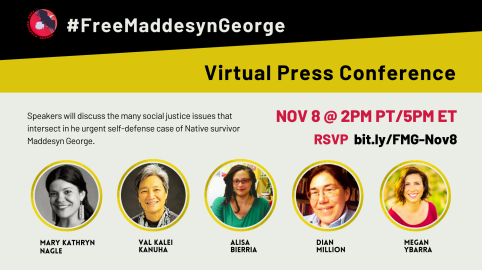
Free Maddesyn George who killed her attacker: Virtual press conference Nov. 8, 2021


Leading Scholars Call for End of Prosecution of Colville Tribal Member Maddesyn George: George’s Prosecution is Part of the Larger Crises of Murdered and Missing Indigenous Women and Abuse-to-Prison Pipeline

 Campaign to Free Maddesyn George
Contact: freemaddesynevents@gmail.com
Censored News

On Monday, November 8 at 2 p.m. PT/5 p.m. ET, leading scholars of violence against Indigenous women and families and the criminalization of domestic and sexual violence survivors will address the urgent self-defense case of Maddesyn George at a virtual press conference.

Among the featured speakers are attorney and award-winning playwright Mary Kathryn Nagle and professors Val Kalei Kanuha (University of Washington), Alisa Bierria (University of California Los Angeles), Dian Million (University of Washington), and Megan Ybarra (University of Washington).

Maddesyn George is a young Native mother from the Colville Reservation in Washington State and a survivor of domestic and sexual violence. She is being prosecuted by the United States Attorney’s Office for the Eastern District of Washington for acting in self-defense against a white man who raped and threatened her. After being incarcerated for more than a year, facing multiple charges, and fearing the unknowns of a jury trial, George accepted a deal from the prosecutors that included pleading guilty to voluntary manslaughter and a charge of drug possession with intent to distribute. Now, prosecutors are recommending a punishment that significantly exceeds the sentencing guidelines for these charges: a prison term of 17 years and lifetime state supervision. George’s sentencing hearing is set for November 17.

The case has inspired a broad-based grassroots campaign of Indigenous and anti-violence organizers to fight for her freedom. Nearly 8,000 individuals and 80 social justice organizations from around the country have endorsed a call for the charges to be dropped before George’s sentencing hearing.

In response, prosecutors have doubled down on discrediting and minimizing George’s account of rape, using her criminal record and the fact that she took drugs and cash from her attacker to deny her victimization claim. At the same time, they have willfully ignored the deceased’s criminal record of violence against multiple women. As George’s attorney told the Intercept, "What the prosecutor is telling is a story of robbery by a drug-addicted

Native woman, playing into stereotypes about substance use and Native people to undermine her claim of self-defense.”

George’s supporters argue that her survival actions prevented her from becoming another MMIW statistic. Indeed, Washington State ranks second highest in the country for missing and murdered Indigenous people, according to the Urban Indian Health Institute. And yet, for acting in self-preservation, Maddesyn is being punished––she has become one of the many survivors from colonized, racialized, and otherwise marginalized communities that have been ensnared by the “abuse-to-prison pipeline.”

It is not too late for the Department of Justice to reverse course, and George’s supporters implore them to do so. George should be reunited with her now 19-month-old daughter and community and provided with resources for recovery and healing.

Registration required for Zoom link to press conference: http://bit.ly/FMG-Nov8. A press kit will be emailed to journalists upon registration.


The Intercept’s Coverage of Maddesyn George’s Case from 10/8/21: https://theintercept.com/2021/10/08/maddesyn-george-self-defense-rape/?utm_campaign=theintercept&utm_medium=social&utm_source=twitter 

Short Documentary on Maddesyn’s Case: https://vimeo.com/600554722 

Campaign website: www.freemaddesyn.com

Change.org petition: www.change.org/freemaddesyngeorge

Organizational endorsement list: https://tinyurl.com/yr88taa3


Organizational Endorsements

Last updated October 26, 2021.


Abused Deaf Women’s Advocacy Services (WA)

Accountable Communities Consortium (WA)

AGE UP (All Girl Everything Ultimate Program) (WA)

All of Us or None – Eastern WA

American Indian Science and Engineering Society at UCLA 

API Chaya (WA)

Asian Counseling and Referral Service (WA)

Big Picture Learning Native American Initiative

Black and Pink Seattle/Tacoma

California Coalition for Women Prisoners

Christian Peacemaker Teams (International)

Coalition Ending Gender-Based Violence (WA)

Collective Justice (WA)

Columbia Criminal Justice Coalition (NY)

Communities of Color Coalition (WA)

Communities United for Restorative Youth Justice (CA)

Connecticut Alliance to End Sexual Violence

Critical Resistance – Portland (OR)

Domestic Violence & Sexual Assault Services (WA)

Dove Project (WA)

Eastside Legal Assistance Program (WA)

Fight Toxic Prisons (National)

Florida Council Against Sexual Violence

ForFortyTwo (WA)

Free Food From Jupiter (WA)

Free Hearts (TN)

Free Them All WA

Friends of Little Saigon (WA)

Gender Justice League (WA)

Hualapai Tribe (AZ)

INTERIM CDA (WA)

Journal of Prisoners on Prisons (Canada)

Kern County Participatory Defense (CA)

Legal Voice (WA)

LifeWire (WA)

Love + Protect (IL)

Mariposa House (WA)

Michigan Solidarity Bail Fund

Minnesota Coalition Against Sexual Assault

Missing and Murdered Native Americans (WA)

Missing & Murdered Indigenous Women Washington

Mother Nation (WA)

Multi-Communities (WA)

Native Women's Collective (CA)

New Beginnings (WA)

New Connections (WA)

New Mexico Coalition of Sexual Assault Programs

New York State Coalition Against Sexual Assault

No New Jails DC Coalition

No New Washington Prisons

Participatory Justice (WA)

Peer Reentry Navigation Community Bail Fund (WA)

Pillars of the Community (CA)

Project Harja (NY)

Radical Women Seattle

Reimagine Safety (WA)

Resilience (formerly Rape Victim Advocates) (IL)

Seattle Community Fridge

The Sentencing Project (Washington, D.C.)

Sovereign Bodies Institute (CA and MT)

South & East King County Mutual Aid (WA)

South Philly Participatory Defense Hub

Study and Struggle (MS)

Support Ho(s)e Collective (IL)

Surge Reproductive Justice (WA)

Survived and Punished (National)

Toronto Abolition Convergence

TRU Unity (WA)

University Beyond Bars (WA)

Vashon-Maury SURJ - Showing Up for Racial Justice (WA)

Washington Coalition of Sexual Assault Providers

Washington State Coalition Against Domestic Violence

Women Who Choose to Live (Ottawa)

Young Women's Freedom Center (CA)

YWCA of Walla Walla (WA)


November 3, 2021

Climate Crisis Film Festival Features Indigenous Films


Telling the Story of Climate Change

Watch films for free anytime Nov. 1 -- 14, 2021. Register at:
The UK's Climate Action Film Festival features more than 60 films from 30 countries!


Virtual Climate Crisis Film Festival Brings BIPOC Documentaries to COP26

Films from the front lines of climate change showcase voices missing from the summit

By Christian Thorsberg | Oct 31 2021

This year’s international COP26 summit is considered by many as the last chance for governments to agree on crucial climate policies that reduce carbon emissions and limit global temperature rise before the planet is set on the path to irreversible climate change. Taking place in Glasgow from October 31 to November 12, the mostly in-person conference is set to host over 200 countries, NGOs, businesses, faith groups, and other governing bodies. But the summit has been widely criticized for being inaccessible to those who are already experiencing the impacts of the climate crisis. For small countries and BIPOC communities and activists, particularly those in the Global South, where the first and most drastic effects of extreme weather are occurring, vaccine inequality and travel costs are barriers to seats at the proverbial table. 

This troubling inequity is very much on the mind of Susanna Basso, artistic director and cofounder of the Climate Crisis Film Festival (CCFF). “The most vulnerable communities have the least to do with carbon emissions,” Basso says. “For them not to be included at COP26 is particularly worrying. The least we can do as a festival is to give over our platform, showcase [these communities], and pass the mic.”  

Accessible online from November 1 through November 14, the festival’s program includes over a dozen films from BIPOC filmmakers on the front lines of climate change around the world, including shorts, mid-length, and feature-length documentaries from Pakistan, Niger, Brazil, Denmark, the United States, Panama, Chile, and New Zealand. The films, and the greater “festival ethos,” Basso says, are linked by the theme of “intersectionality.” The documentaries that were selected, in addition to their artistic power and gripping visuals, Basso says, confront climate change through the lens of social justice, gender inequality, politics, and the economy. 

the climate crisis film festival

The Climate Crisis Film Festival (CCFF) is the UK’s first climate action film festival.

Pioneering, aspirational, grassroots and youth-led, our diverse and eye-opening programming focuses on channeling constructive collective action and providing an intersectional analysis of climate, politics, economics and social justice

The CCFF was started in the summer of 2019 by three 26 year old friends wanting to contribute to what at the time felt like London’s climate awakening.

We felt like existing environmental film festivals across the world were too broad in their scope to tackle climate change head-on and that there was space for a film festival that was laser-focused on the climate crisis and which dissected it through a social, political and economic lens — that is, from an intersectional angle.

We felt a great excitement for what we saw as a ‘new wave of environmentalism’ — at the time we didn’t have the perfect words to describe it, but 3 years on, intersectional environmentalism is on the rise and we’re proud to have been a champion of the concept from the get-go.

October 31, 2021

Zapatistas Bring Autonomous Struggle to Scotland


Autonomy, Self Reliance and Dignity

Article by Brenda Norrell

Censored News

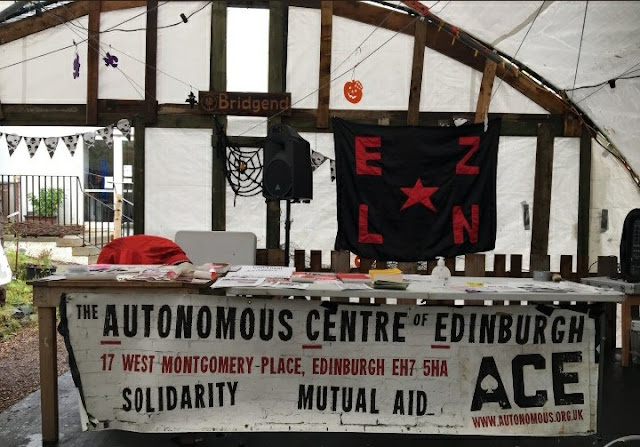
Zapatistas from Chiapas, on the Journey for Life, were welcomed to Scotland. The delegation met with 15 organizations and discussed autonomous governments and the role of women.

The delegation of more than 170 Zapatistas that arrived in Vienna, Austria, are traveling through Europe in small groups and have already joined struggles in the Far North with Sami in Finland and Russia, and supported struggles in France, Germany, Italy, Switzerland, Greece, Ireland, the Netherlands, Basque homelands, and the struggles of migrants and Kurdish women.

The first delegation of Zapatistas arrived from Chiapas by ship, crossing the Atlantic, arriving first in Portugal and then Spain.

Zapatistas are sharing their message of resistance to capitalism and their history of autonomous government, as they battle exploiters, government oppression, and corporate theft of their homelands for mining and development in Chiapas.