Indigenous Peoples and Human Rights
Showing posts with label Navajo Nation Council. Show all posts

April 19, 2022

National Sacrifice Zone: Dine' Protest as Navajo Council Continues Era of Neglect and Abuse of Dine'

.
The banner 'National Sacrifice Zone' outside the Navajo Nation Council on Monday, as Council began its spring session.


Navajo council delegates are among the co-opted players in this roulette of cash, greed and genocide.

By Brenda Norrell
Censored News
April 19, 2022

NAVAJO NATION CAPITOL -- National Sacrifice Zone, the banner reads, outside the Navajo Nation Council, as the Council begins its spring session. The sacrifice zone is the Navajo Nation. The Four Corners region and Black Mesa, and all of the Navajo Nation, have been the United States' sacrifice zone.

Dine' -- and their land, water, and air -- were poisoned by the U.S. government and its corporations, for uranium mining during the Cold War, and coal-fired power plants to produce electricity for distant cities in the Southwest.

Uranium mining, coal mining, coal-fired power plants, fracking, and oil and gas wells, have left behind strewn radioactive debris from uranium mining, scarred land cut and gouged by mining, poisoned water from dumping and runoff, dried up springs from Peabody Coal's mining, and a long genocidal trail of cancer and respiratory disease.

The U.S. Sacrifice Zone continues in the Four Corners region.

Navajo council delegates are among the co-opted players in this roulette of cash, greed and genocide.

Dine' from Black Mesa outside the Navajo Nation Council on Monday, in solidarity with Dine' opposing new helium mining, planned by the Council, on sacred Beautiful Mountain at Sanostee. -- Censored News.

"We came all the way from Black Mesa. We just want our council delegates to do their jobs."

That is the voice of Dine' outside the Navajo Nation Council chambers on Monday. On Black Mesa, Dine' said they have no running water, are using outhouses, and their roads are in bad condition.

During the protest outside the Navajo Council on Monday, Dine' urged real solutions to climate change, and a halt to the dependence on fossil fuels, mining and extraction.

Dine' outside the council chambers on Monday included Dine' hemp farmers who said their voices are not being heard. Dine' hemp farmers said their story, of what they went through after a Navajo police raid, is not being heard.

Dine' farmers brought this message: "Navajo hemp growers are not criminals or drug dealers. Most were elderly," said one Dine', referring to the Navajo police raid on Dine' hemp farmers.

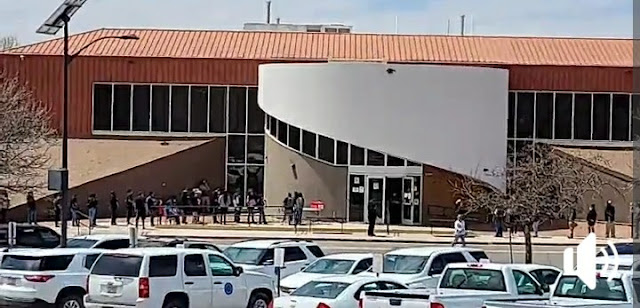
Navajo elderly were refused entry to the springs session of the Navajo Nation Council today. Dine' protesters opposed new helium mining on the sacred Beautiful Mountain. While Navajos are in need of water and help to haul water, the Navajo Council plans to give a half-million-dollar gift to a private Christian school. Dine' lined up outside the tribal finance building in desperate need of funds. The Navajo government received $2.1 billion in federal virus relief funds from ARPA, but the Navajo government has failed to distribute those. Now, 1,741 Navajos have died of COVID-19.
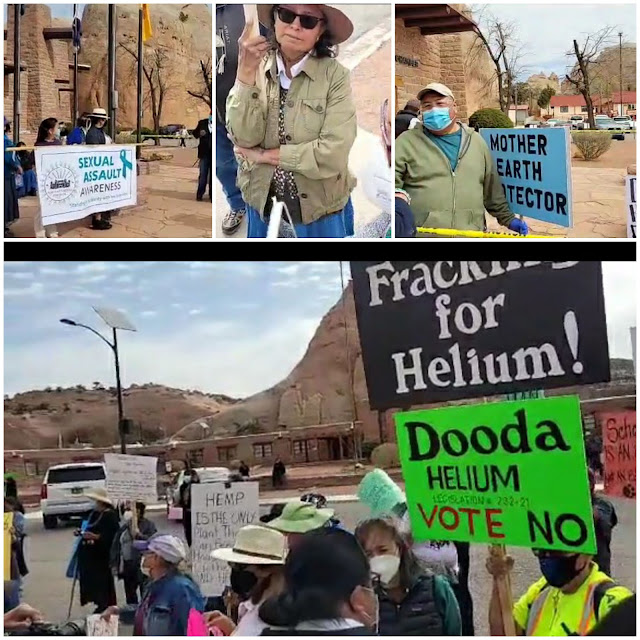
Outside the Navajo Nation Council Chambers in Window Rock, Dine' are opposing new helium mining on sacred Beautiful Mountain at Sanostee.

Dine' are speaking out for real solutions to climate change and voicing urgency for support for sexual assault victims and new efforts in search for missing and murdered Dine'.

“We stand for protecting our precious Mother Earth; we do not want Mother Earth to be destroyed with more pollution from emissions and the potential of destroying the water supply," Dine' organizers of today's march and protest said in a written statement.


An elderly Dine', shown above, was turned away at the door of the Navajo Nation Council spring session today.

During her live coverage, Dine'/Zuni  reporter Marley Shebala, was also turned away at the Council door, and told she "was not on the list." Shebala has been a reporter in the Navajo capitol for 40 years.

The Council's spring session began today. The agenda includes a half-million-dollar gift to a private Christian school.


(Photo above) Reporting live outside the Navajo Finance building, reporter Marley Shebala shows Dine' lined up in need of assistance.

The Navajo government received the American Rescue Plan Act, federal virus relief funds, nearly a year ago, but has not distributed the $2.1 billion in funds.

Now, 1,741 Dine' have died from the COVID-19. Many Dine' are in need of help hauling water and are not receiving help getting water from the Navajo government.

Navajo Council plans half million for private Christian school

The Navajo Nation Council plans to give a half-million dollars to a private Christian school. It will be discussed this week during the Council's spring session.

Dine'/Zuni Pueblo reporter Marley Shebala questions what Native children are being taught at the school. Shebala writes, "When I attended Rehoboth, I was told that my Dine’ and Zuni ceremonies/prayers were devil worship."

During the pandemic, in August of 2020, the Navajo Council gave $24 million of its federal virus relief funds, from the CARES Act, to its casinos. The Council secretly planned to buy the bankrupt Remington Arms for $300 million during the pandemic, for the second time, in June of 2020, but it was purchased by others for far less.

Now, in April of 2022, reporter Marley Shebala reports on the Navajo Council's plan to fund Rehoboth, east of Gallup, New Mexico. Shebala questions what is the position of Rehoboth on teaching the Dine' traditions and ceremonies.

The spread of the coronavirus has come in waves on the Navajo Nation over the past two years. The coronavirus spread began at gatherings of the Nazarene Christian Church on the Navajo Nation.

Shebala writes: "I attended Rehoboth & I saw how my friends were taught to be ashamed of their parents if they were not Christians or if they were traditional Dine’. Rehoboth was a Christian Boarding School. Why hasn’t the Navajo Council called for an Investigation of Rehoboth, instead of handing over more of our Funds. AND Rehoboth Christian School charges Tuition Fees & Other Fees."

"WHAT IS REHOBOTH'S POSITION ON DINE’ TEACHINGS, CEREMONIES, PRAYERS, ART, MATH, HERBS, SAME-SEX MARRIAGE, DINE’ TRADITIONAL CLOTHING. When I attended Rehoboth, I was told that my Dine’ and Zuni ceremonies/prayers were devil worship," Shebala writes.

Read Shebala's column at:

Below, Navajo Council resolution:


TODAY: Watch Marley Shebala's live coverage, and recorded videos:


Screenshots by Censored News from Marley Shebala's video coverage that is underway.

Listen to Dine' voices on the video coverage of reporter Marley Shebala. Navajo elderly and Shebala, Dine'/Zuni Pueblo, a reporter here for 40 years, were denied entry into the Council on Monday by the Navajo Nation Council.

Watch Shebala's video here: 

About the author
Brenda Norrell has been a news reporter in Indian country for 40 years. She began at the Navajo Times during the 18 years that she lived on the Navajo Nation. She was a correspondent for Associated Press and USA Today, covering the Navajo Nation and federal courts. After serving as a longtime staff reporter for Indian Country Today, she was censored and fired in 2006. Norrell created Censored News to reveal what was being censored in Indian country. She traveled with the Zapatistas and to Bolivia for live coverage. Today Censored News is a collective, with 21 million views. Now in its 15th year, it has no ads, grants, salaries or revenues.
Norrell has a master's degree in international health, focused on water, nutrition and infectious diseases. Since 2006, she has been blacklisted by the media as a news reporter.


Copyright Brenda Norrell, Censored News

Read more at Navajo Times

Navajo Times journalist Rima Krisst reports -- "With $1.07 billion in American Rescue Plan Act funds idle because the Navajo Nation Council and president’s office are divided over how to spend it, members of the Dzil Yijiin Regional Council marched on the first day of spring session Monday to express concern. Marcus Tulley, president of the regional council, said the protest was to demand Navajo Nation leaders to 'do their job' and approve ARPA spending."

“The people that are suffering are the chapter people,” said Tulley. “They need to stop playing games with these funds and sit down together and iron things out.” The Dzil Yijiin region includes Hardrock, Black Mesa, Forest Lake, Pinon, Whippoorwill, Blue Gap and Low Mountain chapters.

Read the article at Navajo Times.

July 16, 2020

Coronavirus testing team reports to Navajo Council Committee on tests and gating measures


Coronavirus testing team reports to Navajo Council Committee on tests and gating measures

Health, Education, and Human Services Committee hears Navajo Nation Testing Team report on COVID-19 testing strategies and gating measures

The 24TH NAVAJO NATION COUNCIL
Office of the Speaker
July 16, 2020
Photos by Navajo Council
Censored News

WINDOW ROCK, Ariz. — The Health, Education, and Services Committee (HEHSC) of the 24th Navajo Nation Council heard updates regarding coronavirus (COVID-19) testing strategy and gating measures from the Navajo Epidemiology Center (NEC) and COVID-19 Testing Coordination Team last week Wednesday, Jul. 8.

Team members Dr. Jill Jim, director of the Navajo Department of Health (NDOH), Ramona Antone-Nez, director of the NEC, Dr. Laura Hammit, director of Infectious Disease Programs at the Johns Hopkins Center for American Indian Health and Del Yazzie, epidemiologist, were present for the report.

Dr. Hammit described the Navajo Nation’s COVID-19 testing strategy, which she said is based on recommendations from neighboring states and from the Center for Disease Control and Prevention (CDC).

“We’re learning new information all the time, and we need to be able to adapt to that new information, and our recommendations may change,” Dr. Hammit said.

November 1, 2017

Navajo Council Kills Escalade Monster, Tourism on Colorado Rivers Confluence


Photo copyright Earl Tulley, Censored News
.
Photo copyright Earl Tulley
Censored News
Navajo Council kills Escalade, Tourism Monster on Dineh Sacred Land, at Colorado Rivers Confluence, in Grand Canyon

By Save the Confluence
Censored News
Oct. 31, 2017

WINDOW ROCK, Ariz. -- The Navajo Nation Council, tonight, put an end to a years-long battle to kill a controversial proposal to build a tourist development at the confluence of the Little Colorado and Colorado rivers.

At a special session, the council skewered the Confluence Partners, who wanted to bring more than 10,000 tourists per day to an area containing sacred sites, grazing land, and traditional homelands to hundreds of Navajo families in order to build a tram leading down into the Grand Canyon National Park.
Ultimately, the council voted 16-2 and killed the measure.
Don Yellowman, president of the Bodaway/Gap Chapter, said this is a step toward unity. For years, the proposed Escalade had divided the community, as it had attempted to reclaim land they had been exiled from for more than half a century under the federal Bennet Freeze Act.
Numerous neighbor tribes joined the battle to oppose the Escalade, including the Hopi Tribe, which has shared sacred sites and ancestral claims to the region that the outside developers had sought to once again strip away from the people,
More than 65,000 people worldwide had opposed the effort. The National Parks Service opposed it. All neighboring tribes opposed it. Navajo medicine men opposed it. Families that have lived on the land since at least the late 1700s, and have even buried their relatives on the proposed site, opposed it.
In spite of that — in a last-ditch effort — Scottsdale, Ariz.-based Confluence Partners, LLC,  on a Halloween “trick-or-trick night” — tried to sweeten the deal by offering to build a Boys and Girls Club for the local residents. Their final offer underscored how out of touch they were with the community and the Navajo Nation, of which many chapters also joined hands to fight the effort.
The prospective developers had been supported by Navajo Councilman Ben Bennett, the bill’s sponsor. Bennett said he wanted to give a five-member committee a chance to negotiate problems lawmakers found and raised about the bill. His colleagues made fiery statements in opposition, ranging from delegate Dwight Witherspoon’s comment that, “This (proposal) is exploitation!!”, to delegate Jonathan Perry who said, “We’re setting ourselves up for something bad.”
Norman. M. Begaye, the council delegate representing Alamo area, said, “It’s the People. .. We realize it’s the people. If we approve this, we would open the flood gates on what is sacred.”
The on-and-off again bill struggled to reach the full council starting in August, 2016. None of the council’s four standing committees, charged with scrutinizing the bill, endorsed the legislation.
But, three committees shot down the proposal, and Bennett tried numerous times to re-introduce the measure. He often withdrew it on a moment’s notice if the political winds indicated supporters would not be present to vote. Then, in a last-ditch effort, Bennett called a special session on Halloween Day, when it appeared a majority of opponents of his bill would be out of town at a conference. Opposition remained overwhelming, regardless.
Former Navajo Nation President Albert Hale, who left office years ago in the middle of his term amid financial and sexual scandals, and yet later became an elected member of the Arizona State Legislature, was among the Confluence Partners advancing the effort to undermine the Navajo People.

The Confluence Partners wanted the Navajo Nation  to invest $65 million for off-site infrastructure, withdraw 420 acres for development, agree to ban tourist-related businesses within 25 miles, and waive portions of the tribe’s sovereignty.

The partners proposed to install a gondola that takes tourists from the rim to floor of the canyon where a river walk, an amphitheater and café would be available. The rim would consist of A discovery center, a restaurant, cafeteria and parking lot.
Under the agreement, the Nation would have received a mere 8 cents of the gross revenue per year while the outside non-Navajo partners – plus Hale — took 92 percent.
The revenue would have been dependent on the number of tourists who visited Escalade.
https://savetheconfluence.com/news/breaking-escalade-monster-killed/
Stay tuned for more updates.

Photo by Save the Confluence

Navajo Western Fair, Oct. 14, 2017 Photo copyright Earl Tulley, Dineh, Censored News

.

January 28, 2016

Navajo Nation's non-Indian attorney gives away Utah Navajo water rights

Photo Goosenecks San Juan River, Utah
Navajos urge veto of Utah Navajo water rights settlement ramrodded through the Navajo Nation Council

By Brenda Norrell
Censored News copyright
Dutch translation by Alice Holemans, NAIS
http://www.denaisgazet.be/nieuws/niet-indiaanse-advocaat-van-de-navajo-nation-geeft-utah-navajo-waterrechten-weg

WINDOW ROCK -- The Navajo Nation's non-Indian water rights attorney is once again giving away Navajo water rights. Navajos are urging the Navajo President to veto a water rights settlement for Utah Navajo water rights, ramrodded through the Navajo Nation Council on Tuesday. 

Ed Becenti, Navajo, is urging Navajo President Russell Begaye to veto the Utah Navajo water rights giveaway.

"Another bad water deal for the Navajo Nation is being pushed through by 'our' own water lawyer and 13 Navajo Nation council delegates. They rushed this legislation through in less than a month's time without informing all the community members that it really impacts," Becenti said.

"The deal was rushed through in less than a month with no community education. If this is a good deal for the Navajo Nation, why are they rushing it through?"

The Navajo Nation has employed the same non-Indian water rights attorney, Stanley Pollack, since the 1980s. Pollack has spearheaded the loss of Navajo water rights in the three states of New Mexico, Arizona and Utah, where the Navajo Nation is located. The negotiations have involved extensive secret negotiations and closed sessions of the Navajo Nation Council.

Pollack has intervened to prevent the Winter's Doctrine from being used to ensure future Navajo water rights. The Winter's Doctrine would ensure sufficient water to meet the needs of future generations of Navajos.

Becenti said the Utah settlement was approved by less than 3 percent of community members.

"There were no public hearings!" Becenti said not all of the chapters impacted have even been informed about the settlement or given the opportunity to vote.

The Associated Press reports that the Navajo Nation approved the legislation Tuesday. AP refers to it as a "settlement" of the Navajo Nation's claims to water in the upper Colorado River basin in Utah. 

"The bill passed 13-7 Tuesday without any debate and with few people in attendance at the Navajo Nation Council chambers in Window Rock. Lawmakers debated the settlement in executive session Monday and held a work session last week. The settlement would give the tribe 81,500 acre-feet annually of Utah's unused share of water. The Navajo Nation could draw the water from aquifers, and the San Juan River and its tributaries. It also could divert water from Lake Powell, although it has no plans to do so," AP reports.  http://www.cnbc.com/2016/01/27/the-associated-press-navajo-lawmakers-approve-water-rights-settlement-with-utah.html

The pattern of non-Indian water rights attorneys ramrodding Indian water rights settlements has been occurring throughout the west.

Becenti said this deal is a terrible one for the Navajo Nation. The Navajo Nation, population 300,000, is only claiming 81,500af per year while the Uintah-Ouray Utes, population 1,200, won over 470,000af. 

"The Navajo Nation should claim at least that much," Becenti said. He said the leasing of 57,000af of water per year is valued at over $100 million while the settlement only gives the nation $5 million for water projects.

Update from Censored News:
It seems no one can answer this question: 'Why is a non-Indian water rights attorney still employed by the Navajo Nation after 30 years?'
This is happening all over the west.
Here is one question to ask all those non-Indian attorneys now pushing the so-called 'water rights settlements.'
The question is: 'Does this new settlement prevent the use of Winter's Doctrine in court in the future?'
The Winter's Doctrine ensures Native Americans will have all the water they need for future generations.
The non-Indian attorneys are working to negate the Winter's Doctrine. They are working in the interests of the states, US government and corporations.
Many of these non-Indian attorneys pushing these water rights settlements in Arizona and DC knew each other in Window Rock, Arizona. They worked together when employed by the Navajo Nation and took part in the removal of former Chairman Peter MacDonald. This happened after MacDonald told the United States government that he would use the Winter's Doctrine to ensure water rights.

Read more on Navajos urging veto:

http://bsnorrell.blogspot.com/2016/01/to-bei-nihi-dziil-opposes-councils.html?m=1

Becenti urged Navajos to contact the Navajo Nation and tell them to VETO legislation 0412-15.
Other executive staff to message: rjoe@navajo-nsn.govrjoe.opvp@gmail.com
Staff Assistant's # 928-871-7915


Copyright Censored News
Please share our link

September 18, 2010

Secret negotiations released on Navajo water rights settlement

Secret negotiations released on Navajo water rights settlement

Navajos are urged to attend the Navajo Nation Council special session on Sept. 29, and persuade the council delegates to vote 'No' to this giveaway of Navajo water rights, which has been negotiated in secret.

Censored News http://www.bsnorrell.blogspot.com
Photo by Calvin Johnson

Briefing on the Navajo Nation’s Proposed Little Colorado River Water Rights Settlement Agreement

Summary

The proposed Little Colorado River Water Rights Settlement Agreement gives away, waives, does not protect, and does not claim the Navajo People’s and Navajo Nation’s priority rights to all waters that fall on, run by or through, or are under the land surface between the Four Sacred Mountains. The proposed Settlement waives, gives away and does not claim --

· Navajo priority water rights -- “first in time, first in right”;
· Navajo water rights established by the Winter’s Supreme Court Doctrine to enough water to serve all purposes for which the Navajo homeland was established; and
· Navajo water rights provided for in Arizona v California to enough water to irrigate all practicably irrigable acreage

The proposed Little Colorado River Water Rights Settlement Agreement :
· Prohibits any more than 10,000 acres of irrigated agriculture along the Little Colorado River; including building any surface water reservoirs for irrigation;
· Claim only 40,000 acre-feet (25%) of average annual Little Colorado River surface flow;
· Gives Navajo only 32,000 acre-feet per year of 4th Priority Colorado River water –

-- this water will NOT BE AVAILABLE in times of drought ;
-- this water will require over $500 million of new federal funding to deliver the water to our communities – and may not be used for any new farming;
-- this water will be extremely vulnerable to disruption by natural or human causes;

· Gives Navajo no more than 60,000 acre-feet/year total from the C-aquifer in a 36-mile strip of “Protected Areas” along the Navajo Nation south boundary;

· Allows non-Indian users unlimited amounts of C-aquifer water 18 miles south of the Navajo Nation boundary –even though excessive pumping will reduce flows in the River and may bring more salty water to Navajo wells .

· Allow non-Indian water users to pump as much “underground flow” as they want without regard for impact on Navajo use of same aquifers.

· The proposed Settlement waives all Navajo priority and reserved water rights to the Little Colorado and Colorado Rivers for other uses forever.

Some More Detail on the Navajo Nation’s Proposed Little Colorado River Water Rights Settlement Agreement

Surface Waters of the Little Colorado River (LCR)

The proposed Agreement prohibits any future irrigated agriculture beyond some 10,000 acres of farm projects identified along the main-stem of the Little Colorado River between Birdsprings and Cameron.

The Agreement also prohibits the Navajo People from building any new reservoirs for irrigation anywhere; and prohibits any new agriculture on Navajo off-reservation lands.

-- This makes it practically impossible to use the surface flows of the Little Colorado River, which only come an average of four months a year. This also closes the door in the Leupp area to the beneficial use of LCR water on thousands of acres of Class 1 irrigable soils west of North Leupp Farms – completely eliminating Navajo Winters Doctrine rights to enough water to irrigate the major resource area of “practicably irrigable lands” in the LCR Basin.

The proposed Agreement only claims some 40,000 acre-feet per year of Little Colorado River surface flow within the Nation – even though the Navajo Nation has a clear priority right to all that flow.

-- 40,000 acre-feet are only 25% of the average annual flow of 160,000 acre-feet measured at Cameron -- why not claim 50% or 75% or more of this average ? In wet years, there is a great deal more water in the River – for example, in 1973 the highest recorded LCR annual flow at Cameron was over 800,000 acre-feet -- which could be used if there was a storage reservoir along the River.

The proposed Agreement prevents Navajo either from claiming any priority rights, or from claiming any in-stream flows to provide for and protect wildlife, trees, quality of life, cultural or environmental purposes.

The proposed Agreement encourages the Navajo Nation to give up its priority water rights to other interests with less priority.

-- Whatever happened to “first in time first in right…” ? Why should the Navajo Nation give up its priority water right?
Some More Detail on Proposed Little Colorado River Water Rights Settlement

The proposed Agreement provides the Navajo Nation with some 31,000 acre-feet per year of 4th Priority * Colorado River main-stem water -- which has to be pumped from Lake Powell at enormous energy and operating and maintenance costs; and which will NOT BE AVAILABLE in times of shortage on the Colorado River.

-- We are in a drought cycle which may well be long-term – like the drought which affected the Anasazi for a century or more. Why is the Navajo Nation making many of our communities totally dependent on water which will not be there in severe drought years?

The proposed Agreement does not clearly quantify how much LCR surface water Navajo has a right to.
-- If the Navajo Nation has a right to unappropriated surface waters, how much LCR surface flow is actually unappropriated – and who has appropriated the rest, and when?

The proposed Agreement prohibits the Navajo Nation from challenging non-Indian use of sub-flow waters -- including waters in the alluvial aquifer -- even though such use takes surface waters to which the Navajo Nation is given a right.

-- For example, folks in Winslow or Holbrook could set up a well field beside the LCR to capture large amounts of the waters of the LCR alluvium without regard for impacts on Navajo water rights

Peabody Coal is allowed to retain its surface water impoundment structures on Black Mesa permanently – why?
_________________________________________________________________________

* For more information on Priorities to Colorado River Surface Water, see --

http://www.azwater.gov/AzDWR/StateWidePlanning/CRM/documents/CopyofAzCRPrioritiesListing-Alpha05-2009_web.pdf

Priority 1 - Present Perfected Rights (PPRs) as provided for in the Arizona v. California Decree.
Priority 2 - Federal Reservations and Perfected Rights established prior to September 30, 1968
Priority 3 - Contracts between the United States and water users in Arizona executed on or before September 30, 1968
Priority 4 - Entitlements pursuant to contracts and other arrangements between the United States and water users in the State of Arizona entered into subsequent to September 30, 1968, not to exceed 164,652 acre-feet annually;
Priority 5 - Unused Arizona Entitlement
Priority 6 - Surplus Water

Some More Detail on Proposed Little Colorado River Water Rights Settlement

Ground Water in LCR Basin C-Aquifer

According to the Bureau of Reclamation, there are about 140,000 acre feet average annual re-charge to the entire C aquifer . This is the maximum sustainable yield for all users – if more water than that is taken out in a given year, the aquifer is being mined and will (eventually) be exhausted. See http://www.usbr.gov/lc/phoenix/reports/ncawss/NCAWSSP1NOAPP.pdf

The proposed Agreement allows non-Indian users to pump unlimited amounts of C-aquifer water from wells beyond 18 miles south of the Navajo Nation boundary;

-- Even though excessive pumping will reduce flows in the River and may bring salty water to wells on the Navajo Nation (eg, Leupp). Note for example --

“Local heavy withdrawals from the C-aquifer may also cause upward shifting of the salt water interface from the evaporites in the Supai Formation near Joseph City” …
“ Long-term pumping could lead to long-term increases in salinity of pumped water” …

-- Mann, L.J., and Nemecek, E.A., 1983, Geohydrology and water use in southern Apache County, Arizona: Arizona Department of Water Resources, Bulletin 1, 86 p.

The proposed Agreement allows non-Indian users to pump no more than 50,000 acre-feet per year from an 18-mile strip south of the south boundary of the Navajo Nation; and allows no new large capacity wells within 2 miles of the Navajo Nation boundary;

The proposed Agreement allows the Navajo Nation to use no more than 60,000 acre-feet/year total from the C-aquifer in an 18-mile strip of the Navajo Nation, north of the Navajo Nation’s south boundary.

The proposed Agreement prohibits the diversion of any surface waters out of the LCR Basin …

-- But no mention is made of pumping ground water out of the LCR Basin –
as has already been done by Phelps Dodge – who initiated the LCR Adjudication in 1978. This opens the door to down-state folks who are running out of their local water (Verde Valley, Payson, Phoenix, etc) setting up well-fields along the Mogollon Rim to pump as much as they want of the C-aquifer … without regard to possible long-term impacts to the quantity and quality of Navajo Nation C Aquifer water.

There are many other serious concerns with the proposed Little Colorado River Water Rights Settlement Agreement. The Navajo People must be allowed to study, understand, and decide openly for themselves every aspect of this proposed Agreement which will determine the quality and even the possibility of life for the Dine for all time to come.
.
Download or print this document:
http://www.scribd.com/doc/37688923/Navajo-water-rights-give-away-exposed